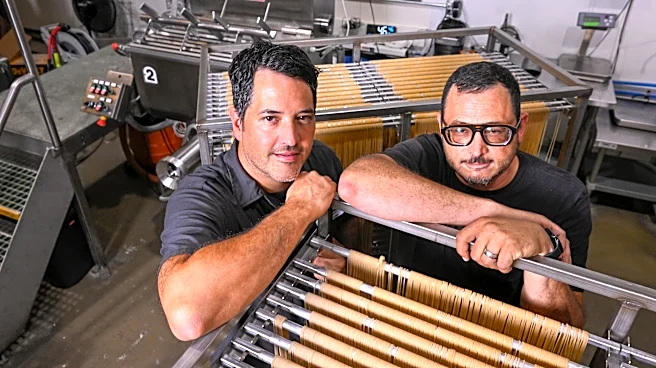





The bronze dies used to shape Nicoletto's Pasta Co.'s noodles are startlingly heavy, weighing up to 15 pounds each. The disks are bored with openings that determine whether dough emerges as spaghetti, rigatoni or another shape. Each costs about $1,000.
Brothers Danny and Ryan Nicoletto started their pasta company with an inheritance that would barely have bought five of the metal molds.
The money came from their father, Tony "Pops" Nicoletto, who died unexpectedly in April 2013. It wasn't enough to open the restaurant they envisioned, but it was enough to start taking baby steps.
"I mean, we grew up playing in bands together," Danny said. "Let's start something."
The brothers have since grown roughly $5,000 in seed money and a few micro-loans into
a 6,000-square-foot Nashville production facility on Elm Hill Pike. There, the production team makes up to 3,000 pounds of fresh pasta and about 1,200 pounds of dried pasta each week. When Danny and Ryan started, they were lucky to make 100 pounds weekly.
Nicoletto's expands beyond East Nashville
The company has restaurants in East Nashville and Donelson, with dried pasta sold in more than 500 independent stores nationwide. This fall brings two of its biggest expansions yet: a restaurant in Mt. Juliet and a major rollout into Middle Tennessee Kroger stores.
Before the pasta company, Danny and Ryan played together in a rock band called The Audible Campaign, a name that makes both of them visibly cringe.
During one tour, their van crashed spectacularly, rolling about eight times across the highway. Ryan, the band's drummer, was knocked unconscious. The bass player was ejected. Everyone survived.
"I woke up on a stretcher on the side of the road," Ryan said. "I remember somebody asking me if I remembered what happened, and I said we got hit by a truck. And I asked if Danny was OK."
Once he knew everyone was accounted for, Ryan lost consciousness again and woke up in the hospital.
Then they got back in a van.

The Audible Campaign kept touring for several years before the band eventually ran its course. By then, the brothers were ready for some professional distance from making music.
"I think when we were younger, you have a sense of fearlessness, and how fast that can be kind of taken from you," Ryan said.
'Too broke to open a restaurant'
Ryan stayed closer to home, working in restaurants, including a small Italian restaurant with a chef from Rome, before moving into design and technology. Danny went back on the road as a guitar tech, a job he would hold for nearly 12 years while traveling around the world.
Then their father died, and the money he left Danny and Ryan gave them a reason to think about working together again.
The answer eventually became pasta, but not because they were trying to recreate the food of their childhood.
Though Tony Nicoletto was the son of an Italian immigrant who came to the United States in 1913, Danny and Ryan didn't grow up with the culinary traditions often associated with Italian-American families. Their father left when they were young, and their mother, who was born in England, raised them while working full time.
"A lot of the meals that we had were out of convenience," Ryan said. "It was more of a sustenance thing."
Their maternal grandparents helped keep food on the table. Their grandmother's cooking was British, hearty and predictable.
"There wasn't a lot of seasoning. There wasn't a lot of flavor," Ryan said. "It taught you what you didn't like. You know, where you're like, 'I could make that better.'"
Instead, the idea for Nicoletto's grew partly from the inexpensive, filling food they'd relied on while touring. After briefly considering a potato chip company, they envisioned a restaurant serving fresh pasta quickly and affordably.
There were immediately several hurdles.
"We were too broke to open a restaurant," Ryan said.
They also didn't know how to make pasta. So they bought a used pasta machine in Cleveland and decided to learn.

Then they discovered they couldn't plug it in.
The machine required three-phase power, an electrical system typically used for industrial equipment. They found a 900-square-foot industrial space in East Nashville. Suddenly, an idea for a restaurant had become a tiny pasta factory.
Even without much experience with food manufacturing, the brothers knew they needed permits. They built out the warehouse and prepared for a six-hour inspection from the Tennessee Department of Agriculture.
Everything was ready except a piece of unsealed wood high above the garage door Ryan knew the inspector would ding them for. He did everything he could to will the inspector's eyes away from it.
"I'm just thinking the whole time, don't look up, don't look up," Ryan said.
The inspector looked up, but they passed anyway, with instructions to make the wood disappear.
"And we had no idea what we were going to do from there," Ryan said.
They kept their day jobs while selling pasta at as many as five farmers' markets a week and supplying early restaurant customers, including Lockeland Table. They also started acquiring used pasta-making equipment, much of it Italian and decades old.
They bought one used extruder that eventually needed a part. They found a decades-old service sticker stuck on its side and decided to call the phone number.
Carlo Varesco answered his home phone. Even more remarkably, he remembered the machine.
Varesco had spent 30 years working for Rice-A-Roni before retiring and turning his attention to small pasta manufacturers. Over the past four decades, he estimated he has helped a couple dozen of them get started.
"They really needed assistance in the beginning, and I was there when needed," Varesco said.
Soon, Varesco came to Nashville and visited the little factory, answering questions about machines, manufacturing and the mechanics of pasta production. Danny later tagged along in Chicago as Varesco repaired a pasta cooker in a busy Italian restaurant and visited a ramen noodle factory filled with aging machinery.
The relationship continued long after Nicoletto’s stopped being a tiny startup. Danny still calls Varesco with machinery questions, and Varesco said they talk at least monthly.
He's never charged them.
"My time is your time," Varesco said. "You get to a certain age, a certain point that you love to help people."
Pasta, he added, is "in my blood."
Years later, Danny still considers him a mentor.
"Seriously, just from a number on the side of the pasta machine, we were able to really just transform the business," he said.
The brothers' shared obsession with old Vespas also proved unexpectedly useful, with the bearing presses and other tools they used on the vintage Italian scooters working equally well on vintage Italian pasta equipment.
From seed money to launching a Nashville institution

Meanwhile, the original restaurant idea hadn't gone away.
They tested it at the Grow Local Kitchen at the Nashville Farmers Market before finding the now well-known space on Gallatin Avenue next to Mickey's Tavern. The former restaurant already had a stove, fryer and hood system, a significant advantage for two people without much money.
It also had sinks and other plumbing fixtures draining into buckets in the basement.
They spent about three months rehabbing the space, opening in 2016 with about five employees. A week later, they needed 13.
Over the next decade, the business outgrew its original factory, opened and later closed a Hillsboro Village restaurant, weathered the pandemic and added a tiny takeout location in Donelson. Pasta production expanded to its 6,000-square-foot facility in 2019.
The scale has changed. The tinkering hasn't.
For nearly three years, Danny has been trying to get spaghetti right. It's fragile, vexing to dry and unforgiving of changes in temperature and humidity.
It is, in short, a diva. The elbows are no picnic either.
Before Nicoletto's had programmable drying equipment, Danny and Ryan would wake at 4 a.m. or 5 a.m. to crack open dryer doors and release humidity.
They bought humidifiers at Walgreens and sometimes arrived at the factory to find 200 pounds of elbow macaroni cracked.
Their early machines didn't have automatic cutters, either, leaving them to cut pasta by hand.
"There'd be times my arm would stop working from hand cutting," Ryan said.
The spaghetti finally went on sale Sept. 1.
That slow process also reflects how Danny and Ryan describe the growth of Nicoletto's. They've passed on opportunities that would have required scaling faster than they wanted.
"I always used to think it was like we were just kind of pushing things off and maybe being a little procrastinators," Ryan said. "But I think it's one of our superpowers."
This fall, they're taking two of their biggest steps yet.
Kroger will begin carrying Nicoletto's bronze-cut campanelle, radiatori and creste di gallo, along with its marinara sauce, in more than 50 Middle Tennessee stores. The deal, they said, followed years of relationship building and waiting until production was ready.
The 3,000-square-foot Nicoletto's planned for Lebanon Road in Mt. Juliet will be their largest restaurant, with an Italian specialty market, expanded fresh pasta selection, grab-and-go meals, espresso and coffee, beer and wine.
It will also have something their existing spaces have had in short supply.
"People can sit down," Danny said.
Reach senior dining reporter Mackensy Lunsford at mlunsford@tennessean.com.
This article originally appeared on Nashville Tennessean: Brothers built Nashville pasta company Nicoletto's from $5,000 and grit