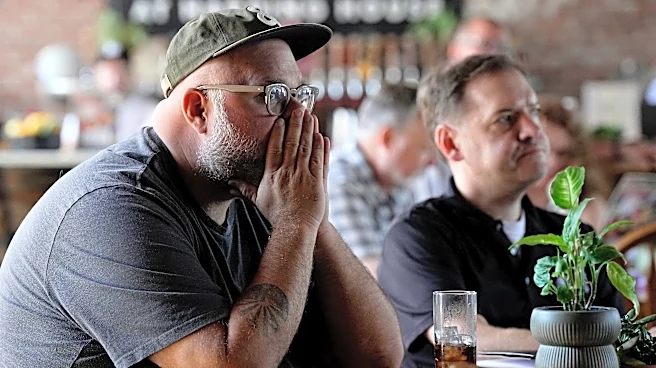









On a September afternoon at The Jubilee Bar at Harding House, a group of Nashville hospitality workers gathered to learn how to have a conversation nobody wants to have.
Bartenders are accustomed to listening. From bad days and breakups to marriages and money problems, customers often confide things to the person mixing their drinks that they might not even share with close friends.
"We're expected to be the cheapest therapist around, and we're not really trained to do that," said Chris Mallon, president of the Nashville chapter of the United States Bartenders' Guild
With gatherings like this, the USGS is trying to build support for hospitality workers who spend their days caring for customers, often absorbing emotional private confessions.
Metro
Public Health Department officials talked to hospitality workers about how to recognize when someone, whether a coworker or bar regular, might be considering suicide. They also learned what to do if the answer is yes, during the event on the stage at Jubilee, located in the L & L Market.
Tennessee continues to record more than 1,200 suicide deaths each year. In 2023, 1,279 Tennesseans died by suicide, a rate of 17.3 deaths per 100,000 people, according to Tennessee Department of Health data presented at the event. Nationally, 49,316 people died by suicide that year, according to data from the Centers for Disease Control and Prevention.
The suicide-prevention training was part of Shift Change, an event marking the first anniversary of Circle Back, a mental health initiative created by USBG Nashville for hospitality workers.
The program helped the chapter earn national recognition as USBG's Chapter of the Year as the organization expanded its focus beyond cocktails and spirits to finding new ways to support the people who serve them.

"If you work in hospitality, you're always on," said Rhonda Cammon, treasurer of USBG Nashville and a registered nurse with 25 years of experience.
An expectation to push through hardship is deeply ingrained in the industry, she said.
"It's to get the job done at whatever cost," Cammon said, whether that cost is "your family, your relationships, your body, your mind or your soul."
Hospitality workers put in long shifts serving a city with a tourism industry built heavily around entertainment and alcohol, often not clocking out until most of the city is asleep.
"Nashville doesn't stop," Mallon said.
Mallon, who is also a longtime bartender, described hospitality as a performative job, particularly for customer-facing workers expected to provide good service regardless of what's happening in their own lives.
"People are trained and expected, through no fault of anyone except for the culture that's been around for so long, to put their head down and work through whatever comes their way," he said.
Cammon said the industry has made progress in talking about workers' well-being in ways that would have been unusual a decade ago, but the pressures remain.
"We cope," she said. "And we cope in some unhealthy ways."
How did Circle Back begin?
Mallon and Cammon created Circle Back after a longtime member of Nashville's bar community known as Speedy died by suicide in 2025.
Speedy was an early figure in Nashville's cocktail scene, introducing customers to spirits like cachaça and pisco well before the city's current cocktail boom.
"Every time you saw him, he had a smile on his face," Cammon said. "He was always very helpful. 'What do you need? Can I help you?' He was just a great person."
In the days after his death, Mallon and Cammon brought members of Nashville's hospitality community together at Reunion in East Nashville to process what had happened.

Mallon watched people he'd known for years share deeply personal struggles he had never heard them discuss publicly. The conversations continued after the gathering ended.
"You could see this sense of connection bubbling up," he said. "It was a very simple human moment."
Those conversations became the foundation for Circle Back, which now brings hospitality workers together monthly for therapist-led discussions about stress, resilience and burnout. Beverage brands help fund the gatherings.
For Cammon, an important part of that work is creating a place where workers feel safe enough to say when they need help.
"How can we be there for you if we don't even know what you need?" she said. "And how do we not know what you need? Because you don't feel safe enough to say it."
Taking care of the person in front of you
At Circle Back's first anniversary, Sheldon K. Walker and Nichelle Foster of Metro Public Health Department's Behavioral Health and Wellness program led attendees through QPR suicide-prevention training.
The training teaches participants to recognize potential warning signs and ask directly but gently whether someone is considering suicide.
Foster said asking the question also means being prepared to make time for the answer.
"This person in front of you, this life in front of you, takes precedence," Foster said.
The advice echoed a fundamental principle of hospitality: Take care of the person in front of you.
The relatively small USBG chapter has grown from roughly a dozen members to about 35, an increase of roughly 200% that Mallon said contributed to its national recognition.

Mallon said some local bartenders once regarded the guild as a "nerdy mixology club," a place primarily for spirits education. As beverage brands began providing more of that education themselves, the Nashville chapter began looking for other ways to serve its members.
That community work predates Circle Back. Cammon, USBG Nashville's first Black board member, said the chapter distributed more than $50,000 in assistance to hospitality workers during crises including the COVID-19 pandemic and Nashville's 2020 Christmas Day bombing, sometimes writing $1,000 checks for people who needed help and handing out food with the money.
For Cammon, the same philosophy drives Circle Back.
"We can't just be about drinking gin at 12 o'clock," she said. "We gotta actually do more for our people, for our community, because if we don't do something for our communities, there won't be a community."
Circle Back remains straightforward by design. Hospitality workers meet with a therapist, share a meal and spend time with people who understand the particular pressures of their industry.
"If we can remove that idea of feeling alone by simply bringing people together, we can remove a lot of potentially dangerous moments just by simply reminding people that they are, in fact, not alone," Mallon said.
Contact senior dining reporter Mackensy Lunsford at mlunsford@tennessean.com.
This article originally appeared on Nashville Tennessean: Who supports Nashville bartenders? Circle Back is trying to help