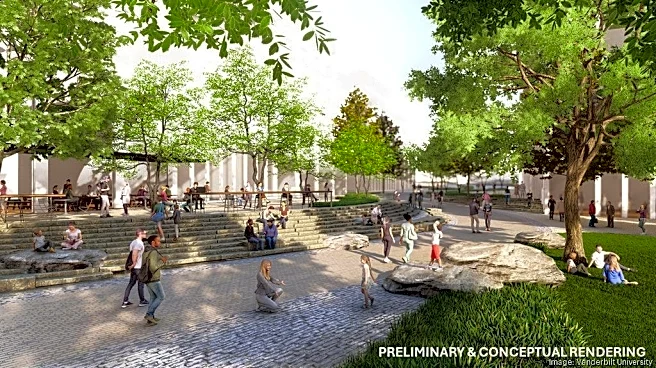









Vanderbilt University’s quest to transform the western edge of its campus into a mixed-use innovation district is moving forward.
It’s also revealing something of a divide within the nearby Hillsboro-West End Neighborhood Association, whose board members spoke out both for and against a key rezoning for the project during a public hearing at the Metro Nashville Council’s Aug. 4 meeting.
Council members voted unanimously, with District 6 council member Clay Capp abstaining, to advance the university’s request to redevelop 40 acres of underutilized campus space into a research and entrepreneurship hub. It’s part of a long-term plan to reshape the area into a mixed-use district of office and lab space, retail and restaurants, new housing and green
space.
It’s a proposal that’s drawn plenty of scrutiny from the university’s next-door neighbors, some of whom have been engaging with the project for years now.
The bill will advance to a third and final reading after a deferral until Sept. 1. The deferral’s thanks to a suite of changes added to the bill by amendment, which District 18 council member Tom Cash said were a direct response to concerns raised by neighbors.
“We did take a lot of time with this, and this is one of the results,” Cash said. “We also got some great things in the planning conditions and departmental conditions I can talk about later, but these things are very important to this bill.”

A battle of neighborhood board members
For as straightforward as the council’s vote turned out, the public hearing that preceded it wasn’t so simple.
Council members heard about an hour of comments on the rezoning request from about 30 Nashvillians, with an even split in the group between support and opposition.
Opponents have taken to calling the project the "Vulch.”
They’re presumably tying it to the Gulch, which today is a densely populated neighborhood home to mid- and high-rise mixed-used residential buildings but spent the early part of the 20th century as a bustling railroad yard before fading into relative disuse for about five decades.
Some of them came to the meeting clad in bright green shirts emblazoned with “CAP THE VULCH,” something of a preview of one of their main concerns: The project area ought to have stricter building height restrictions.
“This would create a second downtown,” said Ginger Hausser, a former Nashville Council member and a current member of the Hillsboro-West End Neighborhood Association board of directors. “It would dwarf Vanderbilt’s academic campus, and it will change the iconic area of Love Circle.”
Another commenter opposed to the project, architect Preston Quirk, equated Vanderbilt to a “king” looking to expand its kingdom and the surrounding neighbors to “peasants.”
Hausser wasn’t the only board member to speak out against the project. So did Gina Napoli, who also mentioned how the project could affect the scenic view from atop Love Circle, and Phil Ryan, who joined the chorus of opposition voices urging reduced building scales and heights.
But the bill also had supporters among the ranks of the neighborhood association’s board, like Lisa Wyatt and Miriam Mimms.
The legislation that council members approved on second reading Aug. 4 came with a whole suite of concessions on Vanderbilt University’s part, which are laid out in the amendment adopted ahead of the vote.
The amended version caps building heights anywhere between 12 stories in a maximum of 135 feet and 35 stories in a maximum of 475 feet, with stair-stepping increases in height maximums across five zones. The higher side would be closer to West End Avenue.
The amendment also requires that Vanderbilt create a $750,000 traffic calming fund, to be administered by the Nashville Department of Transportation, and a six- to eight-member Innovation Neighborhood Advisory Committee appointed by the District 18 council member intended to serve in an advisory role and meet with Vanderbilt quarterly as the project continues.
Other concessions apply to construction, like routing construction traffic away from residential roads in the Hillsboro West End neighborhood, requiring developers and contractors to formulate a parking plan for workers away from residential streets, and avoiding using public roads or property for staging.
Still others would apply after some construction has been completed, like one provision requiring 90 minutes of free parking for retail customers within the district for a 10-year period, starting when the first building including retail uses opens for business, and another asking Vanderbilt to encourage and incentivize office tenants and retail customers to use public transit.
Austin Hornbostel is the Metro reporter for The Tennessean. Have a question about local government you want an answer to? Reach him at ahornbostel@tennessean.com.
Get Davidson County news delivered to your inbox every Wednesday.
This article originally appeared on Nashville Tennessean: Vanderbilt innovation district plan advances, with neighbors divided