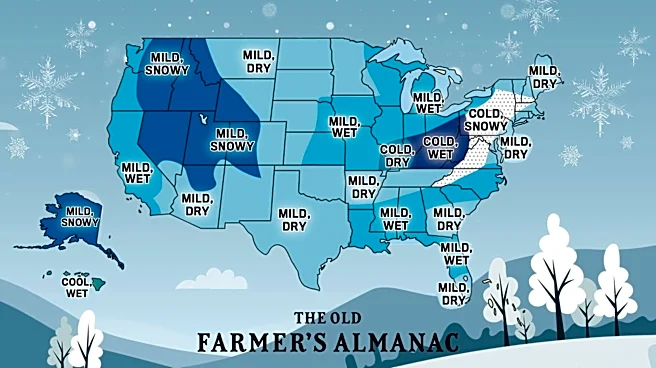







Tennessee is expected to see a mild, dry winter this year, according to The Old Farmer's Almanac's 2026-27 Winter Weather Forecast.
Across much of the United States, temperatures are forecast to be near or above normal.
However, The Old Farmer's Almanac predicts colder-than-average conditions stretching from central New England through the Appalachian region and into the Ohio Valley. Hawaii is also expected to experience cooler-than-normal temperatures.
Shop storm prep essentials on Amazon
“Winter won’t look the same everywhere this year," said The Old Farmer’s Almanac Editor-in-Chief Carol Connare. "While much of the country is headed for a milder season, some areas will still see plenty of cold and snow."
Here's what to know in Tennessee.
What will winter weather look like in Tennessee?

The almanac
predicts a generally mild winter across the Southeast, including Tennessee, with above-normal temperatures expected throughout the region.
The coldest stretches of the season are forecast for mid-November, early and mid-December, early January and late February. Precipitation is expected to vary, with wetter-than-normal conditions across northern parts of the Southeast and drier-than-normal weather farther south.
Snowfall is forecast to be near normal overall, with the best chances for significant snow in northern areas occurring in early January and late February.
Winter seasonal averages across Tennessee
Winter weather patterns vary across Tennessee, with Memphis typically receiving the most precipitation during December, January and February, according tolocal climatology data from the National Weather Service.
Nashville averages 4.43 inches of precipitation and a mean temperature of 42.7 degrees in December, 4.02 inches and 39.6 degrees in January, and 4.47 inches and 43.4 degrees in February.
In Memphis, precipitation averages 5.49 inches in December, 4.14 inches in January and 4.55 inches in February, while mean temperatures range from 44.8 degrees in December to 42.1 degrees in January and 46.1 degrees in February.
In Knoxville, precipitation averages 3.76 inches in December, 3.65 inches in January and 3.81 inches in February, alongside mean temperatures of 39.3, 36.4 and 40 degrees respectively.
Across all three cities, January is typically the coldest month of the winter season.
When is the first day of winter? What to know about the winter solstice
The first day of winter in the Northern Hemisphere arrives with the winter solstice, which will occur on Dec. 21, 2026, at 2:50 p.m. CT. The annual event marks the astronomical start of winter and occurs each year between Dec. 20 and Dec. 23, according to the almanac.
The winter solstice also marks the shortest day and longest night of the year in the Northern Hemisphere, as it brings the fewest hours of daylight.
After the solstice, daylight hours gradually begin to increase, continuing to grow longer until the summer solstice, which marks the first day of summer and the longest day of the year.
Diana Leyva covers trending news and service journalism for The Tennessean. Contact her at Dleyva@gannett.com.
This article originally appeared on Nashville Tennessean: Will Tennessee see snow this winter? Old Farmer's Almanac releases forecast
Our editors independently choose our recommendations. Some content is produced with paid support from a third party, however our editorial decisions remain independent. If you buy through our links, the USA TODAY Network may earn a commission. Prices and availability may change.