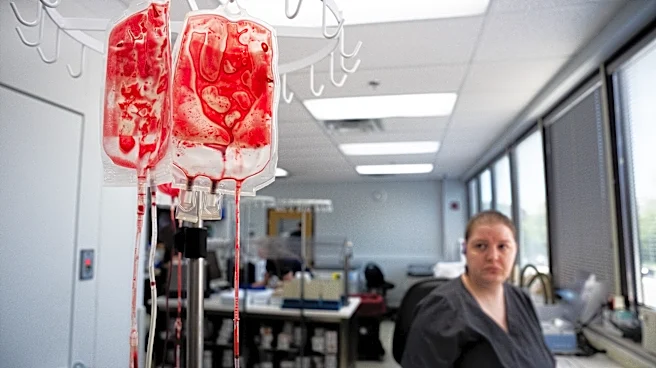








A Nashville surgeon is pleading with residents to donate amid a "scary" blood shortfall hitting Tennessee and the nation, causing the American Red Cross to declare a blood crisis for only the second time in its 145-year history.
Heart surgeon Dr. Brian Wilcox, the chief clinical officer of Ascension Saint Thomas' 20 Middle Tennessee hospitals, said some elective surgeries must be postponed due to the critical shortage.
"It is scary," Wilcox said. "A lot of times you'll see variation in supply across the country and American Red Cross units can share blood or blood products across their markets, but everybody's hurting right now."
The American Red Cross issued an alert saying: "Blood donations have fallen to a four-year summer low, worsening the
emergency shortage and threatening patient care."
Some blood bank workers and physicians blame what's known as the "100 Deadly Days of Summer," when blood donations plummet and outdoor activities and travel lead to more injuries that require blood.
Wilcox said patients often need blood during surgeries or after car crashes and other emergencies, but many others need it, too. Mothers often need life-saving blood after giving birth. Children and adults who have sickle cell disease or other disorders rely on regular infusions.
Cancer patients often need blood platelets, which help blood clot, after chemotherapy. However, this product has only a five-day shelf life, necessitating continuous donations.
"There's no where to go for help but in our own community," Wilcox said. "This is when we have to hold hands and take care of each other and our neighbors."
The Association for the Advancement of Blood & Biotherapies, known as AABB, also sent out an alert, saying: "The blood supply in the United States is significantly lower than it should be and is trending downward at a concerning pace. Blood centers throughout the country face the risk of not having blood available for every patient when it is needed."
The AABB Interorganizational Task Force on Domestic Disasters and Acts of Terrorism teamed with blood banks to issue an urgent appeal July 24 for donors, cautioning that surgeries and treatments across the country may have to be postponed and physicians may have to "make difficult decisions about patient care."
Their plea was echoed by Blood Assurance, a Chattanooga-based nonprofit that supplies Vanderbilt University Medical Center, TriStar Health hospitals and other medical facilities in Tennessee, Georgia, Alabama, Kentucky and North Carolina. Typically, they can receive blood or give it to other areas of the country during emergencies as a member of America's Blood Centers, a national network of community-based centers that provides nearly 60% of the U.S. blood supply.
"We are feeling this shortage at the community level," Blood Assurance spokeswoman Brooke Katz said.
The 54-year-old nonprofit is the main blood supplier to Middle Tennessee and Chattanooga and has operated with less than a two-day supply of several blood types for much of the summer. Katz said that leaves "little room to respond to increased hospital demand or a major emergency."
One donation can save up to three lives, according to Blood Assurance President and CEO Dr. Liz Culler said.
"I know how important it is to get them the product in a timely manner and I know what will happen if we don't," said Culler, a pathologist.
Blood donations are needed ahead of a disaster because it takes time to collect the blood, transport it to a processing lab, test and process it and send it back to area medical facilities.
"You need to donate today and not wait for something to happen," Culler said.
Think you can't donate blood?
"The vast majority of people can donate," Culler said.
Even if you have a disease, you're likely a candidate if it's under control, she said.
Patients who underwent chemotherapy also can donate blood if they've been cancer-free for a year, Culler said.
All blood donations are encouraged because the demand is continuous, but the need is higher for O negative blood type, the universal donor for red blood cells.
About 6.6% of the population has that type, but the demand is double that, Culler said.
With plasma and platelets, AB is the universal donor and just 4% of the population has this type, she said.
How to help
Ascension Saint Thomas is hosting blood drives Aug. 10 from 10 a.m.-3 p.m. at both its Nashville locations. The Midtown hospital is at 2000 Church Street and the West hospital is at 4220 Harding Pike.
The American Red Cross has a Nashville donation center at 2201 Charlotte Ave. To schedule an appointment to donate, call 1-800-RED CROSS.
Blood Assurance has donation centers in Nashville and Middle Tennessee. To find a nearby center or schedule a drive, go to www.donor.bloodassurance.org/donors/schedules/centers.
Beth Warren covers health care and can be reached at bwarren@tennessean.com or on X at @BethWarrenCJ.
This article originally appeared on Nashville Tennessean: Nashville surgeries delayed amid 'scary' US blood crisis. How to help