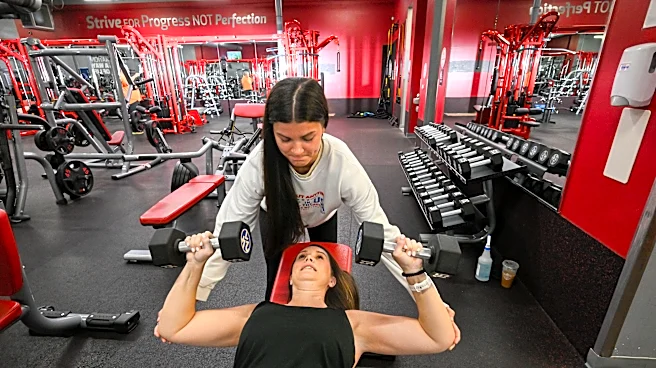




Nashville pediatric nurse Rachel Griffith spent a recent day off lifting weights and using resistance bands at a Hendersonville gym, exercises that help stave off diabetes, according to a new study.
Griffith, who cares for critically ill children with heart ailments at the Monroe Carell Jr. Children's Hospital at Vanderbilt, said she has more energy after years of strength training at Workout Anytime in Hendersonville. Researchers found another key benefit, a lower risk of developing prediabetes or Type 2 diabetes, according to a study published June 22 in the Journal of the American Medical Association, known as the JAMA Network Open.
Tennessee has a higher than average rate of diabetes, according to the state health department's 2025 Diabetes
Action Report. More than 812,000 Tennesseans have diabetes, which impacts 14.6% of the population, compared to the national median of 11.8%.
"This chronic health condition affects quality of life and can lead to serious health complications and even death," according to the state report.
Award-winning vocalist Michael Trotter Jr. discussed his Type 2 diagnosis more than a decade ago and his new ally, the drug Ozempic, during a 2025 interview with The Tennessean. Along with diet and exercise, he credited the weekly injection of semaglutide − within the popular GLP-1 classification of medicines − for helping him keep his blood sugar level under control.
Trotter, who teams with his wife Tanya Trotter to form the duo The War and Treaty, has a paternal history of the disease, which has claimed the lives of several loved ones.
Adults with Type 2 diabetes, which is non-insulin-dependent, have a higher prevalence of heart attack, stroke, arthritis and kidney disease. Between 90-95% people with diabetes have Type 2, compared to 5-10% who have Type 1, often developed during childhood, according to the state report.
Members of the nutrition and epidemiology departments at the Harvard T.H. Chan School of Public Health in Boston participated in the study on diabetes prevention. Three key factors − resistance training, aerobics and reduced television viewing − created the lowest risk of developing the disease.
Harvard teamed with researchers led by China-based physician Tianyue Zhang to study more than 143,700 adults who were followed for more than 19 years, finding that two or more hours per week of resistance training helped lower Type 2 diabetes risks. Participants with consistently high levels of resistance training had a 42% lower risk of Type 2 diabetes than those who didn't do resistance training.
Common concerns some women have about resistance training
More than 78% of the participants who benefited from resistance training in the study were women.
Griffith thought about resistance training six years ago but had her own concerns.
She had a single-level C5-C6 fusion, meaning a surgery to relieve pressure on the spinal nerves by removing a damaged disc and joining the C5 and C6 vertebrae together.
"The last thing I wanted to do was make that worse," she said. "I was so afraid of hurting myself."
She wanted to strengthen her upper body and decided to seek the expertise of personal trainer Ella Presley, whose father, Tim Presley, owns the Hendersonville gym.
"I was new and didn't know what to do and I also needed someone else's motivation," Griffith said.
During a recent workout, Ella Presley encouraged Griffith and corrected her form to prevent injury.
"My confidence is amazing," Griffith said. "I feel better in my clothes."
Presley said using weights and resistance bands can improve women's muscles, easing everyday chores and improving their mental health.
"I think a lot of women are afraid they're going to get too much muscle and look bulky," the personal trainer said.
She said that shouldn't happen unless someone is overlifting by using heavier weights.
How much TV is too much?
The study found that participants who watched less than two hours of television a day, when combined with regular resistance training and aerobic exercise, showed the lowest risk of Type 2 diabetes.
How much exercise is needed to reduce diabetes risks?
The greatest reduction in diabetes risks occurred with more than one hour a week of resistance training and more than 15 total metabolic equivalents hours per week, or METs. These measure the energy exerted during particular exercises.
A brisk walk at three to four miles per hourhas a value of four METs, meaning you're exerting four times the energy of a person sitting still, according to the medical and health information website Healthline. A more vigorous activity, such as jumping rope, is valued at 12.3. Some gym equipment lists MET levels.
Help for Tennesseans with diabetes
Chattanooga-based Blue Cross Blue Shield of Tennessee, the state's largest insurer with more than 3.4 million members, offers many preventative services for free. This includes free case managers, dieticians and other services to help manage diabetes.
Some members face barriers to care such as a lack of transportation or childcare, so the insurance provider offers social workers to find solutions.
Tennesseans can call the member services number on the back of an insurance card to direct them to plan specific information.
Those covered by Blue Cross can download a mobile app, "BCBSTN"for easy access to learn what preventative services are covered.
Beth Warren covers health care and can be reached at bwarren@tennessean.com or on X at @BethWarrenCJ.
This article originally appeared on Nashville Tennessean: Tennessee has high rate of diabetes, study reveals 3 ways to prevent