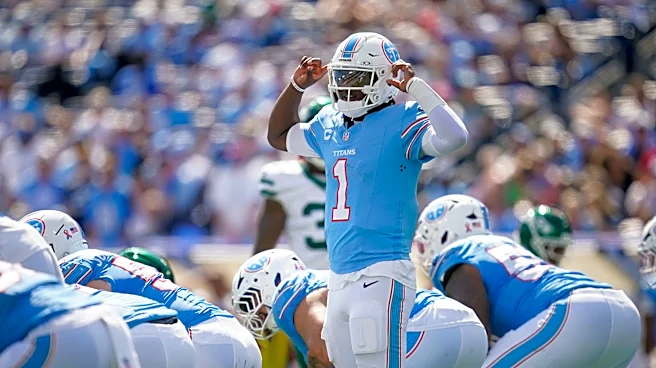



The script remains the same: Cam Ward wasn't the reason the Tennessee Titanslost their season opener against the New York Jets, but he might've been the reason they didn't win.
Ward started his second season with a 19-for-32 passing performance, throwing for 140 yards and one touchdown. He never broke the Titans' backs with a head-scratching bad decision or a turnover born from hubris. But he likewise didn't make the throws that extend drives, elevate his teammates or pry hope from the claws of despair. He more or less managed the game. Some quick throws here, some checkdowns there, a couple of impressive scrambles to avoid the rush sprinkled in, but also a fair number of misfires on should-be gimmes and one or two instances where it sure looked
from above like a receiver was wide open and Ward never saw him.
When asked about his accuracy concerns, Ward emphasized angling and lofting his throws properly to find receivers in stride as they break off their routes in the optimal way rather than throwing the ball to where receivers already are. When asked why the offense stalled so frequently, Ward went back to the old standard of blaming poor execution on first and second down, leaving the offense in unfavorable third down situations.
It's an oversimplification to say the Titans' offense can only get better if Ward gets better. Don't forget last winter, when Ward's play improved as a function of a wide-scale offensive commitment to emphasizing the run game. Quarterback play doesn't happen in a vacuum.
But the Titans' offense is built around Ward. That part's unavoidable. Offensive coordinator Brian Daboll famously coveted Ward in the pre-draft process. The Titans' three biggest offseason additions on offense were receivers Wan'Dale Robinson and Carnell Tate and tight end Daniel Bellinger. Ward has said time and again that Daboll's offense suits him better than Brian Callahan's did, and the thing he likes most about the new regime is the coaches value player input much more than their predecessors did.
So if the Titans are a reflection of Ward, the fact that the passing attack continues to rely on risk-averse, quick-firing, protect-the-defense-first strategies is a little disquieting.
"We've had six months to prepare for this," Ward said postgame. "It's not about the execution of what we had in OTAs or training camp; it's all about what we execute on Sunday."
Based on the early gameplay data collected from the game, Ward was pressured 15 times on 39 dropbacks, culminating in three sacks, four scrambles and four throwaways. The scrambles and throwaways indicated a new measure of poise for Ward in 2026; they often meant turning plays that would've been sacks last season into down resets or, oftentimes, first downs.
Progress is progress, and the fact that Ward's four scrambles resulted in two first downs and two plays that count as wins for success rate certainly is progress. But this is another example of Ward making plays that don't lose the Titans the game while still failing to make plays that contribute to winning.
Ward's next step is to go from getting the Titans back to baseline to elevating them above one. That comes with better downfield accuracy, more willingness to take deep shots and an offense that dares to let him loose.
How achievable those benchmarks are in season is hard to say, but there certainly wasn't enough progress in the opener to say Ward rewrote his reputation.
Nick Suss is the Titans beat writer for The Tennessean. Contact Nick at nsuss@gannett.com. Follow Nick on X @nicksuss. Subscribe to the Talkin’ Titans newsletter for updates sent directly to your inbox.
This article originally appeared on Nashville Tennessean: Unpacking Cam Ward's struggles in Titans loss vs Jets