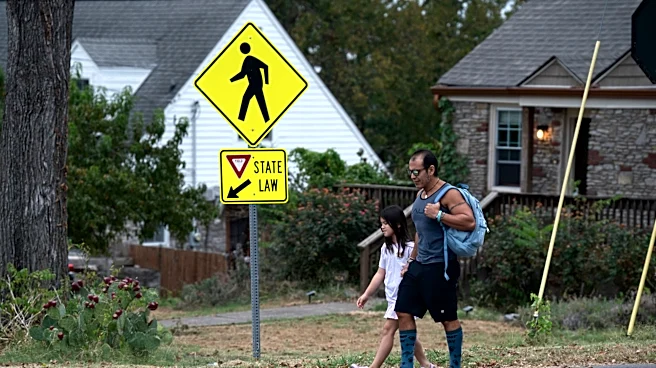




As cars zip along Riverside Drive each morning, Inglewood Elementary students and parents cross the busy East Nashville corridor.
Fernel Valdez has walked his 9-year-old daughter Emilia to school since she was in pre-K. Over the years he's had several close calls with drivers who speed through and ignore school zone and crosswalk signs.
"It's a coin in the air. Today might be the day or not," he said. "It's that thought that you have in the back of your head."
A popular route for cars and bicyclists alike, Riverside runs parallel to Gallatin Pike from the southern edge of the Inglewood neighborhood to Shelby Bottoms.
Valdez is among a group of Inglewood Elementary parents who have spent years pressing for a crossing guard on the road. But according
to the Metro Nashville Police Department, the first prerequisite for getting a guard is the presence of unattended children walking to school. For Valdez, that's out of the question because of the traffic, even if his daughter is old enough to make the five-minute walk alone or with friends.
"Not in a million years," he said. "It's a huge no."
Inglewood Elementary is far from the only Nashville school in a precarious position when it comes to student pedestrians. While the city has rolled out a bevy of safety measures for pedestrians and schools in recent years, some parents worry it's not enough.

Parents push for school zone safety as pedestrian deaths creep up
Emotions ran high over student pedestrian safety at Inglewood Elementary's Sept. 15 parent-teacher association meeting with local officials, according to Valdez. MNPD East Precinct Commander Jessica Ware was on hand, along with another officer and school board member Zach Young.
Sam Singer, who has two children at Inglewood Elementary and teaches at nearby Stratford STEM Middle School, said she left frustrated by the roadblocks to get a crossing guard. She said parents were told to file more complaints about safety issues around the school. Singer pointed out that schools on calmer residential streets in the area already have crossing guards in place. Despite her frustrations, Singer hopes parents keep pushing for a more walkable, bikeable city.
"There's been a powerful shift in parents advocating for these types of things," she said.
In the weeks following the Sept. 15 meeting, MNPD spokesperson Brooke Reese said, a crossing guard was placed at the intersection of Ann Street and Branch Street, which runs behind the school. Officers also ramped up their presence in front of the school on Riverside, Reese said, stopping by as often as possible during drop-off and pickup times. School principal Whitney Russell said that she understands resources may be limited, but that she hopes collaboration continues between the school, police and city officials.
"Ultimately, I would love to see additional support on Riverside that gives our families confidence that they and their children can cross safely," Russell said.

On the morning of Sept. 24, a squad car sat at the intersection of Dorchester Avenue and Riverside with solid blue lights activated. It pulled away just before Valdez and his daughter stepped into the crosswalk. Cars eventually heeded the large yellow yield signs posted, allowing them to cross. A few hundred feet away on the southbound side of Riverside, the school zone speed limit sign with flashing yellow lights was largely obstructed by tree branches.
The conversation around Inglewood Elementary comes as Nashville has seen a rash of pedestrian deaths in 2026. As of September, the total stood at 28. That's nearly double the city's 2025 pedestrian death toll but hasn't topped 2022, which saw nearly 50.
From January 2023 through mid-July this year, virtually all of the city's 1,310 crashes that involved a pedestrian happened within 1.5 miles of a school, according to data from the Nashville Department of Transportation and Multimodal Infrastructure, or NDOT. Roughly 9% of those crashes were fatal, killing 113 people.
Another issue at play is how MNPS determines which students ride the school bus, according to Young, the school board member. He said the district does not provide traditional bus service for high school students who live within 1.5 miles of their school. For elementary and middle schoolers, that distance shortens to 1.25 miles. While there are some exceptions, Young sees the rule as part of the problem, especially in Nashville neighborhoods without continuous sidewalks or dedicated bike lanes. He said parents who opt to drive their children to and from school also compound traffic issues during drop-off and pickup times.
"To me, it's … counterintuitive to the city's overall strategy of trying to improve traffic," Young said.
But pedestrian wrecks and traffic flow only paint part of the picture of student pedestrian safety in Nashville.
Crowded bus stops, reckless drivers: 'It's not enough'
In Southeast Nashville, scores of students congregate in front of apartment complexes along Edmondson Pike on school days to wait for the bus. Some gather on sidewalks or in parking lots, while others hug narrow roads leading into and out of the complexes. As traffic picked up around 7:30 a.m. on Sept. 29, more than a dozen kids sat on the rocks dividing the exit and entrance lanes to The Grove Brentwood apartments. Within a few minutes, the crowd grew and spilled into the divided entry road.
Family members parked cars as they waited with the students, which in turn slowed the flow of traffic around them. One parent said she's watched cars on Edmondson Pike blow past the school bus while its stop signs and flashing lights are active. By 7:45 a.m. the kids all piled onto the bus as parents and family members peeled off.
NDOT spokesperson Cortnye Stone said that the department is aware of crowding issues like the ones on Edmondson Pike and that plans to address them are still in the works.
"We're working on an evaluation of school bus routes, bus stop locations and sidewalk connectivity to determine if there are areas where we can make short-term improvements to pedestrian safety for students," Stone said.

Across town at Shwab Elementary, parent Ashley Warbington has grappled with anxiety about her son and his classmates crossing Dickerson Pike — one of the city's deadliest roads for pedestrians. In the mile leading up to the school, sidewalks intermittently disappear and crosswalks are few and far between.
There is no stoplight at the intersection of Dickerson Pike and Gatewood Avenue directly outside the school, but a crossing guard is in place as students arrive and depart. A collection of poles also marks off an island in the middle of the crosswalk, along with flashing yellow lights during school zone hours.
As school let out on Sept. 28, the guard, parents and school staff worked in tandem to quickly get a crowd of students and parents across the street. Warbington said walkers are released at 3 p.m. while the rest of the kids get out 10 minutes later. Equipped with a whistle, brightly colored shirt and handheld stop sign, the guard kept an eye out for any stragglers before packing up around 3:20 p.m. Warbington said she's seen crossing guards take video of speeding cars, write down license plate numbers and even call in violations on the spot.
That day, Warbington was able to get a parking spot on the same side of the road as the school to pick up her 10-year-old son, Marco. But some days she's forced to park across the street and cross Dickerson. While the crossing guard makes her feel safe, she still worries about the heavy flow of traffic and "constant speeding" through the intersection.
"To be honest, it's not enough," Warbington said of the safety measures in place. "I don't think we're a city that pays close enough attention to pedestrians."

Nashville leaders work to make 'safer streets for everyone'
Pedestrian safety has been one of Nashville Mayor Freddie O'Connell's top priorities since he took office in 2023. He championed a $3.1 billion transit referendum, which Nashville voters approved in 2024.
The nuts and bolts of the plan, dubbed "Choose How You Move," include:
- 86 miles of new or upgraded sidewalks
- 592 smart signals that can improve traffic flow
- 285 upgraded bus stops
- 12 strategically located transit centers
- 54 miles of high-capacity transit corridors, including bus rapid transit routes
- 80% increase in total WeGo bus service hours, along with 24-hour service and decreased wait times
Alesia Howard, who heads communications for the transit program, said the plan includes sidewalk, service and safety improvements that connect with nearly 75% of MNPS schools. She also said WeGo, the city's bus system, lets MNPS high schoolers ride for free through its StrIDe program. Students in grades 6-8 can participate during the school year with parental permission.

Here are a few more student pedestrian safety efforts underway, by the numbers:
- As of late September, MNPD employed 98 crossing guards who cover 71 of the district's roughly 160 public schools. Another three schools that qualify for crossing guards are still awaiting them.
- MNPD has 37 crossing guard vacancies and plans to start training nine new hires in late October.
- NDOT has completed 67 school zone improvement projects since 2024, including refreshing or creating pavement markings and installing or repairing signs.
- Stone, the NDOT spokesperson, said another 149 schools are on the list for improvements and estimated six to 10 projects a month will get done.
Stone also referenced the wide-reaching benefits of transit and safety upgrades and their impact on schools.
"Many of our schools are on or near Nashville's major corridors," Stone said. "Investments in these corridors, including major investments through Choose How You Move, mean safer streets for everyone — especially children and families walking, biking and taking transit to school."
Rachel Wegner covers education and children's issues for The Tennessean. Got a story you think she should hear? Reach her via email at RAwegner@tennessean.com. You can also find her on X or Bluesky under the handle RachelAnnWegner.
This article originally appeared on Nashville Tennessean: Nashville students face busy roads, scarce sidewalks, reckless drivers