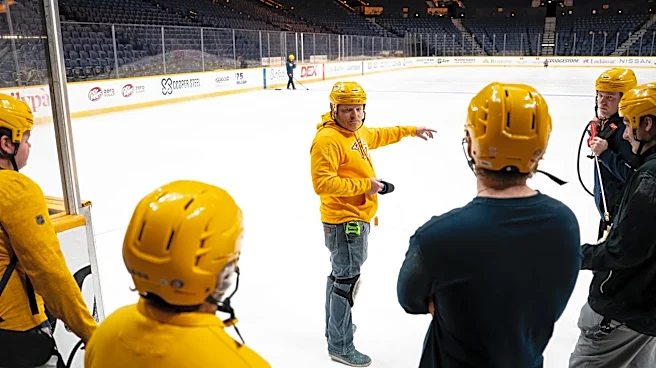








You'd think near triple-digit temperatures in Nashville this week would have the ice tech crew at Bridgestone Arena sweating bullets.
But Nigel Schnarr, the Nashville Predators' senior director of facility operations, kept his cool.
“(The ice) was 14 degrees this morning," Schnarr said on Aug. 31. "We've been under a heat advisory all week long, so that’s lovely when you’re trying to put ice in."
Schnarr, a 20-year veteran of the ice rink industry, has spent the past few days with his crew installing ice at Bridgestone Arena. In the end, 20,000 gallons of water, 600 gallons of paint, and several days of around-the-clock labor will set the stage for the Predators' 2026-27 season.
"This is where it all starts, it starts here today for the upcoming
season," Schnarr said. "The best sheet of ice that we can give them, the better."
There are weeks to go until the Predators actually skate at Bridgestone. After opening training camp on Sept. 17 at Ford Ice Center Bellevue, their first home preseason game is on Sept. 22, and their first regular-season game is Oct. 1 against the Minnesota Wild.
Inside the operation to install ice at Bridgestone Arena
Schnarr's work began early in the morning of Aug. 30, following Brandi Carlile's Dolly Parton tribute on Aug. 29. After load out, he began the slow process of cranking down the arena temperature over a 24-hour period. Too fast, and you'll risk cracking the concrete slab. Slow and steady is best.
Throw in a region-wide heat advisory and you've got a fun challenge.
"Every year, conditions are always a little bit different. Sometimes the outside is dry and we can fly through putting in (the ice), especially the water and the white paint in the morning. Today, with it being hot and humid, it just kind of slows things down a little bit," Schnarr said.
The whole process is more complicated than you'd think. Alternating layers of water and white paint, sprayed on to the ice using an array of nozzles that look more like farming equipment than sports gear. A detailed layer of colored lines and circles, carefully applied with NHL-approved color tones and finish. Then more water on top of that, layering over an inch of ice across the 200-foot long ice rink.

Temperatures must be constantly checked. Humidity must be monitored. Imperfections must be buffed out. All to make a crisp, picture-perfect rink.
"I’m a perfectionist," Schnarr said. " . . . I want to make sure we take care of that so the ice on TV looks great and so the players think it's great."
Schnarr, who has been in his role with the Predators for 13 years, feels an enormous sense of pride for his work. He regularly seeks feedback from players on the ice condition, doing what he can to get the surface exactly how they like it.
For example, Schnarr knows players prefer a thicker, colder sheet of ice. That can be a challenge in the warm summer months, but he likes to keep the ice between 1⅜ and 1½ inches thick and at a temperature about 20-22 degrees.
"When (the ice) gets low, it can get chippy on them," he explained. "The more ice I can hold, the better."
Alex Daugherty is the Predators beat writer for The Tennessean. Contact Alex at jdaugherty@gannett.com, follow him on X at @alexdaugherty1 or check out our Predators exclusive Instagram page @tennessean_preds.
This article originally appeared on Nashville Tennessean: How do Predators install ice at Bridgestone Arena? An inside look at the process