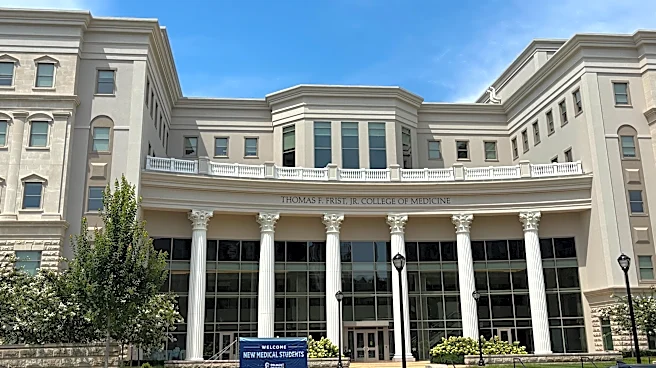







A new document obtained by The Tennessean reveals more details on what led to accreditation probation for the Thomas F. Frist Jr. College of Medicine earlier this year.
Slides presented recently to faculty of the two-year-old Nashville medical school, which is part of Belmont University, show an accrediting committee flagged more than a dozen areas of concern. Several revolved around students saying the school falls short when it comes to research and scholarly opportunities, self-directed learning, administrative support, and access to academic and career advisors. Other issues stemmed from the school's administrative, authority and governance structures and inconsistencies in its admissions process, among others.
While the school’s preliminary
accreditation is still intact under the Liaison Committee on Medical Education, it will remain on probation until at least 2028. After that, it will have another chance to exit probation and advance to the next level of accreditation. A spokesperson for the school said no students withdrew or disenrolled after the probation news broke in late July.
The eight-slide presentation to faculty offered a brief overview of 14 areas the committee marked as either "unsatisfactory" or "satisfactory with monitoring." Here are several key takeaways from the slides.

Committee flags shortfalls in student support, opportunities for Belmont medical school
The committee flagged nine issues as "unsatisfactory." The majority revolved around student feedback.
Unsatisfactory
- The school needs to strengthen its method for identifying concerns, taking corrective action, measuring results and demonstrating sustained improvement.
- School government and authority structures and its decision-making process "require further alignment" to assure consistency in its policies and responsibilities.
- Students shared concerns about how responsive, supportive and effective the school's administration is, especially with students who are further along in their schooling. They also said offering feedback to administration did not consistently yield visible or timely changes to their courses or education programs.
- Students also flagged inconsistencies in their access to "visible, coordinated and accessible research and scholarly opportunities," along with concerns about having enough time for self-directed learning and preparation.
- Students told the committee there are inconsistencies when it comes to how available and accessible academic and career advisers are.
- The school's admissions governance needs improvement to make sure decisions reflect the school's authorities and procedures.

Satisfactory with monitoring
- Faculty resources are sufficient to support the educational program for now, but need to be monitored as the school grows. The school also needs to keep tabs on its resources for scholarships and student educational debt as it expands.
- The school needs to continue strengthening, monitoring and fostering the scholarly work of faculty.
- Plans for spaces for students to study, store their belongings, relax and make calls were still being completed and need monitoring.
- While required clinical experiences and alternatives were in place, the school must complete and monitor their framework.
What's next for Belmont's medical school
The slides included a timeline of the medical school's plans to address the committee's concerns and achieve provisional accreditation by October 2028. They also designated leaders to oversee each of the 14 areas the committee flagged.
The committee is the accrediting body for many medical schools across the United States and recognized by the federal government. It grants three levels of accreditation: preliminary, provisional and full.
The school will develop plans to address the committee's concerns by December, the presentation showed. By January, it will start working to study and correct the issues over the course of several months. The school is also planning a mock site visit in late September or early October 2027. That will happen ahead of the committee's site visit, which is expected in January or February 2028, according to the slides. The committee will host its regular meeting later that year to decide whether the school can advance its accreditation.
The school's website said the probation does not affect degree validity, residency placements or matches, a graduate's ability to obtain a medical license, scholarships and financial aid, or admissions timelines for prospective students. The school said it will keep applicants, accepted students and parents updated through admissions communications, virtual information sessions and FAQ resources.
"We are committed to being transparent with applicants throughout this process," the medical school's accreditation FAQ page read. "Every applicant offered admission will be informed of the college's accreditation status before making an enrollment decision. This information will be provided as part of the admissions process and accompanying enrollment materials so applicants can make a fully informed decision about their medical education."
Rachel Wegner covers education and children's issues for The Tennessean. Got a story you think she should hear? Reach her via email at RAwegner@tennessean.com. You can also find her on X or Bluesky under the handle RachelAnnWegner.
This article originally appeared on Nashville Tennessean: Document shows why Belmont med school was put on probation | Exclusive