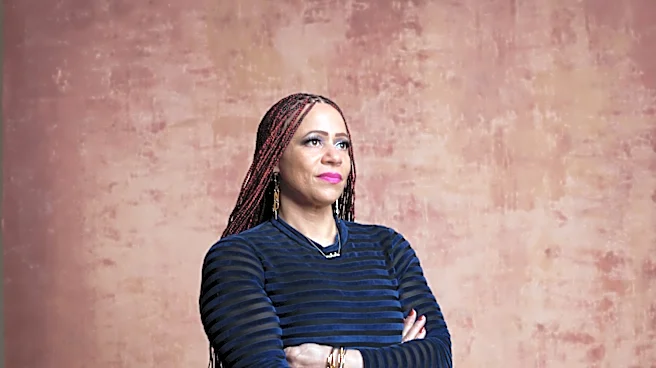






There was a moment in Nikole Hannah-Jones’ Sept. 20 New York Times Magazine essay in which she seemed to understand.
The revelation wasn’t in reference to the lasting ramifications of Hannah-Jones’s decision to enroll her only child in predominantly Black, low-income and grossly underperforming New York City Public Schools beginning in 2016. That much was made clear by her essay’s headline, an endlessly clickable title that has triggered days of social media discourse: “In Fighting for Every Black Child, Did I Betray My Own?”
Hannah-Jones' fleeting moment of clarity refers, instead, to a passage in which she appears to have discovered a source, if not the source, of P.S. 307’s dysfunction.
The scene picks up in the school’s cafeteria, where she
was visiting during lunchtime. While aghast at the children “running wild, chasing, hitting and pushing each other while the teacher’s aides and cafeteria workers stood by looking bored,” she stops short of blaming a lack of home training. Neither did she cite a predisposition to violence rooted in race, zip code or a parent’s meager salary.
“It was not the children that horrified me – kids of all incomes are rambunctious at lunchtime. It was the callous disregard of the adults,” she wrote. “Students respond to the high or low expectations of institutions and the grown-ups who operate them, and it was clear that these children were getting the message.”

What you won't find in the Hannah-Jones essay
I encourage every American to read Hannah-Jones’ essay, whether or not you have kids, whether or not you work in education, whether or not you profess concern about the future prospects of this nation’s most vulnerable and perpetually marginalized children. If nothing else, the piece is a clear-eyed portrait of the real issues plaguing urban schools and the students who attend them. There is no theory or speculation; Hannah-Jones courageously takes us inside, up close.
But if you’re looking for a scathing rebuke against a local education system rigged to fail the majority of the families underwriting its considerable operating budget, you will not find it. Because instead of continuing to shine a light on the adults who fail to do the jobs they are paid quite well to do – the "grown-ups" who are, in fact, responsible for hiring those who failed to properly manage the lunch period in question – Hannah-Jones chose to recycle the tired segregation narrative that guided much of her early, pre-“1619 Project” reporting.
“I knew the consequences of this educational neglect would follow [the students] throughout their lives, as the failures here would be passed on to the next grade and the next,” she wrote. “And then our society would blame their academic limitations on the dysfunctional culture and poor choices of their marginalized families, because blaming poor families is more convenient than calling for the dismantling of segregation.”

Where the Brown v. Board comparison falls short
Hannah-Jones’ logic follows the U.S. Supreme Court's Brown v. Board of Education ruling that segregated schools are inherently unequal, but there is no clean comparison to 1954, not when the per-pupil spend at the elementary school Hannah-Jones’s daughter attended is more than $52,000.
In truth, the schools to which Hannah-Jones sent her daughter were not segregated “solely by race,” as outlawed by Brown v. Board. They were segregated by performance, by opportunity, by standards and expectations. Twentieth century de jure segregation was replaced by de facto separation when parents (including some Black ones) who had the option to enroll their children in better schools, wisely chose to exercise that option.
There was no red-faced, gun-toting sheriff threatening to close the school if the races didn’t keep to themselves. Neither were there crowds of angry white mothers hawking spit into the faces of the Black children daring to enter the same school building as their innocent babies.
Rather, according to Hannah-Jones, the school’s “dynamic” principal left, her role then filled by someone who “was not up to the task of sustaining the work of the veteran educator she had replaced.” As a result, the multiracial, economically advantaged families whose children shared classrooms with Hannah-Jones’ daughter in kindergarten soon disappeared.

A 'ridiculous' and 'disrespectful' premise
I don’t want to dismiss the experiences of Black children in urban school districts. It is, in fact, the guiding light of my ownwriting on education. Black children are too often left to languish in underperforming schools, where they find themselves at or near the bottom of most significant metrics, including ELA and math proficiency, graduation rates, ACT scores and college attendance.
But the idea that Black children are automatically subjected to these realities simply because they are Black and surrounded by other students who are also Black is both ridiculous and disrespectful. If anything, the historical struggles of Black Americans should all-but guarantee quality educational outcomes, especially considering the billions of public dollars being spent in the nation's largest districts.
If the thesis is that otherwise functional (or potentially functional) schools only fail when the population gets Blacker, or Blacker and poorer, it's still a flawed one. Individuals must still execute the dysfunction. Actual humans must decide to watch kids fight during lunch and do nothing, or not grade a semester's worth of math homework, or give students As and Bs when they've yet to master the coursework. And in blue cities like New York, the Republican boogeyman is scarcely involved.
By arguing that segregation is the complex explanation for low-performing schools with which too few people want to grapple, however, Hannah-Jones therefore built an escape-hatch for her own resistance to the logical outcome of her findings: Her daughter, as well as the majority of other Black children in New York City Public Schools and other urban districts across the country, were, and are, failed by a system propped up by so-called allies that prioritizes optics and adult compensation above education.
Hannah-Jones, being the celebrity she is, thought she could evade this truth. "A New York Times reporter in a high-poverty school f***ing changes the school," she said in 2018, just two years into her family's grand experiment. "There's certain things that just are not gonna happen in that school. I can go to that school and say there's a problem, and it gets fixed immediately."
Yet in the end, her gig at the Times didn't matter, neither did her Pulitzer Prize or her MacArthur Genius Grant. I won't criticize her parenting like many readers have, suggesting that if only Hannah-Jones had paid more attention or checked her daughter's homework more diligently – or, perhaps, volunteered as a co-teacher and lunch monitor – the school that had failed so many others wouldn't have failed her child, too. I know you can't PTA your way out of systemic negligence.
What I will say: Individual credentials mean little in the face of incompetent adults and inadequate educational policies who are backed by a multi-billion-dollar machine. And more important: A failure to state that explicitly only insulates the district administrators, school board members and other elected officials who need to be held accountable.
The accountability question left unanswered
Early in her essay, Hannah-Jones considers her daughter’s interrogation of the decision to enroll her in a struggling school. Then she juxtaposes her daughter's anger and frustration with the overwhelming support she received for the 2016 essay, "Choosing a School for My Daughter in a Segregated City, in which explained and defended that decision.
“In the outside world,” Hannah-Jones wrote, “my choice had earned me valor.”
Perhaps that "valor" is why she avoided placing blame where it belongs, even as her own words, her own experiences, forced her ever closer to the truth.
Maybe she didn’t want to upset the liberals who cheered that 2016 essay, eagerly welcoming her into the political groupthink that rejects both private and public charter schools while encouraging enrollment in local, zoned schools no matter their quality. Or maybe she didn’t want to unwittingly cast aspersions on her husband’s New York City Panel for Education Policy seat. Since July 1, Faraji Hannah-Jones has served as the Contracts and Committee Chair for NYC’s school board.
Regardless, if Hannah-Jones’ decision to enroll her daughter in a low-performing school was rooted in a desire to improve outcomes for all Black children in New York City, her essay likely provided her best opportunity. By holding the most powerful in the city’s school system to task, she could’ve opened the door to real reform – the kind that can improve conditions for children enrolled in the schools that will never see a New York Times reporter in the carpool line.
Instead, she made the wrong choice. Again.
Andrea Williams is an opinion columnist for The Tennessean and curator of the Black Tennessee Voices initiative. She has an extensive background covering country music, sports, race and society. Email her at adwilliams@tennessean.com or follow her on X (formerly known as Twitter) at@AndreaWillWrite and BlueSky at@andreawillwrite.bsky.social.
This article originally appeared on Nashville Tennessean: The missed opportunity in Nikole Hannah-Jones' essay | Opinion