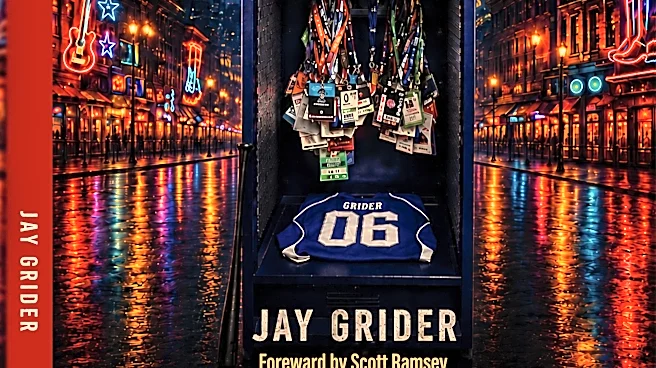





In Nashville's maturation from a minor league town to the big leagues, Jay Grider has seen it all and tells it all in his new book, "Last Call: From the Minor Leagues to Nashville's Rise as a Major Sports Destination."
Grider, a longtime Nashville Sports Council executive, provides a candid, behind-the-scenes look at what the organization faced in its infancy as it tried to put Music City on the national radar as a sports town by bringing in a college football bowl game and other big events.
He pulls no punches, telling how the initial Liberty Mutual Music City Bowl in 1998 almost did not happen. And what it took to convince ESPN not to give up on Nashville and some of the wacky things that took place at many of the events the sports council has
hosted over the years, of course, leading up to the successful bid for the Super Bowl in 2030.
Many believe the frigid weather was the biggest obstacle the sports council faced in putting on the first Music City Bowl between Alabama and Virginia Tech in 1998 at Vanderbilt. But those nasty conditions paled in comparison to what happened when Grider and longtime sports council and Music City Bowl president and CEO Scott Ramsey flipped on the light switch at the stadium as the two teams started warm-ups.
"Half the lights would not come on, and we were all freaking out," Grider said. "And the stadium's operations director at Vanderbilt was very, let's say, casual in his handling in trying to get the stadium lights on. Scott was getting yelled at by ESPN and the two schools because they were trying to warm up but couldn't because of the darkness. Ramsey dropped his first (expletive) that I ever heard him say."
A few years later, the sports council brought an AAU wrestling tournament to Lipscomb's newly opened Allen Arena. The trouble started there when some of the wrestlers were caught urinating off the loading docks, escalated when fans broke into the arena's suites to steal food, and culminated with a fake injury on the mat.
"A coach told a kid during a match to fake a neck injury, and he did," Grider said. "Of course, we didn't know he was faking the injury, so we immediately had the trainers check him out, and they called for the ambulance guys, who were already there, to take him to the hospital."
As the wrestler was being loaded on to a spine board with a neck brace, the coach admitted the wrestler was faking the injury, and he was fine. The fake injury had backfired on the coach, who needed the wrestler to participate in a key match later in the tournament.
The training staff said no deal; the kid was going to the hospital to be evaluated. The coach, fuming at this point, then had the rest of his team lie in front of the ambulance to prevent it from leaving.
After security stepped in, the wrestler was taken to the hospital. The coach then ordered his other wrestlers to pack their bags, and they left before the tournament ended. They also left behind the wrestler who had faked the injury.
"The kid's parents had to come down from another state and pick him up at the hospital," Grider said.
Grider also writes about what went into the sports council's pursuit of the SEC men's and women's basketball tournaments, the NCAA Women's Basketball Final Four, the NHL All-Star Game, the U.S. Figure Skating Championships, WWE's SummerSlam, the NFL draft, the FCS national championship and eventually the Super Bowl.
"It's pretty much a hybrid memoir," said Grider, who is chief operating officer and special adviser to the Nashville Sports Council and Music City Bowl. "The first third of the book is my childhood, going to college (MTSU) and trying to get into sports. Then eventually getting into sports . . . from 1997 when I started here in Nashville to the present."
"Last Call: From the Minor Leagues to Nashville's Rise as a Major Sports Destination"is now available on Amazon.
This article originally appeared on Nashville Tennessean: Sports council exec pulls no punches in book on how Nashville became sports destination