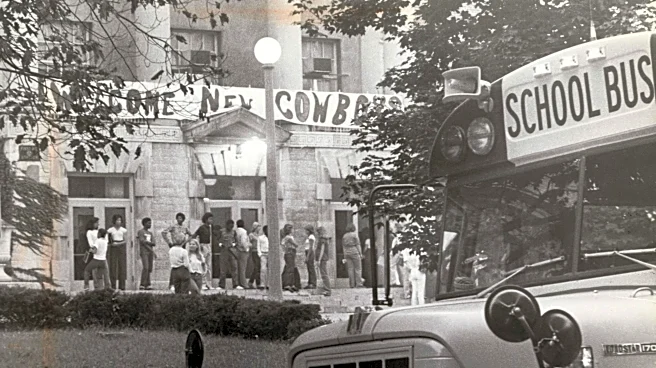








The first day of school typically stirs up anticipation. In 1979 in Columbus, the first day of school was the culmination of more than classroom prep and school shopping.
On Sept. 6, 1979, the Columbus Board of Education began court-ordered busing after the U.S. Supreme Court upheld a federal district court decision in Columbus that the school board was segregating students. That fall, 380 buses hit city streets to deliver approximately 35,000 Columbus public school students to a new school.
Years of court battles, planning, and preparation led to the busing plan for the first week. Columbus police prepared to respond to any potential disturbances or violence, but busing went smoothly, and the 50 officers on standby had little to do. More than
4,000 community volunteers helped orient students into their new schools to smooth the transition.

The busing plan in Columbus was put into action 25 years after the nation's highest court decided in Brown v. Board of Education that it was unconstitutional to separate children in public schools based on race, overturning the “separate but equal” doctrine that had legalized segregation in the United States. The court determined Columbus City Schools had failed to disestablish its dual system.

However, unlike schools in the Jim Crow era that enforced specific policies requiring separate schools for Black and white students, Columbus schools were de facto segregated as a byproduct of housing policies like redlining and racially restrictive covenants in property deeds that kept some Columbus neighborhoods majority white. Because students attended their neighborhood schools, racially uniform neighborhoods produced student bodies that reflected the same.

In 1973, 14 students and their families argued in a class action lawsuit, Columbus Board of Education v. Penick, et al, that the Columbus Board of Education was upholding a segregated public school system because an enclave of schools on the city’s East Side had remained majority Black since the Brown ruling. Therefore, the school district had failed to dismantle the dual system of segregated schools.

U.S. District Court Judge Robert Duncan, the first Black judge appointed to the federal bench in Ohio, ruled in favor of the students in 1977 and required the district to adopt a plan to achieve racial balance in the schools. The Penick case was among many legal battles that followed the Brown ruling that attempted to reckon with the United States’ history of segregation and racial discrimination.
After the Supreme Court held in 1971 (in Swann v. Charlotte-Mecklenburg Board of Education) that busing is an acceptable remedy to end school segregation, a wave of busing plans began, making “court-ordered busing” a hot-button issue in the 1970s.

Some in Columbus resisted the change and appealed Judge Duncan’s 1977 decision. The U.S. Supreme Court heard the appeal in 1979 and agreed by a 7-2 decision with Duncan’s ruling that the Columbus Board of Education was obligated to remedy the historic segregation in the public school system, whether the board had discriminatory intent or not in the perpetration of segregated schools.

Dramatic shifts happened to some schools’ student demographics. East High School, for example, went from 99% Black to only 38% Black, while Monroe Junior High went from 94% Black to 30% Black.
Maria Lee is a librarian with the Columbus Metropolitan Library.
This article originally appeared on The Columbus Dispatch: Back to school in 1979 meant desegregation busing for Columbus City Schools