

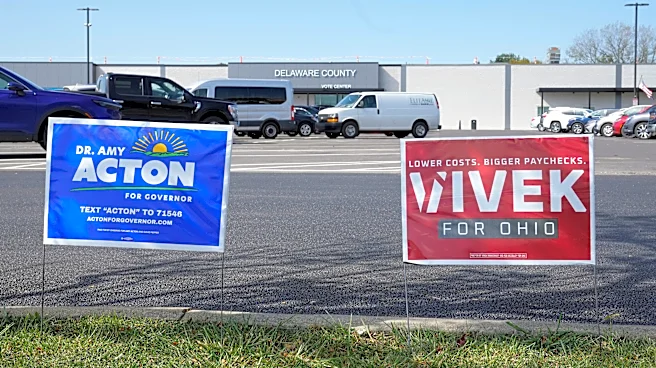
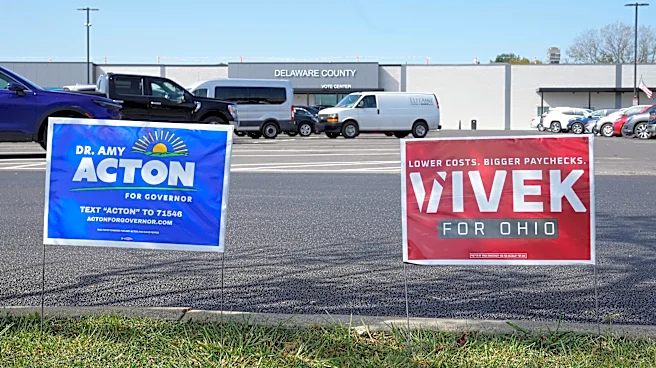

They're interrupting your football game. They're popping up on your YouTube video. They're attack ads in the Ohio governor's race between Democrat Amy Acton and Republican Vivek Ramaswamy.
One particular ad featuring Acton's estranged mother has drawn national attention and calls for Ramaswamy to take the ad down. Ramaswamy has refused. Even before that, candidates and their allies have spent more than $174 million in Ohio's gubernatorial race to replace term-limited Gov. Mike DeWine.
Neither candidate has held political office in Ohio before, so the ads can't cherry-pick former votes or decisions. Instead, they focus on Ramaswamy's past business dealings, Acton's past data center stocks and speculation about what Ohio would look like if a particular
candidate won.
Here's what to know:
Vivek Ramaswamy's failed Alzheimer's disease drug
What's the ad? Alliance for Retired Americans President Norm Wernet, of Bexley,is featured in an adthat says Ramaswamy pushed an Alzheimer's drug that the biotech entrepreneur knew didn't work. Wernet accuses Ramaswamy of making hundreds of millions by scamming people like Wernet, whose wife has Alzheimer's.
Who paid for it: Ohioans for Amy Acton and David Pepper, which is their campaign committee
What are the facts? Ramaswamy founded a biotech company called Roivant Sciences in 2014. Later that year, Roivant purchased an Alzheimer's disease drug called intepirdine for $5 million from a much more established biopharmaceutical company, GlaxoSmithKline.
Before selling the drug, GlaxoSmithKline conducted four phase 2 studies on intepirdine. The results were mixed but showed some improvements for patients, particularly those also taking a different Alzheimer's disease drug called donepezil.
GSK had not conducted a phase 3 trial, a larger study used to determine how effective the new drug is compared to current treatments, on intepirdine.
In 2015, Roivant spun off another company, Axovant, to develop intepirdine. When Axovant went public on the stock market, it became the largest U.S. biotech initial public offering to date. The company was valued at $3 billion as business publications asked: "Is biotech in a bubble?"
In interviews, Ramaswamy described intepirdine as "a great drug candidate" that could "make a huge difference for a lot of patients." But the drug failed its Phase 3 trial in 2017, and Axovant stock plunged 70%, Forbes wrote at the time.
Ramaswamy told Forbes that intepirdine was "the single greatest failure" of his career. The FDA never approved the drug, and it was never marketed to patients. No one's relative was scammed into purchasing a faulty Alzheimer's drug.
Did Ramaswamy make hundreds of millions off intepirdine? PolitiFact concludedthat it's not clear how much of Ramaswamy's earnings from Roivant and Axovant could be attributed to intepirdine. Ramaswamy personally owned less than 1% of Axovant. But he was CEO of Roivant, which owned nearly 70% of Axovant, according to PolitiFact.
Democrats have accused Ramaswamy of a "pump-and-dump" scheme with intepirdine. Neither Ramaswamy nor his companies have been charged with securities fraud for knowingly inflating stock prices with misleading information and then selling them to profit.
#OHGov: R candidate Vivek Ramaswamy is up on TV with this spot --
— Medium Buying (@MediumBuying) October 13, 2026
Patty slightly off camera:
"I couldn't believe what I was seeing. It was an 85% increase to the property taxes"
"I am worried about losing my home because of the real estate tax. I'm very concerned. If Amy Acton… pic.twitter.com/LeUmgl2RIi
Amy Acton's property tax plan
What is the ad? Patricia "Patty" Edwards, of Amherst near Cleveland, says her property taxes increased by 85% and she's worried she'll lose her home if Acton becomes governor. Edwards said she reached out to Ramaswamy and trusts him to solve the problem.
Who paid for it? Vivek Ramaswamy and Rob McColley for Ohio, which is their campaign committee
What are the facts? Between 2023 and 2024, many Ohioans' property values increased dramatically for a variety of reasons, including rising home prices, inflation, periodic reappraisals of home values and reductions in state assistance.
The property value of Edwards' farm home increased 84.1% between 2023 and 2024, according to Lorain County auditor records. During that same time, her annual property taxes increased 63.9% from $5,575 to $9,136, according to auditor records. Their property taxes then decreased 14.8% between 2024 and 2025.
How would Acton's property tax plan affect Ohioans' bills? Acton has proposed expanding eligibility for Ohio's homestead exemption, which currently allows lower-income homeowners age 65 and older and people with disabilities to exempt the first $29,000 of their home’s value from taxation.
Currently, the exemption is available to those earning less than $41,000, but Acton wants to increase the eligibility threshold to those earning less than $50,000. Records indicate Edwards is old enough to benefit from the homestead exemption, but it's not clear whether her income level would make her eligible.
Also worth noting: Edwards owns the Amherst property with her husband, Vernon, who is a convicted child sex offender, The Bulwark, a national, center-right publication, first reported. The Ramaswamy campaign said it would remove Vernon Edwards from the ad after The Bulwark's reporting, but has not taken the ad down.
What has Ramaswamy said about Medicaid, data centers?
What is the ad? The ad uses clips of Ramaswamy talking about his personal wealth, health insurance coverage and data centers. The voiceover accuses Ramaswamy of wanting to cut Ohioans' health care and raise their electric bills.
Who paid for it? Acton's campaign committee
What are the facts? The ad uses Ramaswamy's own words from previous interviews. In one, he tells television host Greg Gutfeld that he's "dirty, dirty rich." Forbes estimated Ramaswamy's net worth at about $2.3 billion, which would make him the third-richest elected official behind President Donald Trump and Illinois Gov. J.B. Pritzker, whose family owns the Hyatt hotel chain.
In another interview with New York Times commentator Ezra Klein, Ramaswamy responded to a question about whether Medicaid and Medicare were mistakes.
"I believe they were," Ramaswamy told Klein during an October 2024 interview. Ramaswamy went on to say that Medicaid should require recipients to work. "It has harmed the very people that it was created to help."
The Ohio governor can influence the direction of Medicaid, a state-federal health care program that serves mostly low-income Ohioans. One in four Ohioans, about 3 million residents, receive Medicaid benefits, including two in five children, according to an analysis from the Center for Community Solutions.
The Ohio governor has little authority over Medicare, a federal health insurance program for people 65 and older and those with disabilities.
Ramaswamy spokeswoman Connie Luck told the statehouse bureau in February that Ramaswamy wants to improve Medicaid, not end it. Ramaswamy has since pitched ways toaddress fraud in the system. Both Ramaswamy and Acton support work requirements for Medicaid.
“Medicaid is a vital program that millions of Ohioans rely on, and it must work better for the people it serves and for taxpayers who fund it," Luck said in February. "Vivek believes Ohioans deserve a Medicaid system that delivers stronger results than what we have seen over the past six decades, including basic work requirements for those who are able."
The ad also says Ramaswamy will raise Ohioans' electric bills by backing data centers. Ramaswamyhas investments in data center companies and has praised the "AI data center boom" in 2025.
Since then, he's proposed a moratorium on new data centers unless they can cover neighbors' electricity, pay their own property tax bills and follow environmental standards. He told a crowd at the Columbus Metropolitan Club that he opposes Ohio's current tax breaks for data centers.
Amy Acton sold data center stocks
What is the ad? An ad accuses Acton of talking tough about data centers while investing in them. "She's playing the stock market and playing us for fools," the ad reads.
Who paid for it? Ramaswamy's campaign committee
What are the facts? Acton had invested in data center companies as recently as earlier this year. Acton had stock in Microsoft, which is building data centers in central Ohio, and Iron Mountain Inc., which owns a data center near Dayton, among others, according to a financial disclosure report.
But Acton sold all of her individual stocks on April 10, according to records reviewed by the statehouse bureau. Her running mate, David Pepper, currently has investments in data center companies, but agreed to put his individual stock holdings in a blind trust if elected lieutenant governor.
Both Ramaswamy and his running mate, Ohio Senate President Rob McColley, reported investments in data center companies.
State government reporter Jessie Balmert can be reached at jbalmert@usatodayco.com or @jbalmert on X.


This article originally appeared on The Columbus Dispatch: Fact-checking Acton and Ramaswamy ads in Ohio governor race