






Ravi Bellamkonda wasn't looking to take on the presidency at Ohio's flagship university.
The bioengineer and neuroscientist was hired in 2025 to be Ohio State University's provost
and executive vice president, having previously served in a similar role at Atlanta's Emory University. But just over a year later, the man who hired Bellamkonda, former Ohio State President Ted Carter, resigned in disgrace.Mere days and a board of trustees decision later, Bellamkonda felt no choice but to deviate from his plan.
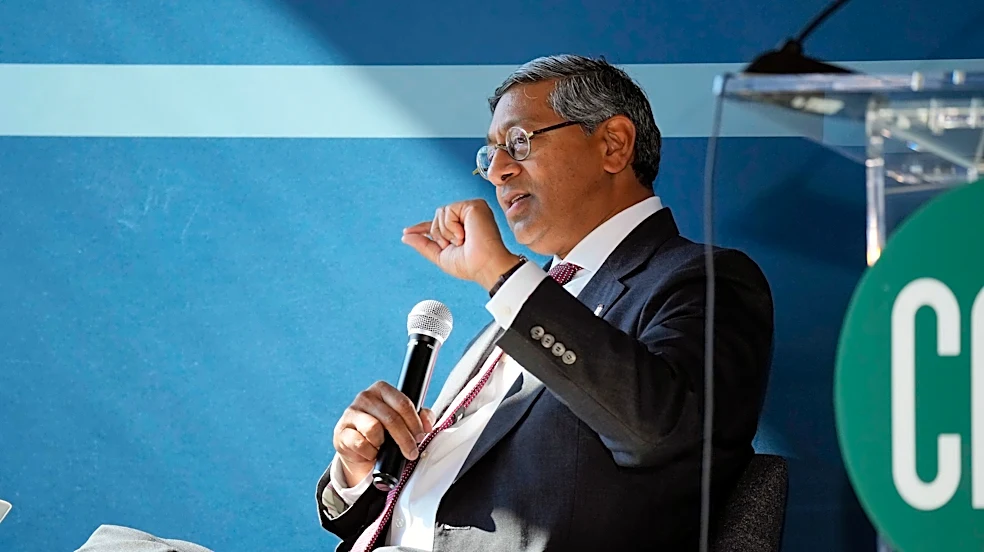
"I felt that the institution was vulnerable," Bellamkonda told the crowd on Oct. 21 at the Columbus Metropolitan Club's live forum, hosted at the National Veterans Memorial and moderated by Dispatch higher education reporter Sheridan Hendrix.
"It was not a hard thing to say yes."

Bellamkonda assumed leadership of the university about seven months ago, at a tumultuous time for both Ohio State and the broader higher education industry. His promotion came just days after his predecessor stepped down over what was later reported by The Dispatch to be an "inappropriate relationship" with military podcaster Krisanthe Vlachos, to whom Carter supplied university resources to help further her personal business.
"It's no secret that we've had some transitions," he said. "We will be defined by how we react to the situation, and I'm proud to say that the community of Ohio State has reacted well to what happened."
Across the hour-long forum, Bellamkonda answered questions about everything from artificial intelligence and campus enrollment to the politicization of higher education and immigration policy. Here's what else Ohio State's 18th president had to say:
AI fluency can be a 'moderating force' to technology's threats
Bellamkonda said his initial approach to artificial intelligence was skepticism. He is a scientist, after all.
But in the past year, Ohio State has emerged as a leader in AI education. In 2025, the university launched its AI Fluency Initiative, a program that encourages faculty and staff to integrate AI education into every undergraduate's core curriculum and aims for every student across all majors, starting with the class of 2029, to be well-versed with AI tools by graduation.
Though the ambitious program was officially launched under his predecessor, Bellamkonda was one of the program's architects during his time as provost.
Bellamkonda acknowledged fears about the technology but said the way to grow as a society is to confront the challenges while "using the technology for all of the good that it can do."
"I believe strongly that the more people engage with AI and know it and play with it, there's a sort of moderating force that happens when more people know what it is than trusting a few people to make those decisions for us," Bellamkonda said. "It's like civics; we have a democracy, and democracy is only as good as how civically engaged we are."
When asked about concerns that future classes of Ohio State undergraduate students may lack foundational knowledge given a potential over-reliance on AI, Bellamkonda said it's up to the university to develop new curriculum that prioritizes critical thinking skills that can't be replaced by an AI bot.
"The flip side is, if we are blind to AI and don't give [students] the skills, what is the future?" he said. "And I would suggest that that's a bleak future, and it would be irresponsible of us, of any university, to do that."
'There is no plan B for higher ed'
Bellamkonda recognized higher education as an industry under duress, but he said he remains bullish.
The higher education landscape has become "unfortunately politicized," but that hasn't lessened its value, he added. Even though public confidence in higher education has dropped, Bellamkonda's message rang optimistic, saying he holds firm in the notion that the U.S. higher education sector is "the envy of the world."
He added that universities offer so much more than formal academics, from a "grounding in ethics" to communications skills and beyond. And those are values that are unlikely to waver, he said.
"What happens at the university is partly the credentialing and the skills and what happens in the courses, but a lot of growth of students happens outside the classroom, and there's no real substitute for that either," Bellamkonda said. "It is making friends, it is having a relationship and breaking up, having to deal with your first C that you're not used to, meeting professors who care about you, playing sports, an athletics program."
"There's a magic in U.S. higher ed that happens both giving skills and education and credentials, but also the growth of the person that is very hard to replicate in other ways."

'You don't have to settle when you come to Ohio State'
In response to a high school audience member's question about what sets Ohio State apart from the state's other universities, Bellamkonda said "the magic" of Ohio State is that you can get a high-quality education, and "have a little fun on the side."
"Some institutions make it like 'where fun goes to die,'" Bellamkonda said. "That's not us. You don't have to settle when you come to Ohio State."
The university president also addressed another audience member's question about federal immigration policy and the impact on international students. Having immigrated to the United States from India at age 21 to pursue higher education himself, Bellamkonda said he strongly believes that Ohio State and the nation should be open to "attracting the brightest minds in the world."
Among Bellamkonda's other notable remarks was an apparent suggestion that Ohio State could seek to lower its enrollment figures in the future.
"Is the size of Ohio State going to grow? We don't anticipate it growing too much," he said. "I think we're about where we need to be; if anything, we're thinking about, you know – and our provost is in the room, he's actively looking at what is the optimal size of Ohio State?"
He also somewhat sidestepped a question from Hendrix about Ohio Stadium. As she pointed out, Northwestern University and Penn State University both recently underwent football stadium makeovers. Though Bellamkonda didn't directly address whether The Shoe is due for a facelift or even a complete rebuild, he confirmed that at least for now, the stadium's here to say.
"Some campuses have chapels, and you have a certain feeling walking into a chapel," he said. "The closest thing we have is The Shoe."
Reporter Emma Wozniak can be reached at ewozniak@dispatch.com or @emma_wozniak_ on X.
This article originally appeared on The Columbus Dispatch: OSU President Bellamkonda took over a 'vulnerable' institution. Where are we now?