






The Ohio agency responsible for approving major energy construction projects has given the final OK for what would be Ohio's largest utility-scale solar farm.
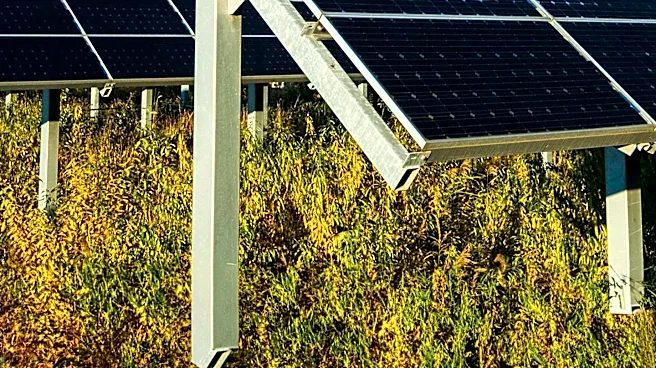
To be built in Madison County on land partially owned by Microsoft founder Bill Gates, the Oak Run Solar Project would be an 800-megawatt solar array with up to 300 megawatts of battery storage, substations and transmission lines in portions of Monroe, Somerford, and Deercreek townships in the center of Madison county's farming community.
The Ohio Power Siting Board on Sept. 17 approvedthe final plans. Once constructed, it would be Ohio's largest solar project to date. But it may face additional hurdles, including further appeals. Already it has faced a lengthy history of regulatory delays
and legal challenges.
And some are wondering if it could be Ohio's last large renewable energy project altogether.

"We're seeing less and less interest by this process at the siting board," said Nolan Rutschilling, managing director of energy policy for the Ohio Environmental Council. "We've seen inconsistencies around what constitutes the public interest, convenience and necessity.
"We're seeing (solar) developers start the (application) process and get very close and then say it's not worth my time and money to go through all this and be three-feet from the finish line and have the board change their minds," said Rutschilling.
A reportin Frontiers in Sustainable Energy Policy examined how regulators in 19 states handle wind and solar applications and found that Ohio had the most projects either rejected by state regulators (7) or withdrawn by developers (5) over the past eight years. The trend has caused Ohio to be known by some as “where wind and solar projects go to die.”
While Ohio has followed the federal government in embracing natural gas for many new energy projects, especially to power data centers, some say a better, longer-term solution is to have a variety of sources including wind, solar, gas, and nuclear. They hail Oak Run as an example.
"I'm glad they resolved it because that's a lot of affordably priced power that we need," said Tom Bullock, executive director of Citizens Utility Board of Ohio, a Cleveland-based consumer watchdog organization that advocates for residential and small business utility customers. "It's a positive sign that this energy project seems to have resolved on its merits rather than on politics."
Bullock's non-profit group monitors energy issues across the state and believes that partisan politics creates poor energy policy.
"We've created a long-term snafu, because of the political tactics of sticking to one fuel source over another source that you prefer. That kind of brutally self-interested gamesmanship makes for terrible economic development," Bullock said.
Madison County already is producing more than a gigawatt of solar electricity, enough to power every home in Columbus. Oak Run would almost double that at a time when it's needed to keep energy prices low.
"Doubling down on natural gas would bring a lot of health risks and natural gas supply is not a fixed cost. It's dependent on global supply issues and global market," said Rutschilling.
Many of the objections to Oak Run, including an appeal in 2024 to the Ohio Supreme Court, involved the project's visual impact, including to connected power stations and other equipment in the area.
However, in it's ruling,the siting board found that "the facility (including its substations) would have a minimal,overall aesthetic impact. Therefore, the Board affirms its issuance of a certificate of environmental compatibility."
"We are pleased with the Ohio Power Siting Board’s decision to reaffirm its approval of Oak Run, following additional review, providing further confirmation that the project can move forward responsibly and in the public interest," Samantha Sawmiller, the project's senior development manager, said in an email to The Dispatch.
Matt Schilling, siting board spokesman, said the certificate (back-dated to 2024) is valid for five years "as long as the company is in an active state of construction." That means that operators Savion Renewable Energy must complete construction by 2029.
Bullock, with the Citizens Utility board, said more and varied projects will be needed "for our grid to modernize and to meet the moment for exploding data centers and other things. We're going to not have to remain in 'business as usual.' Our grid needs to resemble iPhones more than 1950s steel plants."
Growth and development reporter Dean Narciso can be reached at dnarciso@dispatch.com.
This article originally appeared on The Columbus Dispatch: Ohio's largest proposed solar farm gets OK. But will it be the last?