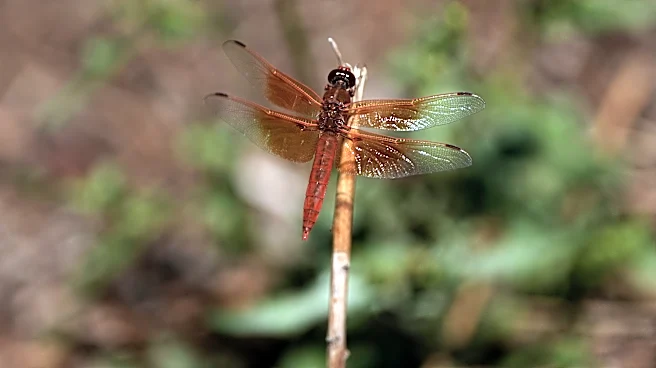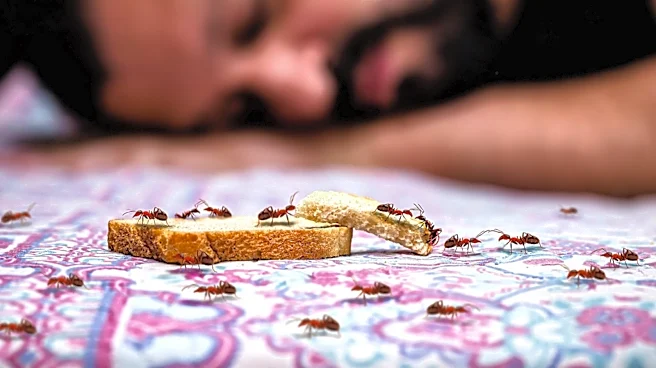









Notice an increase lately in sweat bees and bugs of all kinds flying and crawling outside or – even more annoyingly – inside your home?
You're not crazy. Some insects have been more active the past couple of weeks. Heavy rainfall from storms and flooding in recent weeks drove some bugs from underground or allowed others to reproduce more quickly, explaining the multiplication of crawlers and fliers across central Ohio, according to a bug expert interviewed by The Dispatch.
Water disrupts underground habitats
Many insects live in the soil, and their homes are flooded anytime heavy rain occurs, said Ellen Klinger, Ph.D., associate professor of professional practice of entomology at Ohio State University. The insects come to the surface of the soil or fly out of their holes to avoid
drowning.
"Immediately after a lot of rain falls, you're going to get things like bees that nest in the ground or yellow jackets that nest in the ground, termites, ants – all the things that have underground nests – are gonna come to the surface as sort of an immediate survival need," said Klinger, a 2026 recipient of Ohio State’s Alumni Award for Distinguished Teaching.

Ants use chemicals to mark their trails as they walk along, Klinger said. When those trails get washed away, they expand their roaming to establish new paths. This activity can lead ants to find new food they didn't see on their previous scent trail.
People may see more ants walking around their homes as they reestablish scent trails or are flooded out of their habitat, Klinger said. Ants are never truly lost, she said; they just establish new pathways.
This time of year, ants are already booming in population, Klinger said. For example, spotting a flying ant means ants are making new colonies.
Sweat bees also are easy to find post-rainfall, Klinger said. These bees are pollinators and attracted to salt and minerals found in human perspiration. They don't live in hives but live in a more solitary manner. Each female has her own underground tunnel.

"If you imagine lots of little tunnels, lots of little homes for all these female sweat bees, they're getting flooded out," Klinger said. "They're coming out. So, in the course of all the sweat bees, maybe in a backyard or in a park, you're going to notice them more because they're all coming out of their flooded underground homes."
How has rainfall impacted ticks and mosquitoes?
Ticks do not live in habitats that are getting flooded, Klinger said. These infamous parasites continually search for a host, sticking to tall grass.
However, another notorious pest – the mosquito – has gotten a boost from the heavy rain.
Mosquitoes are classified as flies, Klinger said. Flies are talented at taking temporary water sources and using them to make an entire next generation "very, very quickly."
 City of El Paso Department of Public Health officials are urging residents to take proactive steps to prevent mosquito bites and eliminate mosquito breeding ground" id="91421588007">
"When you have a lot of rain, and you get little bits of puddling in your yard, or because the ground's so saturated, the mosquitoes can use that to breed," Klinger said. "So, it's just increasing their breeding ability that much more."
Franklin County Public Health's Mosquito Management Program has been busy throughout the county setting up more traps and spraying for mosquitoes in the wake of the heavy rains as they monitor for West Nile Virus. To see a map of the county's scheduled spray areas, go to: https://mosquito.myfcph.org/spray-schedule-maps/.
When to expect bug populations to decrease after a storm
Ground-nesting insects that are immediately impacted by rain, like sweat bees, should find new habitats within a week or so once the ground dries out some. However, continual rain can keep disrupting that process.
For bugs like mosquitoes, the damage is already done. Their population boomed in the standing water. But when the weather turns chilly, the cold-blooded mosquitoes will go into a resting state, Klinger said.
Meanwhile, ants evicted by the heavy rains have colonized new places they likely wouldn't have if their scent trails weren't disrupted.
"The ants, if they find a new food source or they find a new route, now the homeowner, whoever, is going to have to deal with them," Klinger said. "And they're just going to keep coming back unless you deal with them using methods that can reduce ants."
Dispatch Reporter Nora Igelnik can be reached at nigelnik@dispatch.com.
This article originally appeared on The Columbus Dispatch: Why heavy rain may have introduced more bugs into your home