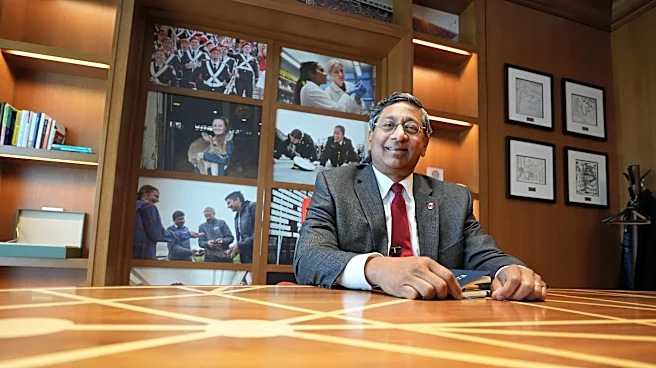








September is just around the corner, but for Ohio State University President Ravi Bellamkonda, the first day of fall semester feels more like a springtime revival.
"I love this time of year, where the university renews itself," Bellamkonda told The Dispatch in a recent sit-down interview. "It's like fresh leaves coming out. We have all of these young students here, and everybody's mood is better."
Much like the thousands of new freshmen traversing campus, Bellamkonda in many ways will be experiencing Ohio State for the first time.
Bellamkonda joined Ohio State's leadership team in 2024 as the university's executive vice president and provost. But he was appointed as Ohio State's 18th president on March 12, just four days after his predecessor and former
boss, Ted Carter, resigned under inauspicious circumstances. Carter abruptly resigned two years into his tenure after an unnamed source revealed to the board of trustees that he was having an affair with a woman seeking public funds for her private business.
Though he's worked in higher education for more than 30 years, this semester will mark the beginning of Bellamkonda's first full school year as president. There's a cadence to an academic calendar that can't be replaced, he said, and he's excited to connect with students, faculty and staff in this new role.
Bellamkonda also recognizes the responsibility he's shouldering to bring a sense of stability to an unsettled university.
"My sense is that we would have not liked things to have happened the way they did. But sometimes things happen, and the sign of a strong, mature institution is we take that in our stride, keep the mission in view and do what we're really about – which is supporting our discovery mission and research, supporting our students, undergraduate and graduate and professional, and supporting our faculty and staff to make this a vibrant place," he said.
Between Carter's abrupt exit and the aftermath, mounting pressure from some to remove billionaire Les Wexner's name from campus buildings, and the university navigating settlements with the sexual assault survivors of former university doctor Richard Strauss, Bellamkonda inherited all of it when he became president.
It's difficult, Bellamkonda said, to speak fully about the future he sees for Ohio State "when we still have some issues to settle."
"I am trying to find my voice to balance the gravity of these things and giving them due attention," he said.
Bellamkonda also said, however, that the university is not defined only by its past.
As Carter's self-described "most important hire," Bellamkonda was intimately involved in developing Ohio State's current strategic plan, Education for Citizenship 2035. He previously said he intends to primarily focus on the framework that Ohio State already has in place.
But that doesn't mean that he doesn't have bold ideas of his own.
Namely, Bellamkonda wants to give people a reason to see Ohio State in a new light.
"I want people to think of Ohio State differently," he said. "We have many wonderful things, but I want them to think of us as entrepreneurial, dynamic, bold, innovative."

Bellamkonda wants to promote student startup companies
One of Bellamkonda's ideas to demonstrate Ohio State's entrepreneurial spirit is BuildX, a soon-to-be-launched program with the aim of producing 100 investable student startups annually by 2030.
BuildX is similar to a program Bellamkonda started at Emory University. The timing is ideal, he said, as Ohio was recently named the top U.S. state for business by CNBC.
While it's great to have businesses come to Ohio, Bellamkonda said he wants to promote student-built startups, too.
This academic year, the university will identify 20 startups for the inaugural BuildX program. Students will then participate in a summer accelerator program beginning in 2027. BuildX is not a club or a class project, Bellamkonda said. Rather, it's an academic entrepreneurship program, complete with three new courses specifically designed to support it.
Students will also be eligible to earn credentials through BuildX, and Ohio State also established a $1 million donor fund to back the student startups. Student startups will be housed in a central campus location.
"The world is changing so fast that we're asking ourselves, 'What skills do we want an Ohio State student to have?'" Bellamkonda said. "Analytical skills, communication skills, the ability to work in a team – but one of the skill sets is the ability to imagine a world, a process, a product that doesn't exist yet and having some experience of creating that. I think of that as an entrepreneurial mindset, but entrepreneurial mindset is not just making businesses. It's just a way of thinking."
The university is also planning to build a new 100,000-square-foot, eight-story building to house future faculty and community-led startups in the west campus Innovation District. Bellamkonda said the new space will be a physical representation of Ohio State's commitment to entrepreneurship.

AI Fluency continues to grow
One of the continuing programs that Bellamkonda is investing in is AI Fluency.
Officially launched last academic year, Ohio State faculty and staff are encouraged to integrate AI education into every undergraduate's core curriculum, the university announced in June 2025. The goal is that every student, starting with the Class of 2029 and regardless of major, will be comfortable and competent with AI tools by graduation.
Bellamkonda said at the program's launch event last year that AI Fluency will both boost students' AI literacy and push them to be "bilingual" in both their major field of study and in how AI applies to that area. He said he believes no other U.S. university has taken on an AI initiative at the scale of Ohio State.
As AI Fluency enters its second school year, Bellamkonda said he and others have been hard at work over the summer ironing out kinks and crafting its future.
Ohio State is introducing 50 new courses this year as part of AI Fluency. Sixty new faculty fellows trained in responsible AI use through the Michael V. Drake Institute for Teaching and Learning will be embedded across campus to be "local guides for faculty," he said.
Faculty will also have access to a new tool called Simple Syllabus that allows instructors to quickly create class syllabi. The platform was introduced to reduce faculty workload and streamline syllabus preparation, increase accessibility and comply with Ohio Senate Bill 1 requirements for syllabus access. But another feature of the platform allows faculty to rank on a scale from one to five how AI-friendly their course is.
Bellamkonda said more transparency and better expectations about AI use are top of mind.
"Can I use AI? Can I not use AI? Can I use AI only in some things? Can I use it for research but not actually for my assignments?" he said. "There's a range of things that we want to declare to our students and make transparent because I don't want the students to get into honor court problems because we say, 'Yeah, AI Fluency,' and then say, 'Hey, you used AI,' and punished them."
It's a massive undertaking, Bellamkonda said, but one he thinks is worth the effort.
"I'd rather we grapple with issues of ethics, critical thinking, if we are outsourcing critical thinking or not in our classrooms, than our students try to figure it out on the side," he said. "We take things head on. And when I say hard things worth doing, this is one of those things."

'You are welcome here'
Ohio State welcomed students from 47 U.S. states and 37 countries to its Columbus campus this year. International enrollment at universities in Ohio and nationwide, however, has been on the rocks since President Donald Trump took office for his second term.
Ohio State reported a nearly 37% drop in first-year international students last year in its annual enrollment census report. The decline followed an academic year of student visa revocations; the mandated end of diversity, equity and inclusion programming; a 19-country travel ban issued by the Trump administration, and a weeks-long pause in new student visa interviews.
Recently, the Trump administration finalized a new rule limiting foreign students to four-year stays.
Ohio State's typical enrollment is made up of about 10% international students. There may be a small dip this year to maybe 7% or 8%, Bellamkonda said, but that is speculation until the fall enrollment census is complete.
Bellamkonda said the issues of international students are personal to him. He moved to the United States from India to pursue a master's program at the Massachusetts Institute of Technology in the mid-1990s, traveling 8,000 miles away from home for a higher education.
There are always bureaucratic hurdles for international students, Bellamkonda said, but there is "just incredible value to having international students here.
"My message to students here is that we will support your journey here. You belong here," Bellamkonda said. "We will do everything we can. We'll follow the law, obviously, and we respect the law. At the same time, we will be unafraid to articulate the principle that we should as a country be open to legally having the brightest minds come here and contribute to us."
Lightning round with Ohio State President Ravi Bellamkonda
Summer reading?
"84, Charing Cross Road" by Helene Hanff
Top artist on Spotify?
Bellamkonda's favorite band is The Beatles, but he also enjoys listening to Talking Heads and classical Indian music.
Best cup of coffee around campus?
Bellamkonda said he hasn't had much time to explore campus coffee shops yet. He did buy a Nespresso machine for the office when he started as provost that gets a lot of use, he said.
Favorite campus event?
Ohio State football games are hard to beat, Bellamkonda said. He particularly loves when the cheer team runs the flags out onto the field after Script Ohio.
"There's a certain energy in the stadium that I love," he said.
If you're visiting our campus, you can't miss...
The Oval, Mirror Lake and Thompson Library.
"There's some magic there," Bellamkonda said. "When I walk there, I can't help but think that a hundred years ago somebody walked on this place. I feel like when I'm there, I'm somehow connected not just to the present, but to the past and to some degree to the future."
Higher education reporter Sheridan Hendrix can be reached at shendrix@dispatch.com and on Signal at @sheridan.120. You can follow her on Instagram at @sheridanwrites.
This article originally appeared on The Columbus Dispatch: Ohio State President Ravi Bellamkonda's aims to wrap up past problems, push bold plan