

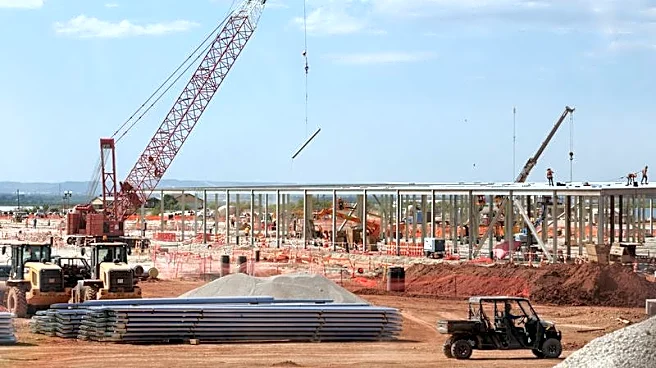
Largely unspoken at the Sept. 3 Energy Affordability Summit in the Arena District was the subject of data centers − even though a panel of national and local officials spent much of the four-hour session discussing the need to speed up and simplify the permitting process for major infrastructure projects.
Data centers are the backbone of the artificial intelligence boom, driving warnings of energy shortages and public backlash.
Data centers require up to 4% of the total U.S. energy usage, and demand is surging. At the same time, as many as three-of-four Americans oppose new data centers in their communities, according to national polls. And many lawmakers are scrambling to justify their importance.

The distaste for the energy behemoths seems to
be rising. A Gallup poll in May found 70% of Americans oppose building data centers, including 48% who do so strongly, USA Today reported. And divisions have crossed party lines.
Ohio, home to about 240 data centers, already is among the fastest-growing data center markets in the country.
The summit's speakers said easing permitting of air, water, industrial waste, stormwater, and other restrictions would free up major new construction projects in Ohio and elsewhere. Local approvals would still be needed for zoning, land usage, noise, traffic, and grading permits.
Sen. Bernie Moreno, R-Ohio, told an audience at The Stack, a reconditioned former power plant next to Miracle-Gro Field, that he's expecting federal permitting reform legislation to pass by year's end, regardless of the November election results.
Speaking to moderator CNN contributor Scott Jennings, Moreno said he's found ways to work across party lines. "I think that's what voters want us to do, because to keep being completely partisan you're not going to get anything done."
"We are all Americans. And we do want to make our country stronger and more secure. And that starts right here with energy security right here at home," Moreno said.
Moreno on the elephant in the room
Moreno watches the polls. And he's pledged to seek just one more term in office, allowing him to "do the right thing," without political consequence, he said. That includes his view of data centers.
"There's anger out there. You have to understand 'Where's that consternation coming from?'" he said.
When it comes to data centers, Moreno said he thinks the critics are right.
"There's been a narrative of data centers coming to our community. Take our water and pollute our environment. They're going to raise our electricity prices. They're going to eventually put us out of work. And our taxpayer dollars are going to support their construction."
He calls the rhetoric "the worst sales pitches in the history of sales pitches. Who would be for that?"
After he spoke, Moreno told The Dispatch that polls don't tell the whole story.
"I think that 70% of the country is against giving taxpayer money to trillion-dollar companies, having them come in and raise electricity prices, suck up our natural resources and then ultimately produce a product that un-employs us all," he said.
Moreno strongly opposes tax breaks for data center construction, criticizing their business model at a June Senate hearing. He instead wants federal legislation that would tax at 100% any tax savings given locally for data center operations, essentially wiping out incentives.
"If you want to win this battle in China, you have to win over the American people," he said he's told tech CEOs. "That's the way our system of government works." Moreno wants "open source U.S.-derived models" for AI that can be believed, trusted and counter foreign models that may foster misinformation.
Moreno said it is wrong to tell the public that they are wrong, dumb or don't understand the threat posed by data centers.
"No, they understand it, because it's been framed to them in a terrible way."
In a Truth Social post Aug. 31, Trump said that communities that don't embrace data centers will become "backward and poor."
Cruz attacks dems
Sen. Ted Cruz, R-Texas, speaking on "the art of the deal," appeared to be stumping for Sen. Jon Husted, a Republican colleague who is running to retain his seat against Democratic challenger Sherrod Brown.
"I tell green-haired lefty kids, if this is really about saving the world, you ought to be the greatest fan of natural gas and fracking the world has ever seen," Cruz said. "But of course they're not. These are the same idiots that were fire-bombing Teslas, because suddenly they were mad that Elon Musk was willing to work with President Trump."
"It's real simple. If you get out of the way, you allow innovation, and innovation, in turn, is what drives energy."
Cruz was reminded of the proposed Pike County power plant, said to be the nation's largest, if it is built.
"And if Sherrod Brown had his way, he would shut it all down. and if you asked him how do you turn on the lights tomorrow ... that's not his problem," Cruz said.
In an email to The Dispatch, Brown's campaign said: “Jon Husted doesn’t want to talk about the real reason Ohioans are paying thousands of dollars more in utility bills: He led the charge to bring data centers to Ohio."
U.S. Energy Secretary Chris Wright also extolled the virtues of natural gas, new pipelines and battery storage while also lamenting decades of manufacturing decline.
"Manufacturing is the infrastructure of the built world," he said, "the root industry" that has been hampered by "weaponized regulation."
"Americans build big things," Wright said at the summit. "But how many new big things do you see, precious little."
He faulted the 1970 National Environmental Policy Act, whose provisions he said "can be exploited to stop building things. That's just not America." Wright also expects bipartisan permitting reform, though he doesn't expect it before year-end because "people don't want to give President Trump a win."
He said that power plants and industry are "massively cleaner than they were before." And if not built in the U.S. they're going to be built somewhere else that has "meaningfully lower" environmental standards.
Wright envisions small modular nuclear reactors becoming a very large source "for civilizations," but requiring "100 to 500 years" to reach their full potential.
"We have a moment now... go big and go bold. enable people with big dreams to do it," he said.
Growth and development reporter Dean Narciso can be reached at dnarciso@dispatch.com.
This article originally appeared on The Columbus Dispatch: Sen. Bernie Moreno talks tough on data centers at energy summit in Columbus