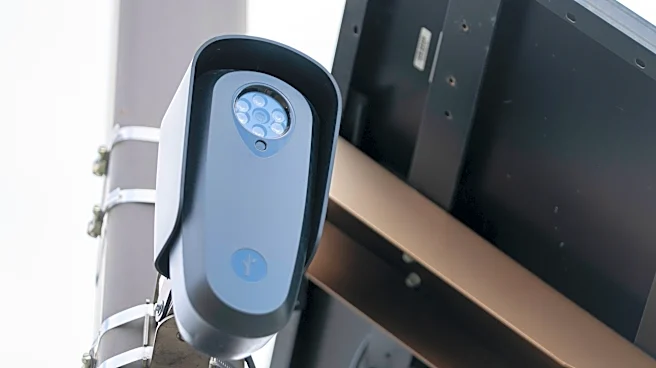







An untold number of Flock license plate readers surveil Columbus streets around Ohio State University even after the city covered its 66 cameras while it investigates an officer accused of misuse.
After The Dispatch documented active Flock license plate reader cameras in the University District and Old North, Mayor Andrew Ginther's administration said Sept. 23 that the city paused permitting Flock installation in the city's right-of-way by Ohio State University and other entities.
This will not remove the dozens of cameras that are already installed. But it won't allow new ones.
"The city’s right-of-way permitting for Flock camera use has been paused," said Randy Borntrager, Ginther's spokesperson. "Existing cameras in the University District,
the Columbus neighborhood with the densest population, are part of the Ohio State University’s safety operations. The city will work with the university going forward on their policies regarding usage."
The Dispatch identified over two dozen uncovered Flock cameras in the University District and Old North, including on Indianola Avenue and on Hudson, North Fourth, Summit and High streets. Flock Safety and OSU have declined to confirm who is responsible for the cameras, but the city confirmed they are OSU's. Ohio State University Police has 77 Flock cameras on and off campus, more than any other public institution in Franklin County.
After The Dispatch reached out for comment, Columbus City Council President Pro Tempore Rob Dorans, who represents the University District, said on Sept. 22 he was unaware of the extent of the cameras and called for a pause on granting permits to install Flock cameras in public areas.
“I urge the City's Administration to first pause this practice to protect residents by ensuring these cameras are not being misused and then to work toward establishing real guardrails for private entities seeking such permits in the future. We, as a city, cannot stay on autopilot while these technologies evolve faster than our policies," Dorans said before Ginther's administration announced the pause.
Dorans said he’s become increasingly skeptical of automated license plate reader technology as national reporting continues to emerge about misuse, cost effectiveness and true public safety impact of the cameras.

Columbus police, Reynoldsburg police and the Franklin County Sheriff’s Office already have identified cases of possible Flock camera misuse by law enforcement officers. OSU has not yet audited its data on its police officers’ searches but “is working toward it later this fall,” said Dan Hedman, an Ohio State spokesman.
At a recent press conference, OSU President Ravi Bellamkonda told local media that good governance is important, but the university is not considering getting rid of Flock cameras.
“We are not immune to what's going on in the world, but we see that as an essential part of the panoply of tools we have for public safety,” Bellamkonda said.
OSU first started installing cameras on and off campus in 2021 amid a broader push for increased public safety and surveillance. By 2022, the university said in a promotional video that there were over 4,000 surveillance cameras in its system, including Flock cameras.
“Some cameras were installed outside of the University District because it is helpful for police to be alerted to vehicles of concern – like stolen vehicles – when they are heading toward the University District so police officers have time to get to the area to take action if appropriate. LPR’s are also used to follow-up on crimes after they have occurred,” Hedman said in an email.
The city’s repository of right-of-way permits included records of two camera installations directly linked to OSU. A search of the city's database didn't return records for most of the cameras The Dispatch identified in recent weeks.
Columbus Police said one of the uncovered cameras observed by The Dispatch at North High Street and 13th Avenue was the city's responsibility, but it was mistakenly missed when crews were covering the cameras in early September.

Other cameras also remain in the city
In addition to OSU’s network of cameras and any others that may be around the University District, there are also dozens of cameras at businesses, hotels, apartment complexes, neighborhoods and community organizations around Columbus. Some are in parking lots but some are on public streets.
The data from the private Flock cameras is not shared as widely as OSU’s.
Privately contracted Flock cameras can opt into sharing with local law enforcement on a one-to-one basis. However, OSU shares data with the statewide Flock network and could have other direct sharing agreements with other law enforcement agencies around the country. OSU can access data on networks it is sharing data with, and those agencies can access OSU's camera data.
The Dispatch filed a public records request with OSU on Aug. 10, asking for audit logs and the list of sharing agreements, among other records. As of Sept. 23, OSU had not provided any responsive records.
Several other law enforcement agencies in central Ohio have also published Flock data transparency portals, which sometimes list data sharing policies.
Although Flock Safety has urged law enforcement agencies to publish portals, Hedman said OSU has not and does not have plans to publish such a portal.

Anna Lynn Winfrey and Jordan Laird are reporters for the Columbus Dispatch. They can be reached at awinfrey@dispatch.com and jlaird@dispatch.com.
Dispatch Higher Education Reporter Sheridan Hendrix contributed reporting.
This article originally appeared on The Columbus Dispatch: Ohio State has dozens of Flock cameras, including off-campus locations