





Julia Molchanova has always loved to paint.
After escaping years of manipulation and abuse from disgraced financier Jeffrey Epstein, painting about her experience was the first way she processed what happened to her.
“The art spoke for me way before I was able to find my own voice and talk about it now,” said Molchanova, who first met Epstein at age 22.
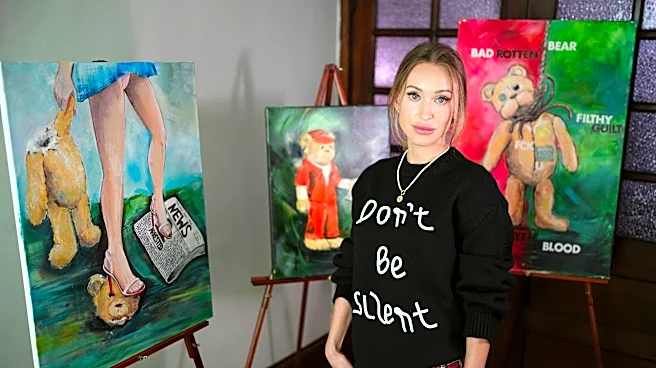
Her paintings are on display to the public for the first time in Columbus at the traveling exhibition of the Trump-Epstein Reading Room, which is open to the public at The Sanctuary on Neil, 618 Neil Ave., through Oct. 11.

Molchanova, now 37, drove her art from Washington, D.C., where she lives part of the year, to Columbus. She was wearing a red plaid skirt that she sewed herself at the age of 21
before she left Russia, and a black sweater she bought online with white lettering that says “Don’t Be Silent.”
Wearing that skirt now brings her sadness because it brings her back to how she felt excited about her future when she made it.
“Instead, I went through a lot of darkness and challenges,” Molchanova said.
Painting after leaving Epstein’s world felt different: While in art school growing up in Russia, she made art for assignments, but she said these paintings felt like they came from her soul.
Molchanova said she became entangled in Epstein’s orbit after meeting him while on a trip to New York in December 2011. After Epstein served a 13-month sentence from a 2008 conviction for soliciting prostitution and soliciting minors, Molchanova said he moved on to mostly abusing younger-appearing Eastern European women who were over 18 but vulnerable.

When Molchanova met Epstein, she only spoke a few words in English.
“That man was supposed to be in jail. Instead of jail, he was walking on the street,” Molchanova said.
He promised her training at the Fashion Institute of Technology in New York, but that never materialized.
Epstein also manipulated people in all kinds of powerful positions around the world, Molchanova said, so someone in her early 20s who didn’t speak English well was an “easy target” for him.
Molchanova started referring to Epstein as a “mishka” – which means “bear” in Russian – in 2015 after hearing a song in Russian about a criminal bear who’s found guilty.
She finished her first painting featuring a teddy bear in June 2019, which includes a newspaper page of a woman stepping on a beheaded bear and a newspaper with “arrested” on the front page. She finished the painting about a week before Epstein was arrested on federal sex trafficking charges on July 6, 2019.

The woman in the painting, who is only shown from the hips down, is wearing white heels, which Molchanova said Epstein disliked.
“On an emotional level, I was seeking justice. I just didn’t know how to express it,” Molchanova said.
Another painting on display Molchanova made in July 2019 shows a bear as a prison inmate holding a tray of food that represents what would be his last meal, but Molchanova depicted food that she thought he wouldn’t like: An apple, vegetables and a main dish that could involve seafood.
A third on display, from 2021, shows a hanging teddy bear with worms coming out of its neck.
“The more time passes by, you learn more and it’s always traumatizing and disgusting – for me, he’s like a can of worms,” Molchanova said.
Molchanova left Epstein’s orbit in 2019, but she went through three years of depression with suicidal thoughts.
“I didn’t see that my life could turn and change for good – it was constant darkness,” Molchanova said.
Her dog Monty, a Shih Tzu-poodle mix she adopted in 2016 and brought with her to Columbus, also helped her get through her most difficult time, she said.
Molchanova’s name appears in unredacted versions of the Epstein files that were first published earlier this year. However, her dog’s name as mentioned in some emails has been redacted from the files.
She went public with her full story for the first time in a Wall Street Journal profile that published in early September. That article also mentioned that Molchanova was the lead Jane Doe plaintiff in a class-action lawsuit against Bank of America settled for $72.5 million earlier this year about its links to Epstein’s sex trafficking operation. The bank did not make any admission of liability or wrongdoing.

She said that she’s gone through with the darkest part of her recovery, but knows that other people are still in a difficult mental space.
“It’s a relief that it’s out there because it’s a heavy burden – it’s very heavy mentally to keep it – your life is affected every single day because of this,” Molchanova said.
Women still experience harassment on a daily basis, Molchanova said. She said more people should learn about how to spot signs of grooming and abuse so others don’t go through the same experience she did.
“It’s a crazy case when the whole world is still talking about him, but in general, I think women and girls need to be educated to spot this immediately. For a long time, I blamed myself,” Molchanova said.
She hopes her art will continue to raise awareness about grooming and sexual abuse.
“I feel like I need to create something good," Mochanova said, "because so much of my precious time has been stolen.”
Anna Lynn Winfrey is a reporter for the Columbus Dispatch. She can be reached at awinfrey@dispatch.com.
This article originally appeared on The Columbus Dispatch: Her art on public display for first time in Columbus, Epstein survivor finds voice