







At a time when a majority of Ohio voters support a temporary ban on new data center construction, one Columbus City Council member is trying to instead regulatethem as much as he can and is running into frustrated residents who want more done.
"We, the city of Columbus, are not facing data centers being built in the city limits, so passing a moratorium would be performative where we're trying to be constructive," Columbus City Councilmember Christopher Wyche said ahead of a council hearing on Sept. 16. "We have the ability to create a regulatory framework that other municipalities in the state of Ohio can copy."
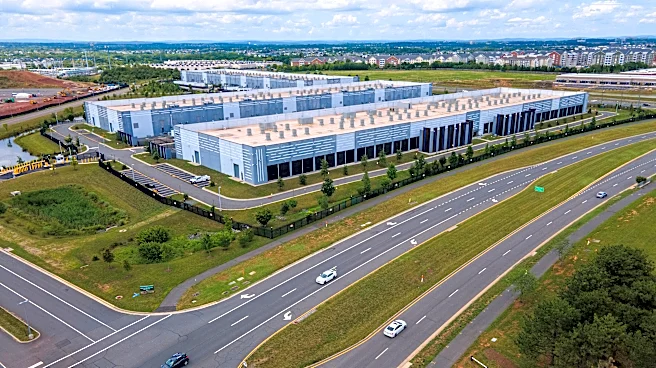
Most of the region's largest data centers are built outside the city's limits but many get water from Columbus Water & Power.
Still, most
of the approximately 20 speakers at the council's data center regulations hearing asked Wyche for a moratorium on data center construction within the city. The hearing drew testimony mostly from two groups: residents who loathe everything about data centers - the noise, the artificial intelligence, the power and water usage, possible environmental impacts from gas power plants - and a couple of representatives with the construction trades that benefit from the building boom.
Columbus City Council traditionally doesn't hold many hearings on legislation, but Wyche has held three on this topic.
Wyche, a three-year council member who has focused his advocacy around the environment, expressed sympathy to all the speakers but emphasized that he and the city have limited local power to address some of these issues. The hearing turned into a venue for residents to vent frustrations, demonstrating how impassioned Ohioans are on this issue.
At times, the hearing devolved into Wyche going back and forth with speakers. Some of the speakers pointed to data centers being built outside city limits in New Albany and elsewhere, where Columbus City Council has no jurisdiction.
Many speakers and Wyche discussed the threat artificial intelligence poses to humanity in the wake of recent comments from officials with some AI companies, including an Anthropic researcher named Jacob Coxon, who recently resigned and posted on X: "The people building AI earnestly believe that it could kill us all by the end of the decade."
But decision-makers at the state and federal level with more authority on the issue weren't in the hearing room. And at the council hearing, only Councilmember Wyche sat through the whole hearing.
Council President Shannon Hardin, who is cosponsoring legislation with Wyche that would charge data centers for peak water usage, attended the hearing, but left before it was through.
At one point, Wyche explained why he was frustrated he couldn't do more on the issue of clean energy.
"We are a blue dot in a red state that has decided that renewable green energy is an ideology they cannot consider even though it would be faster, cheaper and better for our environment to go down that path," Wyche said to one resident during the hearing.
He was speaking to Pat Merida, one of more than a dozen residents who spoke at the hearing and shared a long list of reasons why they dislike data centers.
"There's very little public good," Merida said. "They're not producing products for human needs, they're rushing to compete for dominance or a share of the pie from the lucrative profits of taxpayer-funded public surveillance, biometrics, and war-making, and shower us with targeted advertising."
She said this is all a terrible way for humanity to be headed. Most in the audience applauded.
Three speakers from the building trades testified about data centers providing jobs. Dorsey Hager, executive secretary-treasurer of the Columbus/Central Ohio Building and Construction Trades Council, said the three Google campuses in Columbus, Lancaster and New Albany provided the building trades 6.5 million work hours last year, the equivalent of almost 4,000 jobs.
"That's 4,000 members of our community making good union wages, making good benefits for themselves and their family," Hager said.
Later in the hearing, data center opponents said construction jobs are not reason enough to support data centers when balancing all of the other factors.
Nobody representing the data centers testified at the hearing.
Few speakers addressed regulations Columbus has the power to pass locally.
Other legislative proposals related to data centers that Wyche is exploring would promote water conservation at data centers, require data centers in the city to have a decommissioning plan, and establish some regulations around behind-the-meter power generation.
Wyche's argument that a moratorium would be performative rang hollow for many attendees.
"I do not believe a moratorium would be performative for the capital of the state," said Darcie Odom, the Franklin County lead organizer for Conserve Ohio, the campaign to amend Ohio's constitution to ban large-scale data centers.
Government and politics reporter Jordan Laird can be reached at jlaird@dispatch.com. Follow her on X, Instagram and Bluesky at @LairdWrites.
This article originally appeared on The Columbus Dispatch: Data center opponents press Columbus for moratorium at public hearing