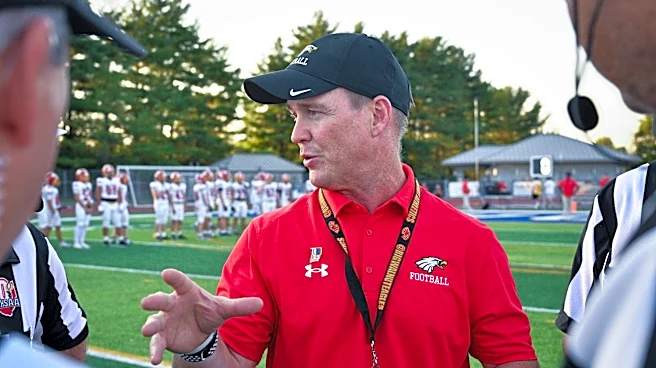


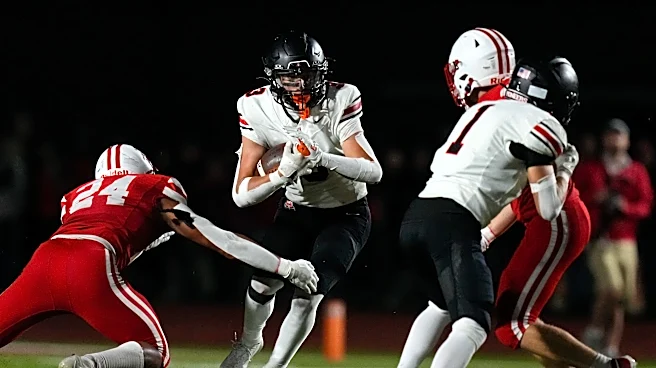
Forty-eight hours or so after the Friday night lights go out, Curtis Crager finally packs up and heads home after a long Sunday of preparation.
In some respects, devoting virtually his entire weekend to film study of his team’s next opponent takes Big Walnut’s fourth-year football coach back to the essence of the job.
Crager admitted it also makes him feel like a graduate assistant, but that is partly because he is not only the Golden Eagles’ head coach, he is their defensive coordinator. He has led the Golden Eagles to 28 wins, including a dominant 3-0 start this fall, and consecutive Division II state semifinals since the start of the 2024 season.
“I always joke with people that you have to be like a grad assistant like at the college level because
you break down all the film and take all the time to do the scripts and the scouting reports, but that’s how you learn too,” Crager said. “That’s how you learn an opposing offense and how to defend them. It’s an abundance of time that you spend, but you have to [in order] to do it right.”
If it sounds like Crager wouldn’t have it any other way, that would be correct. He has loved the defensive side of the ball since he was a strong safety in the early 1990s at West Jefferson. He also played linebacker collegiately at Findlay and Capital and served as a defensive coordinator at Dublin Coffman and DeSales over a 20-year span.
Given all of that, running an entire program was not enough to make Crager relinquish another familiar title.
“It’s embedded in me, kind of like second nature,” Crager said. “It’s too important to me.”

While some high school head coaches double as either offensive or defensive coordinator, staffs at larger schools often have dedicated coordinators for both sides of the ball as well as special teams. They come from all stripes, with some working their way up from coaching specific positions with the goal of being a head coach.
Still others already having served in that role and embrace concentrating on their preferred unit without the administrative duties of overseeing a program.
“Ultimately, it was the spot I wanted,” said Kyle Stout, a former head coach at Westerville South now in his fifth season as Gahanna Lincoln’s offensive coordinator. “I get to help the head coach [Bruce Ward], help run the program, but I don’t have to be responsible for admin meetings, fundraising and the other things.”

‘To coordinate is to communicate and lead’
Offensive and defensive coordinators across central Ohio – some of whom are also head coaches – agreed the job goes far beyond devising and calling plays.
Stout, who after two seasons at South (2015-16) had stints as a co-offensive coordinator at Gahanna and Pickerington North before returning to Gahanna, cited the book “Developing an Offensive Game Plan” by former Baltimore Ravens head coach Brian Billick in describing his role.
“He opened up talking about the definition of coordinating something and [it was that] to coordinate is to communicate and lead,” Stout said. “I really took that to heart when he talked about that [his] job isn’t to be the offensive guru or the expert. It is [an offensive coordinator’s] job to communicate everything and lead the offense, and ultimately then, that is funneling in everything from assistant coaches and the players and then getting it all going in one direction together.”
That is where the long hours come into play – whether that consists of weekend coaches’ meetings, film study or bantering over the game plan – on top of practices, teaching, family responsibilities and the actual games.
Pickerington Central coach Jeff Lomonico, the Tigers’ defensive coordinator since 2003 and their head coach since 2023, said his days often start before sunrise and end well past 9 p.m. with every possible minute of film study.
“I love watching film,” Lomonico said. “I like the chess match against the offensive coordinators. I think that’s the most fun. The second half is the most fun of a football game when it comes to the coaching standpoint. …
“I still have butterflies in my stomach before I call a game.”

Fisher Catholic head coach and defensive coordinator Luke Thimmes said “every coach works on both sides of the ball” in his Division VII program, reflecting the reality of small schools where virtually every player plays both ways.
“Along with being the [defensive coordinator] and linebacker coach, I also coach the running backs,” said Thimmes, who was defensive coordinator for five years before taking over the Irish in 2020. “I rely heavily on a couple coaches who are very good at breaking down tendencies and scouting reports. I make the calls for the front six and our defensive backs coach makes the coverage calls.
“Those five years [as a coordinator] helped immensely, but with anything, I am learning and growing every day and adapting the nuances of the defense to match the abilities of the athletes.”

Coordinating is ‘a group effort’
Ward, Gahanna’s head coach, spent more than 20 minutes during a recent practice talking to a reporter, smiling while admitting he could trust his coordinators – Stout and Murad Holliday – to run on-field activities.
Ward was a defensive coordinator at Beechcroft in the 2000s under veteran coach Tom Dunlap, then remained in that role when he succeeded Dunlap in 2009.
Ward recalled a 2011 playoff game at Big Walnut when 13 of his Cougars played all or the majority of the game on offense, defense and special teams. According to Dispatch reporting at the time, Beechcroft’s roster was further limited because 11 players were on academic suspension.
That pushed Ward’s creativity, especially when quarterback Maurice Hale – who threw for 258 yards and a touchdown in a 14-7 loss – was playing cornerback.
“I remember making him play our side of the field so I could talk to him in between plays about offensive adjustments,” Ward said.
Lomonico alternates between talking to his defensive players and concentrating on the game when the offense is on the field, sometimes leaving adjustments to position coaches.
“I’m trying to pay attention to the offense, but I will definitely rip somebody and make adjustments in between [plays],” he said.
Groveport coach Mitch Westcamp emphasized a collaborative approach to play calling that includes him and assistants Skylar Scott, Hayden VanKirk and Bryan Schoonover – the latter of whom led Groveport to the Division I, Region 3 final in 2019 before spending the past five seasons at Lancaster. Westcamp succeeded Schoonover in 2020 and welcomed him back to the staff this fall to coach quarterbacks.
“Everybody is on the same page and when that happens, things go well,” Westcamp said. “But it’s a group effort, it really is.”
High school sports reporter Dave Purpura can be reached at dpurpura@dispatch.com and at @dp_dispatch on X.
This article originally appeared on The Columbus Dispatch: Ohio high school football coordinators love the game, and the grind