






There was surprise when Ohio State University announced Sept. 14 that it was moving its law school into the century-old former Huntington National Bank building at the city's Downtown crossroads.
Moving the Moritz College of Law into the historic 12-story structure by 2029 makes sense, university officials said, providing budding esquires with real-world access to the state capitol, work opportunities, law firms and lawmakers. The building is owned by quasi-public development agency Downtown Columbus Inc. Ohio State will lease for 30 years roughly the entire 200,000 square feet within the building.
Law school Dean Kent Barnett the location would provide "opportunity in every direction."
So where might other opportunities be hiding Downtown? Where
some might see decline in Downtown office demand, having a glass-full attitude is worth exploring. The Dispatch reached out to a couple of experts.
There are a handful of other Downtown buildings that might have potential, said David Robinson, principal of the Montrose Group, a business consulting firm.
The properties include former bank headquarters, like the Huntington, and an office tower once home to the Borden company.
Robinson said post-pandemic effects combined with a changing workforce are creating openings in traditional office space.
"It's in part a hangover in work-from-home and changing occupations due to AI (artificial intelligence) that is being felt in the Downtown office stock," he said.
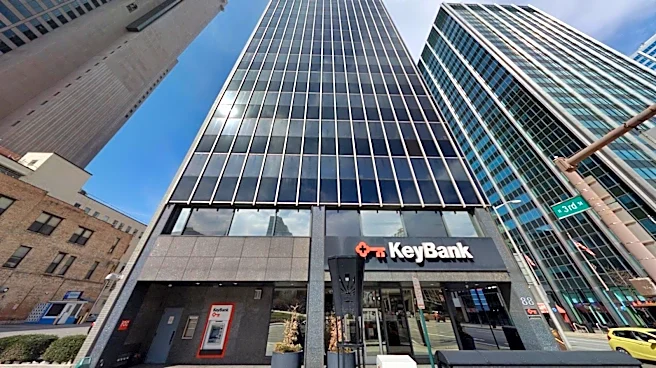
KeyBank

The 21-story KeyBank Building at 88 E. Broad St. sold in April for $5.1 million after a two-day online auction, becoming an emblem of the city's flagging Downtown real estate market.
It has been in various stages of disrepair and vacancy. At one point developers had considered its 248,832 square feet ideal for apartments and office space.
The city of Columbus had once threatened to turn off the building's water because bills had not been paid.
So will it be known as a distressed property that sold for half of what it did in 2022? Or is it a prime location overlooking the Ohio Statehouse that just needs a makeover? The new owner, John Kalogerou, owner of a Cleveland-based powersports vehicle dealership said he plans to return the troubled office tower to its former status as "premium space." The building is Kalogerou's first property in Columbus.
Chase Tower

The glass-covered Chase Tower at 100 E. Broad St. sold in 2025 to a California investor who planned to spend "millions" to improve the 301,389 square-foot building.
Los Angeles investor Andrew Brog and a partner bought the 25-story tower at 100 E. Broad St. from the Virginia firm Lingerfelt CommonWealth Partners for an undisclosed price.
Lingerfelt bought the building in 2019 for $9.5 million. Brog did not say what he paid but said it was less than $5 million, a price that allows money to be spent on improvements.
Like the Key Bank tower, location is prime here.
Fifth Third Building

Again, largely empty, except for an operating bank branch, 21 E. State St. has been completely gutted and available for tenants. Its 365,457 square-feet of office space has some of the best views both north and south.
"The people downtown are here for the Statehouse," said Robinson "or they're law firms where that's traditionally been the place to be."
Continental Plaza (Borden) building
Some buildings don't easily lose their names, even after 20 years of leaving the city.
That's the case with Borden, once a major employer and headquarters of brands like Borden Ice Cream, Meadow Gold milk, Creamette pasta, and Borden Condensed Milk. Its consumer products and industrial segment marketed wallpaper, adhesives, plastics and resins. Elmer's and Krazy Glue were also among its brands before divesting its assets in 1995.
The building at 180 E. Broad St. is yet another opportunity for reinvention, it's plaza-like entrance is one of its hallmarks. But it must pull itself from receivership after a series of legal and financial setbacks
With 910,992 of square feet, it is now referred to as either Continental Plaza or the Hexion building and struggles with low occupancy. It has a 57% occupancy rate, according to a Colliers report from the end of 2025.
While the new Hilton Hotel and Merchant buildings on Downtown's northern edge are the newest high-rise additions, there is still value in rehabbing what's already there, said Mike Copella, executive managing director of CBRE's Advisory Services. "The cost to construct and in Columbus is really at an all-time high," he said.
Still, "People tend to be drawn to new development because everything is nice," he said. "They bring a buzz and vibrancy of life."
A Colliers report from last year lists occupancy rates of other Downtown buildings.
Growth and development reporter Dean Narciso can be reached at dnarciso@dispatch.com.


This article originally appeared on The Columbus Dispatch: As OSU fills Huntington Building, what is still vacant in Downtown Columbus