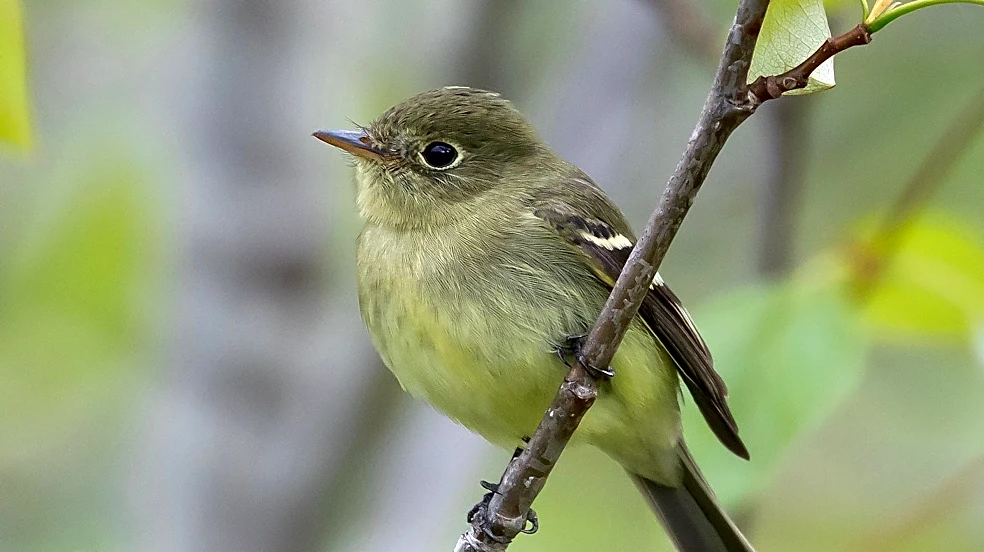








The yellow-bellied flycatcher is one of North America’s most poorly known species. Even though it is a fairly common migrant in Ohio, as it travels between boreal breeding grounds and wintering grounds in Central America, the vast majority go undetected.
This species is a notorious skulker, often staying in dense vegetation where they’re hard to see. Also, the flycatcher seemingly has little to say in migration and doesn’t often reveal its presence with songs or calls.
One of the toughest identification challenges in North America is the flycatchers in the genus Empidonax, to which the yellow-bellied flycatcher belongs. Four species breed here: Acadian, alder, least and willow flycatchers. The yellow-bellied flycatcher nests far to our north but
its migratory corridor passes through Ohio.
Bird banding in Ohio requires a federal permit
At a casual glance, all these species look quite similar and are easiest to separate by song. Or, if you are an expert bird bander, when holding one in the hand.
But catching birds to identify and band is not easy, and few people in Ohio are licensed to do so. A permit is required from the U.S. Geological Survey’s Bird Banding Lab. To earn a permit, would-be banders must do extensive apprenticeship work with a licensed bander, then provide three letters of reference from banders and submit a research proposal regarding the work the bander hopes to accomplish.
One of the most experienced bird banders anywhere is Mark Shieldcastle, a former biologist with the Ohio Division of Wildlife. In 1992, Shieldcastle and others founded the Black Swamp Bird Observatory (BSBO), an organization dedicated to furthering avian research and education along the shores of western Lake Erie.
Kim Kaufman had been involved with BSBO since its infancy, and in 2005, she became its education director, and then in 2009, she was named executive director, a position she still holds.

BSBO has gone on to become a tour de force in North American ornithology and bird conservation, on several fronts. Its educational outreach seemingly knows no bounds and includes an active young birder’s program. BSBO’s Biggest Week in American Birding event, which takes place over 10 days in early May, reaches thousands of birders from most states and many countries, and pumps about $40 million annually into the local economy of western Lake Erie.
I will soon return to the yellow-bellied flycatcher and a very special BSBO encounter with one, but first a few words on BSBO's bird-banding operations. Since 1992 at its primary banding station, Navarre Marsh, which is part of the Ottawa National Wildlife Refuge, BSBO researchers have banded an incredible 435,605 individual birds representing 150 species.
To catch and band birds on that scale, one must be in a very birdy region, and BSBO certainly is. The headquarters is at the entrance to Magee Marsh Wildlife Area, which is one of the most-visited birding sites in North America. The adjacent Lake Erie marshes rank high among the most biodiverse areas of the entire Great Lakes and are critical stopover habitat for migratory birds.

Flycatcher broke a longevity record for its species
One morning last August, Ryan Jacob, BSBO’s banding project director, and his crew arrived at the Navarre banding station to unfurl the mist nets and begin another day’s banding. At such times, there is always an undercurrent of excitement, as one never knows what might appear in the nets.
Later that morning, the crew was pleased to catch a yellow-bellied flycatcher. Their pleasure quickly turned to excitement when they saw the bird was already sporting a band on its leg! The flyweight aluminum band bore the unique code 2900-00286.
It turned out that Jacob and this flycatcher had previously met. It was he who placed the band on the flycatcher way back on May 22, 2018, at the same site.
The 5.5-inch long, 11-gram sprite was an adult when BSBO first caught it, which means that it is at least 9 years old – a Methuselah among songbirds. The previous yellow-bellied flycatcher longevity record was 6 years old. The average longevity of songbirds in general is probably one to three years.
That such an elfin long-distance migrant could live that long is remarkable. Once ensconced on its breeding or wintering grounds, the flycatcher is relatively safe. But the long migratory journey, which is made at night, is fraught with peril. If this bird wintered at the southern reaches of its wintering grounds, in Panama, and breeds near the northern limits of its nesting grounds, in eastern Alaska, it could travel up to 10,000 miles annually.

Since John James Audubon first placed a band on an eastern phoebe in 1804, the science of banding has become far more sophisticated and the work of banders has generated mountains of data on birds. Their research has furthered conservation efforts and elucidated previously unknown details of life histories, such as how long a yellow-bellied flycatcher can live.
We’re fortunate to have BSBO based in the Buckeye state, and they’ve earned the support of conservationists far and wide. BSBO is an organization well worth supporting. For more information, visitbsbo.org.
Naturalist Jim McCormac writes a column for The Dispatch on the first and third Sundays of the month. He also writes about nature at jimmccormac.blogspot.com.
This article originally appeared on The Columbus Dispatch: Hidden Ohio flycatcher lived long enough to make history