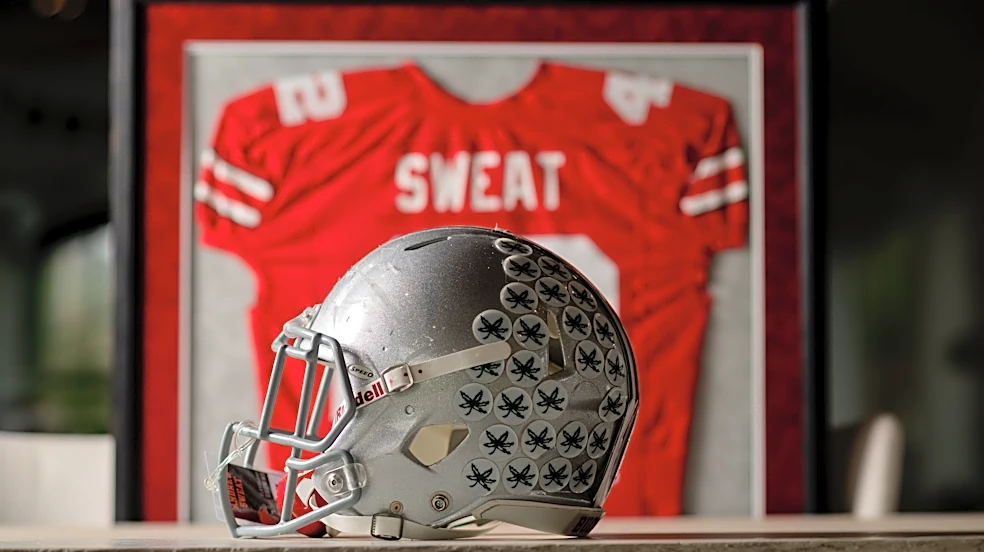



Looking out through his helmet’s facemask, a young Andrew Sweat’s vision of the field in front of him turned blurry.
Feeling dizzy and lightheaded, the wobbly 6-foot-2-inch, 238-pound Buckeye stumbled to the sideline. As he leaned on trainers to make the short walk from Purdue's field to Ohio State’s locker room, he thought to himself: "Am I having a stroke?”
Sweat knows he played in that November 2011 game against the Boilermakers, but he doesn’t remember much about it or the big hit that took him out in the first half. Instead of a stroke, Sweat was suffering from a concussion — one of hundreds of thousands stemming from youth leagues up to professional football every year in the U.S.
“I played linebacker at Ohio State in the Big Ten. You’re
just supposed to roll up your sleeves and tough it out,” he said. “But I felt so weird. It was really frightening.”
Although 20 years have passed since football was first linked to chronic traumatic encephalopathy, an eight-month Dispatch investigation found collegiate programs have failed to protect players like Sweat from the brain disease and what doctors have dubbed a "silent epidemic" of repeated head injuries.
At the same time, the emergence of mega conferences, billions in TV deals and athlete name, image and likeness payments have upended the game and narrowed the fine line between pro and college football. And The Dispatch found the very policies designed to protect players who suffered concussions allow them to return to play while still feeling symptoms, potentially putting them at higher risk of another injury.
As the NFL has changed some rules to try to address player concerns, collegiate protocols haven't kept up.
The NCAA as a whole, for example, doesn't require unaffiliated doctors to patrol the sidelines of all college football games to evaluate for head injuries, as the NFL has for more than a decade. Physicians who work directly for Ohio State's Wexner Medical Center walk the sidelines at Buckeyes games, as required by the Big Ten conference.
"They think this is a pro issue... It is not," said Dr. Ann McKee, a neurology professor at Boston University who has studied CTE in young athletes. "It's something that's in our youth athletes, our teens and young adults and nobody is taking responsibility for it."
Exactly how hard head injuries hit the most storied Division I college football teams remains a mystery.
While college programs report concussions to the NCAA, Ohio State and some other Big Ten schools cited unrelated health and academic privacy laws to deny Dispatch public records requests for data. College players typically sign waivers allowing their injuries to be made public.
The pressures of the game have culminated in a "concussion time bomb" and the clock is close to running out, said Julie Sommer, executive director of the Drake Group Education Fund, a nonprofit focused on promoting student-athlete safety and well-being.
“Secrecy allows athletic departments to handle health crisis management behind closed doors,” Sommer said. “When major programs withhold data, it skews research, undermines normative medical baselines, and hinders broader public health efforts.”
While Sweat’s concussion jarred the linebacker, he said that “what followed was even more frightening.”

The concussion may have actually been the second one Sweat sustained in a week after a hit in practice. Sweat now believes he experienced "second impact syndrome," a potentially catastrophic condition that can cause brain swelling when players suffer a second concussion while still recovering from their first.
Sweat was forced to sit out the next two games, including a season-ending loss to Michigan. He still wasn't feeling right when he returned six weeks later for a bowl game against Florida.
After the season, the Cleveland Browns invited Sweat to train with them. But even months after his concussions, Sweat said he still suffered from headaches, brain fog and fatigue. He decided to retire from football to become an attorney and run a business with his father.
Although Sweat put his body on the line for his alma mater, he’s been left to pay the tens of thousands of dollars in concussion-related medical bills himself. And though he still loves Ohio State, he said a program bringing in millions every year should do more to help alumni.
“It’s almost like: Yeah we’re going to use you and get everything out of you. And good luck man,” Sweat said “But, let’s be honest. It’s just big business.”

Prioritizing profit over protection?
A year after it's football team won a national championship, Ohio State athletics brought in a record $336 million in revenue during fiscal year 2025.
The rise in funding came as no surprise to experts like Sommer, who said the formation of coast-to-coast conferences have resulted in athlete safety rules being shaped by “financial pressures rather than guided by medical expertise.” The Big Ten in 2022 became the first college conference to sign TV deals worth a total of $1 billion a year.
“The NCAA and major conferences have fundamentally failed to protect college athletes by prioritizing institutional profit and legal protection over long-term neurological health,” Sommer told The Dispatch.
Head Coach Ryan Day declined to be interviewed for this story through a spokesperson and Ohio State barred a Dispatch reporter from attending one of Day's weekly press conferences to ask the coach a question. In a prepared statement, Day praised the university's medical center staff and said that protecting student athletes is the team's top priority.
When it comes to concussions and other injuries, Athletic Director Ross Bjork told The Dispatch that Ohio State is at the forefront of sports medicine and will continue asking experts whether there are better and newer things they can be doing.
Although physicians from the university's Wexner Medical Center work with the team, Bjork insisted a "layer of independence" is maintained and that the hospital treats the team like it would any other customer. He praised the medical center's expertise, which not only includes physicians on the sidelines during games but also a neurosurgeon.
"The game has evolved and advanced ... But nothing is foolproof," he said. "There's no way to make something 100% safe. But, have we made the game as safe as possible?... I believe yes."
Still, at least two Buckeyes have died by suicide, pointing to head injuries they suffered playing football for Ohio State as the cause.
In 2019, former offensive lineman Zachary Slagle, 31, posted a message on his Facebook page prompting family and police to rush to his home, where he was found dead. In the Facebook post, he included the phrase “#CheckForCTE.”
In 2014, Kosta Karageorge, 22, was found dead in a dumpster after texting friends and family that he planned to kill himself. In one of his final messages, the defensive lineman wrote: “I am sorry if I am an embarrassment but these concussions have my head all f----- up."

Karageorge's death prompted a top-down reevaluation of concussion treatment for Ohio State athletes, said Doug Calland, a senior associate athletic director who oversees sports medicine and athletic training.
Twelve years later, Calland said there is a lot more communication between the staff who oversee medical care for players. A psychiatrist, for example, is now available in the locker room so student-athletes feel comfortable seeking mental health care, Calland said.
"Not that everyone worked in a silo before but they're embedded now," said Calland, who has worked at the university since 1995. "They used to be people you called when you needed them."
Still, secrecy continues to reign over head injuries in college football.
Both Ohio State and the University of Michigan told The Dispatch they had no records showing how many concussions football players suffered. Even deidentified concussion information would be considered protected health information for students, an Ohio State spokesperson told The Dispatch.

Data provided by fellow Big Ten rival Michigan State University showed student athlete concussions can fluctuate dramatically from season to season. During the 2020-2021 academic year for example, Michigan State reported 26 student athlete concussions compared with 48 in 2024-2025.
Of the Big Ten's 16 public member universities, 10 responded to records requests from The Dispatch, and five had yet to provide records or data initially requested in March. Penn State University is shielded by state law from providing such records, a university attorney told The Dispatch.
In 2013, 12 of the Big Ten’s then-14 members joined an ongoing concussion study between the conference and the Ivy League. Ohio State was not one of them.
And a new study of CTE shows that the number of football players suffering from the neurodegenerative disease caused by repeated hits to the head may be far higher than previously known. At least one in four NFL players suffer from CTE, the study published earlier this year in the British Medical Journal found.
While there may still be some differences between the pros and college football, those shrinking distinctions don't matter when someone’s health is on the line, said Dan Daneshvar, an associate professor at Harvard Medical School and the lead researcher on the study.
“The brain does not know whether an impact happened in college or in the NFL,” Daneshvar said. “It all adds up.”

Will Howard ‘gets crushed’ but keeps playing
As the game clock struck 10:10 in the second quarter, Will Howard was tackled by two Wolverines at Michigan's 33-yard-line. He laid on his back for more than half a minute.
The quarterback, playing in his only game against Michigan as a Buckeye in 2024, took another player's helmet and a shoulder to the head when he fell. As he went down, the television announcer’s reaction captured the shock of the tackle: “Oh he gets crushed.”

Teammates helped Howard up and he walked over to Ohio State’s medical tent. He sat out for a play as the medical team took his helmet and evaluated him for a head injury.
A TV sideline reporter told viewers that the quarterback pleaded to return to the game.
“I wasn’t feeling great after that but for me it was hard to come out of the game. All I wanted to do was keep playing,” Howard told The Dispatch in July at Pittsburgh Steelers training camp.
Howard later confirmed he was tested for a concussion but ran back onto the field with 9 minutes and 24 seconds left in the quarter. He’d go on to play one of the worst games of his Ohio State career resulting in a fourth consecutive Buckeyes loss to Michigan.
When asked in July whether he suffered a concussion during the 2024 Michigan game, Howard declined to give a yes or no answer. He has, however, since questioned his decision to return to the game.
“At that point, I didn’t know what the actual deal was but…you can look back and say hindsight (is 20/20)," he said.
In the event a concussion diagnosis is missed during a game or practice, Bjork said the athletics department would sit down with doctors and re-evaluate the situation to figure out what went wrong.
When asked about Howard's possible concussion after the game, Day told reporters he relied on what the team's doctors said about the quarterback's condition.
"He came out for a second and they said he was available and OK to go back into the game," Day said at the time. "I checked with him. He said he was in good shape."
Calland said he wasn't aware Howard may have suffered a concussion. But without a specific diagnostic test for concussions, Calland said diagnosing one comes down to players being upfront about their symptoms.
Ohio State coaches, athletic trainers and physicians are all given annual education on how to spot concussions via a PowerPoint presentation, according to the university's protocol. If they fail to complete other required head injury training, Calland said they lose access to their computers.
"It doesn't happen that often... But that's the trouble in not having anything more specific to evaluate," Calland said of missing a diagnosis. "There's no x-ray, there's no MRI, there's no CT scan... so be honest with us. Help us help you."
In the NFL, independent athletic trainers in the replay booth can halt a game to pull a player with a suspected concussion. While the NCAA in 2016 began recommending medical officials in the booth be able to stop a game, there's no requirement that a conference or university allow the action.
At the college level, the Big Ten and the Southeastern Conference both have spotters working in the replay booth who can call down and order a player to be examined. That happens two or three times a season at Ohio State, Calland said.
Since 2014, the NFL has brought unaffiliated medical staff and local physicians onto the sidelines to help identify injuries, adding a layer of separation to a process that once relied solely on team-employed doctors to clear players. The league and players union jointly hire those personnel.
Ohio State too has what Calland called “independent” medical staff on its sidelines who make sure treatment decisions aren’t “influenced by another agenda.” The NCAA requires schools to give team physicians and athletic trainers "unchallengeable autonomous authority" over student athlete care, including diagnosis and when they can return to play. But unlike the NFL’s unaffiliated personnel, Ohio State’s trainers and physicians work for the university’s Wexner Medical Center.
When players suffer an injury, such as Howard’s blow to the head, they are often ushered off the field and into a tent on the sidelines that shields them from public view. Players who emerge without their helmets, like Howard at first did, are typically ruled out.
But diagnosing concussions remains difficult and when a game is on the line, doctors can feel the pressure to clear someone quickly, said Donnie Nickey, captain of the 2002 Ohio State national championship team.
“It's about how fast we can get them back on the field,” said Nickey, who's suffered several concussions. “It's not really about how quality the care is or how well their mental health is at age 50.”
A major hurdle to diagnosing concussions is how much testing relies on the person who might have just suffered a severe blow to the head to self-report one, said Edward Meng, an assistant professor of computer engineering at Cedarville University researching ways to better diagnose head injuries.
While sports medicine has made huge advances in recent years, Meng said old-fashioned sideline tests are highly subjective. For that reason alone, nearly 80% of concussions go undiagnosed, according to the Centers for Disease Control and Prevention.

And former Buckeyes told The Dispatch testing on the football field is easy to beat.
Testing includes a variety of medically approved measures, including checking for 22 concussion-specific symptoms, testing a person’s balance on one or both legs and repeating a string of words, though Nickey said players memorized the words because they often used the same ones for each game. Players who fail a concussion test are kept from returning to a game or practice and referred for further evaluation, according to Ohio State’s policy.
The tests are far from foolproof though, especially if a player is desperate to get back in the game, a Big Ten referee told The Dispatch on the condition of anonymity. Ohio State declined The Dispatch's request to speak with team physicians, many of whom work with the program for years.
“Just because he can repeat some words or answer how many fingers I'm holding up, that doesn't mean he doesn't have a concussion,” the referee said.
Does concussion protocol go far enough?
TreVeyon Henderson got the OK to play again, but one week after another he had to take breaks on gameday as he felt the symptoms creeping back.
Henderson, a former Ohio State star running back, suffered a concussion during his 2021 freshman season. While he didn’t specify when he suffered the head injury, Henderson told reporters in March of 2022 that he was tested for a concussion and removed from a game.

After going through concussion protocol, Henderson said a doctor cleared him to play again. But, he still felt the effects for weeks.
“I played through that,” he said at the time. “During the games, I still had the side effects of it… When you all kept seeing me come out of the games, I was having side effects so I had to go sit down for a little bit.”
Henderson, who now plays for the New England Patriots, did not respond to an interview request from The Dispatch.
And while it might seem alarming that Henderson continued to play with symptoms, the university’s concussion protocol actually allows it.
Ideally, players should not return to physical activity until their symptoms have ended. But, even with “limited symptoms” a student athlete can return to their sport under supervision if they follow a process that gradually increases activity, the policy states.
Henderson being pulled from a game because his symptoms worsened is actually a sign that the protocol is working rather than failing, Calland said.
All sorts of things in a game — from stadium noise to a tackle — could worsen symptoms if someone returns to play before they're ready, said Melissa Anderson, an assistant professor and co-director of Ohio University's Neuromuscular Biomechanics and Health Assessment Laboratory. If someone has already suffered one concussion, Anderson said they are much more likely to suffer another one.
"I would hope that someone isn't returning to play when they feel awful because then they're not performing well and that puts them at even greater risk," Anderson said.
Once a student athlete is diagnosed with a concussion at Ohio State, they must first be cleared to return by the team’s physician or someone else the physician designates. While the protocol doesn't stipulate a designee must be someone with a medical background, Calland said it can only be another doctor or an athletic trainer and not a coach.
Concussion protocols for individual universities surveyed by The Dispatch follow the NCAA's minimum guidelines, though not all allow a physician to designate someone else who can clear a student athlete to return to play after a concussion. Michigan only allows a doctor to OK a player's return while MSU allows a team physician to appoint a "medically qualified designee."
Research has found that college football players suffer far more hits to the head than pro players, Daneshvar said. On average, NFL players experience less than one contact with another player in practice per week and Daneshvar said college teams should follow the NFL’s lead and limit tackles in practice.
And while concussion protocol is important, Daneshvar said it fails to catch equally dangerous hits in football. For every diagnosed concussion in an average collegiate offensive lineman, Daneshvar said that player experiences about 341 other hits to the head of equal or greater force.
“We cannot just wait until somebody has a concussion and then intervene… Improving concussion protocols is important, but it is not enough to prevent CTE,” he said. “If we only focus on the hits that cause obvious symptoms, we are missing the hundreds or thousands of other impacts.”
Part of the problem though, is getting players to admit they’re struggling with head injury symptoms in the first place. It’s an issue that stems from the game’s culture of toughness.
Nickey, for example, said the last thing he wanted was his teammates or fans to think he was weak. Doug Plank, who played safety and cornerback for the Buckeyes from 1971 to 1974, said he was focused on doing what he could to help his team win even at the cost of his own body.
“I was determined to come down there and run through you if I had to,” Plank said. "Trying to control this game is like saying: 'Hey, Indianapolis 500, we don't want any wrecks.' That’s just not the way it is.”
All players today are asked to sign a consent form by the NCAA that provides details on concussions and what they should do if they fear they have one. But rather than educating players, that form acts more like a waiver to safeguard the NCAA and schools from legal ramifications, Sommer told The Dispatch.
And despite what’s known about head trauma today, football’s all-or-nothing mentality of leaving everything on the field has persevered.
“As long as I can run, I’m going to play through it,” Henderson said in 2022. “But I’m going to keep myself safe at the same time.”
When concussion rules work
Although concussion guardrails are a one-size-fits all approach in college sports, they sometimes do exactly what they’re designed to do.
During Ohio State’s 2022 playoff run, wide receiver Marvin Harrison Jr. reached up to catch the ball inside the University of Georgia’s endzone. But a Bulldog defensive player ran head first into Harrison with their helmets colliding.
Harrison, who was recently traded from the Arizona Cardinals to the Houston Texans in the NFL, was pulled from Ohio State’s playoff game.

He wanted to go back in, but said the doctor on the sidelines diagnosed him with a concussion and so he was barred from re-entering the game. While it was difficult for Harrison to accept, he knows it was the right call and said in retrospect he appreciates it.
“They just said it looked too bad to go in. So they didn't even give me really a chance,” Harrison said. “As a player, you have no control over that.”
Head injuries, Harrison said, are simply "an unfortunate part of the game that you can't really have much control" of. But the risk of repeated hits to the head have actually been known for decades.
The dangers of concussions were first revealed in 1952 by Harvard researcher Augustus Thorndike, who recommended people stop playing contact sports once they suffered three of them.
The NCAA was created in 1906 by President Theodore Roosevelt to address safety concerns after several severe injuries and deaths were reported and some schools had already eliminated the sport. But while the NCAA was designed to “clean up football,” power conferences such as the Big Ten and the SEC now have more control and influence over the game — especially the ever-expanding playoffs.
An NCAA spokesperson declined to comment for this story when reached by The Dispatch.
Raising public awareness of CTE and its connection to football’s violence is difficult because the neurodegenerative disease can only be diagnosed after death, researchers told The Dispatch.
While Ohio State's Calland praised studies on CTE, he questioned whether the disease will be diagnosed as much in the future given the latest safety advancements that past players, whose brains are often studied, never had.
"They played 40 years ago," he said of CTE studies. "So what does that look like now? Is it relevant?"
‘Every game was PTSD’ for former Buckeye
Standing near the endzone of the Ravenwood High School football field just outside of Nashville, Nickey called out plays to some of the student athletes running drills.
For Nickey, a safety and captain of the 2002 Ohio State national championship team, staying alive this long after his playing career ended has been the greatest challenge of his life. Nickey went on to play with the Tennessee Titans after college until the team ended his contract in 2011.
Without the game, the former Buckeyes leader felt alone and rejected from the sport he loved for so long.
Nickey struggled with depression and often felt overwhelmed by grief. At the same time, he was suffering from brain fog and headaches that he believes stemmed from the head injuries he sustained playing football at Ohio State and in the NFL.

“Every game was PTSD,” he said. “Having so much pressure, having victories and defeats. It’s just a lot to deal with for a developing prefrontal cortex.”
To cope with it all, he turned to painkillers, alcohol and marijuana until his wife and a former Titans teammate staged an intervention. He finally got clean in 2014.
As a perennial national title contender, Nickey said it’s incumbent on Ohio State to find a way to take care of Buckeyes long after they leave the field.
One such option could be offering former players free health care after they depart, which is something Sommer said her team is pushing for in Congress right now.
The NFL offers former players five years of health benefits if they’ve played at least three seasons with a team. By comparison, the NCAA in 2024 launched a health insurance program that student athletes can take advantage of for up to two years after leaving school, though the policy is meant to act as secondary coverage to another health plan.
With its funding and assets, Calland said he thinks Ohio State could do more to provide medical care long after graduation for student athletes.
"It could be better," he said. "With our resources here, we have the ability to do whatever it takes."
Nickey is intent on making sure his son Tre, who is on the team he coaches, enjoys all the positive aspects of football without the dangerous side effects he’s faced.
As a player, when Nickey felt dazed or saw stars after a big hit, he’d “push those feelings down” because he didn’t know how to explain them and he didn’t want to be removed from a game. As a coach and father, Nickey now encourages his son to speak up if he takes too hard of a hit —because in the end, he said staying in to win is not worth the consequences.
“You couldn’t have told me I could die. I just had that belief in the team above all else,” he said. “It’s like a higher power, man. It’s the religion of football. And we worship every Saturday in Columbus.”
Dispatch reporters Rob Oller and Joey Kaufman and Arizona Republic reporter Theo Mackie contributed to this story.
Dispatch investigative reporter Max Filby can be reached by email at mfilby@dispatch.com. Find him on X at the handle @MaxFilby or on Facebook at @ReporterMaxFilby.
This article originally appeared on The Columbus Dispatch: Concussion rules fail to protect Ohio State football players from CTE