
Hummingbirds are heading out, and that's a reason to keep your feeders up.
The second hummingbird surge of the year is starting in Ohio, Toledo's WTOL meteorologist Ryan Wichman shared on Facebook. The birds'
migration has started to the north of Ohio, and some those birds will be headed through the Buckeye State as they head out of town.
The tiny birds spend the winter in Mexico and Central America. Like many other birds, they head south in search of food — small insects and flower nectar, according to the American Bird Conservancy. The decreasing daylight hours in late summer and early fall signal to hummingbirds that it's time to make the journey.
So, how long should you keep your feeders out? And are you interfering with their travels by keeping them up? Here's what to know.
Hummingbird migration backyard feeding tips
Feeding hummingbirds in the fall will not discourage the tiny birds from migrating, according to the Ohio State University Extension. Instead, feeders give birds passing through the state a place to stop and refuel for the journey, Wichman said. He recommends keeping the feeders clean and nectar fresh.

When to stop feeding hummingbirds in Ohio
You can keep hummingbird feeders out through October, or take them down when hummingbirds stop visiting them, per the OSU Extension.
Hummingbird wing speed. How fast do they fly during fall migration?
A hummingbird's heart beats up to 1,260 times a minute and its wings flap 15 to 80 times per second as they migrate south, Hummingbird Central says.
Hummingbirds prepare for their journey by gaining 25% to 40% of their body weight in the leadup to migration season, according to Hummingbird Central.
When do hummingbirds migrate south?
Ruby-throated hummingbirds, the most common species in Ohio, typically begin their travels south in September, Kathy Garza-Behr, a wildlife communications specialist at the Ohio Department of Natural Resources, told the Cincinnati Enquirer. Known by their green backs, white bellies and red throats for males, these hummingbirds arrive in Ohio in April and May.
These hummingbirds spend the winter in Central America, Garza-Behr said, with many crossing the Gulf of Mexico, renamed by the U.S. government as the Gulf of America, in one nonstop flight. The American Bird Conservancy says that crossing can be up to 500 miles.
In Ohio, another species, the rare rufous hummingbird, is sometimes spotted during the late fall and winter months.
Ruby-throated hummingbird fall migration map
For more than a decade, Hummingbird Central has tracked hummingbirds' migration, relying on "citizen spotters" to report sightings, according to Ken Freeman, a Hummingbird Central staff member. Those reports are then plotted on an interactive map that shows the date and location of the site, and any comments that spotters want to leave. Sightings are color-coded by hummingbird species.
The spring migration map shows when hummingbirds arrive in the U.S., and when they reach Ohio and other states. The summer and fall map does the opposite. The fall map for 2026 is not yet active on the website.
What species of hummingbirds will we see in Ohio?
There are two main species of hummingbirds in Ohio, according to Bird Advisors, but a total of seven are recognized in state bird records.
- Ruby-throated hummingbirds are a common sight in summer. They are bright green on the back and crown, with a gray-white underside. Males have an iridescent red throat. Female Ruby-throated Hummingbirds are green on the back and white underneath, with brownish crowns and sides.
- Rufous hummingbirds are not very common in Ohio, but a few each year do wander this far north in winter, Bird Advisors says. They are bright orange on the back and belly and have a white patch below the throat; males possess an iridescent red throat. The females are greenish-brown on the back and rusty colored on the sides with a whitish belly.
- Mexican violetears are extremely rare in Ohio. Some non-breeding Mexican violetears may fly north into the United States, more commonly to Texas. Some have been spotted as far north as Michigan and Ohio, but very rarely.
- Black-chinned hummingbirds have only been seen once, near Columbus in 2020.
- Calliope hummingbirds have only been spotted here a few times around Columbus, 2017 being the last.
- Allen’s hummingbirds have only been spotted in Ohio a few times in winter. They have not been recorded in the past 10 years.
- Anna’s hummingbirds have been spotted only a few times in the state in winter.
What do hummingbirds eat?
The typical backyard hummingbird feeder is filled with sugar water. But that's only a small portion of a hummingbird's diet.
The sucrose in flower nectar and sugar water gives hummingbirds the energy for their high metabolisms and swift wings, according to The Spruce, but it lacks protein. Up to 80% of their diet is small insects like mosquitoes, flies, gnats, spiders and aphids, reports Choose Natives, which promotes using native North American plants over invasive species to attract the birds.

How to make homemade hummingbird food. What's the ratio?
If you want to make your own hummingbird nectar for backyard feeders, use a 4-to-1 ratio of water to sugar, according to the Smithsonian's National Zoo & Conservation Biology Institute. Mix the water and sugar until fully dissolved, and store in the refrigerator between fills.
Change the solution in hummingbird feeders frequently. The National Zoo recommends changing feeders every other day, and cleaning them thoroughly each time to prevent mold growth.
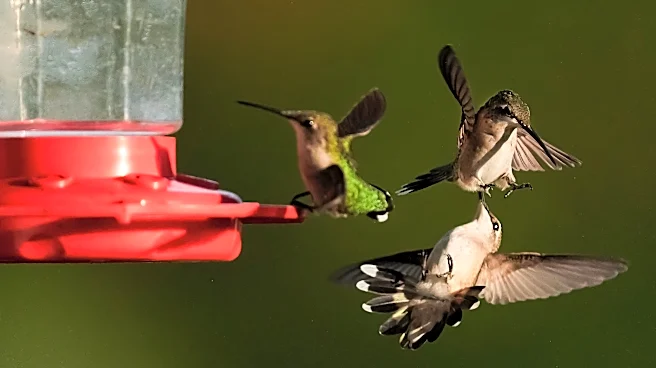
Hummingbird aggressive feeder behavior. Why do they chase each other?
Hummingbirds are territorial. They get aggressive with each other because they can't afford to share resources when flower blossoms are scarce, according to All About Birds. "This aggression is so deeply ingrained that they just can’t figure out that feeders are different."
According to the website, you can try and alleviate their territorial instincts by setting up multiple feeders so birds won't have to see each other when feeding.
When will hummingbirds be back?
Hummingbirds typically return to Ohio in April. In 2026, Hummingbird Central reported sightings along Ohio's southern border on April 15.
This article originally appeared on The Columbus Dispatch: Hummingbird migration begins, but you should keep those feeders up