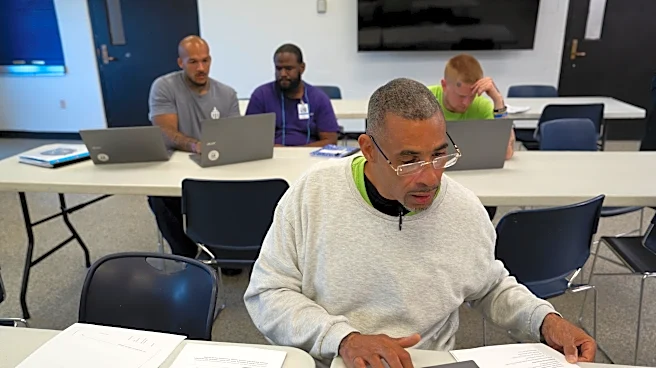







Daylight was just beginning to fade outside the walls of the Franklin County Community Based Correctional Facility at 6 p.m. on Tuesday, Sept. 29. Inside, however, a room full of entrepreneurs in training were taking their seats at long white tables, laptops cracking open and blinking to life one by one as a quiet focus flooded the room.
The group of just under 20 incarcerated men attend a weekly entrepreneurship course offered through The RIDGE Project, a nonprofit organization that provides services including educational programming and professional development opportunities to support families impacted by incarceration.
What is The RIDGE Project?
Founded by Ron and Catherine Tijerina in McClure, Ohio in 2000, The RIDGE Project has been providing programming to incarcerated
individuals in central Ohio for years. This is the first year, however, that it’s offered the entrepreneurship course in Franklin County. Project manager Timothy Snoke and project associate Matt Eiting have overseen the course since it began in May and have witnessed firsthand how seriously the participants are taking the opportunity.
The Franklin County Community Based Correctional Facility (CBCF) isn’t a typical prison. The minimum-security institution is considered a “residential prison diversion program for adult male offenders.” Incarcerated men at CBCF are often first-time offenders serving time for nonviolent felonies, Eiting said. Their days are structured around programming designed to support their successful reintegration into society after their release. The RIDGE Project’s entrepreneurship program is just one of the many offerings available.
“There are [nearly] 46,000 incarcerated people in Ohio,” Eiting said. “Almost all of them are going to get out at some point. I just think there should be more of an eye on these guys that are about to get out and more of an effort to support them so that they don't fall back into old habits.”

How does the entrepreneurship course work?
The RIDGE Project’s entrepreneurship course takes six months to complete and includes three phases.
Phase one focuses on fundamental business training. In the second phase, class time is divided in half – participants spend one hour developing their business plans and one hour hearing lectures from local business professionals.
In the third phase, six participants and two alternates are selected to participate in a public pitch competition. These men are assigned mentors, often the same local professionals who lectured in phase two, and at the end of the course, they’ll present their business plans to a panel of judges in a public event. All participants will have completed their sentences by Pitch Night on Nov. 16.
The judges will determine two winners: Best Business Plan and Best Presentation. Depending on their performance, each presenter could earn between $500 and a few thousand dollars in capital investments, Eiting said. The RIDGE Project doesn’t award a check or cash, however. Instead, the organization will either reimburse the recipient's business-related purchases or accompany them in person to make those purchases.

A competition where everyone wins
Many of the men’s business plans focus not only on how they can generate income, but how they can give back to the community.
Gregory Siebeneck, 44, has crafted a detailed, thoroughly researched plan for his pastry shop, Glaz’d. The layout includes an open-floor concept that will allow patrons to watch their food being prepared in what he calls a “baking theater.” The mock-up menu includes cream puffs, cake rolls, cannoli, donuts and coffee, and sourcing ingredients from local farmers and vendors is a top priority in his business plan.
The program participants’ personal growth and hope for the future are also heavily reflected in their business designs.

Physical fitness has played a key role in helping Curtis Williams, 34, stay focused on sobriety. Through Body By Jump, he plans to provide more than just a fitness center, but an environment focused on health and healing where everyone from recovering addicts to single parents to young athletes can find community.
While Williams was hyper-focused on writing his pitch during class, he also said he and the other participants frequently listen to one another’s pitches and provide input.

“I want everyone to win,” he said. While not every participant will earn a winning title at the end of Pitch Night, most participants appear to share Williams’ desire to see everyone in the program succeed beyond the competition.
Pitch Night is scheduled for the evening of Nov. 16 at the Ohio Statehouse. The event is free to attend, but it’s by invitation only. Anyone interested in attending can reach out to Eiting at eiting.matt@outlook.com.

Reporter Kelly Tucker can be reached at ktucker@dispatch.com.
This article was made possible by support from the Center for HumanKindness at The Columbus Foundation, which has partnered with The Columbus Dispatch to profile those making our community a better place. Help us lift up inspiring stories of kindness by suggesting people, initiatives, or organizations to feature by emailing kindness@dispatch.com. The Dispatch retains full editorial independence for all content. Learn more at Dispatch.com/Kindness.
This article originally appeared on The Columbus Dispatch: Incarcerated entrepreneurs pitch a second chance