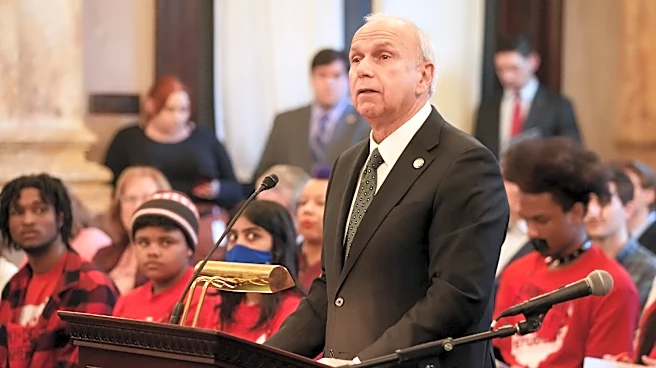








In defending his decision to push for Senate Bill 1 and establish civic centers at five state universities, Ohio Sen. Jerry Cirino laid some of the blame for taking on higher education reform at the feet of Ohio's public university trustees.
Cirino spoke on a panel at the Education Writers Association's annual Higher Education Seminar on Sept. 9 titled, "Public University Civic Centers: Needed Civic Reform or Conservative Trojan Horses?" Inside Higher Ed reporter Ryan Quinn moderated a discussion between Cirino, Paul Carrese, a professor in the School of Civic & Economic Thought and Leadership at Arizona State University; and Mary Anne Franks, a law professor at George Washington University.
Cirino (R-Kirtland) discussed two higher education bills
during the panel for which he was the primary sponsor: Senate Bill 1, a massive higher education overhaul that went into effect last summer; and Senate Bill 117, which established civic centers to promote "intellectual diversity" at five state public universities.

Quinn asked Cirino why he felt the state legislature needed these bills to address what the senator has previously described as "wokeness" and "leftist ideology" on Ohio's college campuses.
"There is nothing in Senate Bill 1 that could not have been done by the trustees or faculty organizations," Cirino said. "So the idea that by the legislature taking action in our case that somehow we are undermining academic freedom. That's our freedom. That is a red herring."
"I would've much rather been doing something different and not taking all the shots I've been taking for reforming higher ed in Ohio," Cirino continued. "I'd rather be doing something else if these institutions would've reformed themselves. They didn't and the legislature has every right – in fact I would argue with an obligation – to see the change happens."
Cirino said Ohio wasn't the first to establish such state-funded civic centers at universities.
Arizona State University became the first public institution to receive an order and funding from a state legislature in 2016 to establish a department “of civic thought and leadership,” which eventually became the School of Civic and Economic Thought and Leadership. Carrese served as its founding director from 2016 to 2023.
There are now 17 public university campuses across 12 states — including in Florida, North Carolina, Tennessee and Texas — with such centers.
Carrese said these civic centers serve "a legitimate public role" in the "restoration" of civics education in public education.
"Educators always believe that more education will help everything, right? So if we have a restoration of this, I believe it will be good for our civic culture, especially now in America," Carrese said.
While Cirino didn't say that Ohio's university civic centers are meant to promote conservatism, he did say that universities have a "leftward tilt" and that "we should be a little bit more neutral and make sure that course work developed to present different alternative views."
"I'm not talking about forcing beliefs down anybody's throat," Cirino said. "It's just about knowing America's civics history, and the good and the bad and the ugly. We have all three certainly in our history."
Frank – who also serves on the advisory board for The Uncivil Collective, a group of scholars and researchers who reject private- and state-funded civics centers – questioned the connection between correcting perceived politics and promoting civics education.
"We're talking about government-mandated centers, government-mandated civics education," she said. "We've got millions of dollars in public funds... I think it really is worth getting a very clear answer to what is the problem we're trying to solve."
People have a "crisis of confidence" about higher education, Frank said, not because of faculty members who vote for Democratic politicians but "because we are sliding into authoritarianism." She said that other factors like rising tuition costs, lower state funding formulas and increased political interference on campus are to blame.
“Academics want to paint this as a left-right issue," Cirino said. "It is not a left-right issue. Don’t fall for that."
Cirino said these civic centers are about "how to make higher education better in our respective states."
Frank pushed back on the idea that there is no political influence.
“But the reason that we have these centers in the first place is because of too much leftism?” she asked.
With Ohio's civic centers established through the state's last biennial budget, Cirino is now looking to securing their futures.
In June, Cirino introduced Senate Bill 461 to ensure the five centers remain well-funded and independent. Directors would have "sole and exclusive authority" over hiring, promotion and tenure of faculty and "exclusive and unlimited authority" over curriculum.
If the bill becomes law, directors at two of the programs – one at Ohio State University and another at the University of Toledo – would be promoted to deans by Jan. 1. The other programs – at Miami, Cleveland State and Wright State universities – could follow.

Higher education reporter Sheridan Hendrix can be reached at shendrix@dispatch.com and on Signal at @sheridan.120. You can follow her on Instagram at @sheridanwrites.
This article originally appeared on The Columbus Dispatch: Mandated civic centers needed because Ohio colleges wouldn't reform themselves, senator says