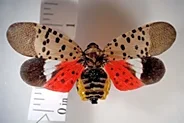








These invasive insects are spreading across Ohio. And anyone who spots them is encouraged to show no remorse and kill them immediately.
The Ohio Department of Agriculture issued a statewide quarantine to combat the spotted lanternfly in Februrary 2026, restricting the movement of wood, trees and other items that might spread the infestation.

“The spotted lanternfly is an invasive pest that is known to cause harm to Ohio’s agricultural industry,” ODA Director Brian Baldridge said in a statement. “ODA is committed to protecting and preserving our plant life, and plant health experts are working with nurseries and wineries to reduce the negative impact of SLF.”
Now, the spotted lanternfly is entering its breeding season, laying eggs that will hatch
the next generation in the spring. If you want to join the fight against them, here's how.
Spotted lanternfly entering breeding season. How to spot egg masses

The spotted lanternfly is currently preparing the next generation. The insects lay eggs from October through December, per the Ohio Department of Agriculture. The egg masses — which are small and gray, and protected by a waxy coating — are placed in sheltered areas of trees, buildings, firewood, outdoor furniture, lawn equipment and rocks.
Lanternfly nymphs start hatching in April and grow through four nymph stages before emerging as adults in late June. The adults are then active through December.

How to kill spotted lanternflies, destroy their egg masses
If you see spotted lanternflies or their eggs, ODA has several recommendations on how to kill them:
- Egg masses: These can be destroyed before the eggs hatch by scraping them with a knife or the edge of a credit card into soapy water or rubbing alcohol to kill the eggs. The masses can also be treated with horticultural oils during the winter, or before the plants start sprouting in spring.
- Nymphs and adults: If there are only a few, they can be swatted or crushed. If the infestation calls for an insecticide, lower toxicity ones such as horticultural oils and insecticidal soaps can provide control with little residual effects. Contact insecticides such as bifenthrin, carbaryl and malathion may be used as spot treatments. Or, systemic insecticide treatments with dinotefuran or imidacloprid can be used as trunk sprays, trunk injections or soil drenches depending on the label. Also, removing spotted lanternfly host plants — some of which are invasive themselves, like the tree of heaven — can help reduce populations.
Some insecticides may need to be applied by certified personnel, per the agriculture department, or require specialized equipment. Also, pesticides will kill beneficial insects, such as pollinators. Do not apply when trees or shrubs are in bloom or if nearby flowering plants may absorb the insecticide.
All of Ohio now under quarantine for spotted lanternfly
In February 2026, Ohio's list of spotted lanterfly quarantined counties expanded from 18 to 88.
Under the quarantine, products such as trees and nursery stock may not be moved out of Ohio without a compliance agreement, permit, or inspection certificate. Producers who ship these products to non-regulated areas must have their stock inspected and each load must be accompanied by a certificate which confirms their product is free of the invasive pest.
Regulated articles include, but are not limited to:
- Spotted lanternflies in any living stage of development.
- Live or dead trees, nursery stock, firewood, logs, perennial plants, garden plants, agricultural produce.
- Other products or articles that may carry spotted lanternflies.

Do lanternflies die in the winter?
Yes. Most spotted lanternfly adults freeze to death in the winter, according to the Penn State Extension, while their eggs survive.
Should you report a spotted lanternfly sighting?
Because the entire state is now under quarantine, the ODA is no longer encouraging community members to report sightings of the spotted lanternfly in Ohio.
Where did the spotted lanternfly come from? Its origin, diet and damage it causes
The spotted lanternfly, native to Asia, was first spotted in North America in 2016, in Pennsylvania, according to the Ohio Department of Natural Resources. It was first identified in Ohio in 2020, per the Ohio Department of Agriculture.
The insects feed on a variety of plants, causing them to wilt and die back, and making them susceptible to damage from outside factors, such as mold. They're particularly fond of the tree of heaven, also an invasive species, as well as grapes and hops, according to ODNR.
The spotted lanternfly also produces a sticky, sugary substance known as honeydew that attracts ants, flies and wasps. The honeydew is also colonized by a fungus called sooty mold, which can ruin grape and hop crops.
This article originally appeared on The Columbus Dispatch: Invasive spotted lanternflies breeding in Ohio. How to spot egg masses