






In districts across Ohio, school bus routes are delayed due to a widespread shortage of drivers.
Year after year, school districts are failing to fill all the necessary bus driver positions because they're unable to compete with companies like Amazon, FedEx and UPS that offer drivers higher pay, flexible hours, good benefits and signing bonuses, according to Tom Hosler, CEO of the Ohio School Boards Association.
"Schools can't increase the price on what we're providing to offset the transportation cost," Hosler said. "We're a service industry, so it makes it hard for us to adjust in real time."
In addition to competitors driving up pay expectations, bus drivers are required to complete around 6-8 weeks of training before driving students. They
must get a commercial driver's license (CDL) to operate large vehicles, plus undergo background checks and other school bus-specific training, according to Hosler.
Because of budget restrictions and hiring troubles, districts are left with few solutions. Some have drivers double up on routes, which gets more kids to school, but often makes them arrive late.

The bus driver shortage is widespread
Kevin Miller, superintendent of Licking Heights Local Schools, said his district was able to fill its routes for this school year, but only barely, leaving the district vulnerable if a driver takes leave. Licking Heights has 45 routes and 43 drivers, plus three "floaters" who can pick up routes when needed. It's the most bus drivers they've had on staff in years.
Licking Heights has more than 5,000 students and covers about 36 square miles in Licking County and in the eastern part of Franklin County, according to its website. Miller said they've incentivized drivers to join their team in part by paying them based on how long they've been CDL certified.
Westerville City Schools serves a 37-square-mile area and has about 14,600 students, according to its website. When school started Aug. 18, the district didn't have drivers for 18 of its 118 transportation routes.
After struggling to fill many of its bus routes at the beginning of the school year, Westerville City Schools announced it's finalizing a contract with Community Bus Service Inc. to provide five fully trained drivers beginning Sept. 14 at $5,000 monthly.
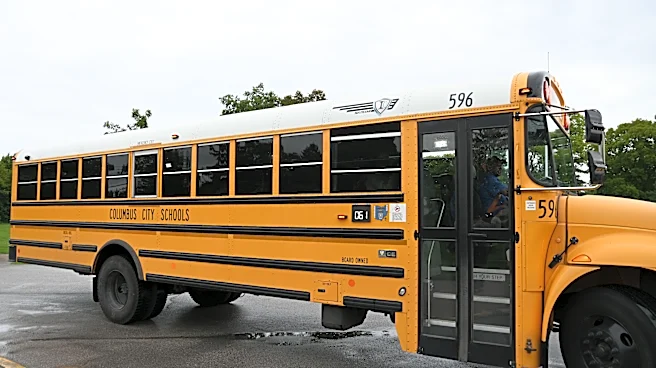
A representative from Columbus City Schools aims to have 500 bus drivers but currently has only 395. Last year, they ran 495 routes, but this year they have 425. CCS is the largest district in the state, serving 45,000 students across 110 different schools, according to its website. It covers about 140 square miles.
Late buses directly impact learning opportunities for students. English is usually the subject teachers start the day with because that's when students are the most attentive, Miller said, so when kids are consistently late, they miss hours of important learning time.
Unreliable transportation communication
Sarah Curtin, a mother of two children who ride CCS buses to school each day, said the buses are difficult to keep track of and often arrive at home and school late. Her daughter is now a third grader at Ecole Kenwood French Immersion Elementary School. Her son just started kindergarten at the same school.
Curtin said the beginning of every school year is rough, with buses arriving as much as 45 minutes late as drivers learn their routes. Although CCS has a communication system for notifying parents of late arrivals, she said it's inconsistent and unreliable.
She's started keeping an Apple Airtag in her children's backpacks, so she has a better idea of where they are when they're on the bus. She's also joined a group chat with other parents so they can collectively share information.
Last year, Curtin said her daughter was on a school bus that got in an accident. The school took significant time trying to get information from the transportation department, Curtin said, but eventually she and other parents used Airtags they had on their kids to locate and go to the site of the incident. There were no injuries.
"You've got to realize that when your kid walks out the door and then nobody can tell you where your child is and there's a bus accident, and even the school is trying to get ahold of the right people, that gives you pause," Curtin said.
"It's a systemic issue," she said. "The school is doing what they can, but it's the organization of the transportation or the communication and the fact that the school doesn't have access to any direct information."
Bus drivers: Job is rewarding
Larry Fravel is a bus driver for Licking Heights. He said he gets good pay and benefits, likes the scheduling flexibility, and enjoys the work because he's a patient person who loves kids.
He's a third-generation driver − his grandfather drove a bus starting in 1924, and at the time was required to purchase his own bus. His mother and father also were school bus drivers, his father starting in the 1950s and his mother in the 1970s.
Historically, being a school bus driver was ideal for farmers, ministers, and stay-at-home mothers because it gave them the flexibility to have a job in the morning and evenings but freedom during the day. Now, fewer people in those roles can find the time to drive, according to Fravel, whose mother, father and grandfather were all farmers.
Hosler said even though being a bus driver can be stressful, it's also very rewarding.
"We talk about teaching being a calling, but many of us can point to a bus driver that we've had who was someone pretty special, who could make our day better, and sometimes we can point to the bus driver who maybe didn't make it so great," Hosler said.
Fravel, who Miller describes as "an outstanding employee," said he knows the names of every kid who rides his bus. He drives routes for preschool, elementary, middle and high school every morning and afternoon, plus some additional routes for extracurriculars.
"We try to stay cheerful in the morning," Fravel said. "Greeting them is important. Being the last person they see for the day, it may be the last cheerful person they have depending on what kind of family lives they have. I try to greet all of them by name at least two or three times a week, otherwise they just get a 'Good morning,' or a 'Good afternoon,' 'Have a great evening' or 'A great weekend.' Just trying to make them know that they are cared for."
Fravel said one of his favorite parts of his job is watching students he started driving in kindergarten graduate from high school. He even gets to drive the children of some of the people who previously rode on his mom or dad's bus.
Public schools required to bus kids attending nonpublic, private schools
In 2023, Ohio passed legislation requiring public schools to provide transportation to students who live within the boundaries of their district but attend a nonpublic school, such as a charter, private or parochial school, so long as those students live over two miles from the school they attend.
This transportation rule remains mandatory even on days when the public school is closed, so long as the private school the student attends is in session. Schools that fail to transport private school students can have up to 100% of their transportation funding from the state removed.
Hosler said this rule makes planning transportation significantly more complex, citing some districts that transport students to three times more school buildings outside of their district than within it.
A representative from Westerville said at the beginning of this school year they allocated a total of nine bus routes for transporting non-public school students. One of those buses is dedicated purely to the nonpublic school students, and the other eight transport a combination of public and nonpublic school students.
In total, Westerville is responsible for transporting 449 nonpublic school students each day. They removed 105 students from the list by deeming them impractical to transport, a designation schools can legally place upon students who are more than 30 minutes out of the way of existing bus routes, according to Section 3327.01 of the Ohio Revised Code. The parents or guardians of those students refused busing are given a payment in place of transportation ranging from just over $600 to more than $1,200 for the school year.
A representative from Columbus City Schools said they bus a total of about 32,500 students each day, 8,500 of which are to nonpublic schools. The district has substantially cut the number of nonpublic students it buses under the impractical to transport rule, which has led to legal action by at least one charter school and the state Attorney General's office in the past.
Across Ohio, more than 23,000 charter and nonpublic students were paid in lieu of transportation during the 2024-25 school year, The Dispatch previously reported. CCS is the largest user of payment in lieu of transportation, and district officials say the state reimbursement does not cover close to what the district spends on busing. Meanwhile, the district is facing a huge budget deficit, having cut $50 million and plans to cut another $50 million by December.
Hosler said the added stress of transporting students to nonpublic schools can drive away potential bus driver applicants and reduce public schools' ability to provide transportation to their own students for field trips and extracurricular activities.
Miller said Licking Heights drivers have to transport kids to 10 locations outside district limits. He doesn't think it's the most effective way to divvy up the responsibilities.
"The public school has to fund that transportation for students who aren't even attending that school," Miller said. "It's impacting the children within the school district itself. I do think there are better ways to do that, and maybe the simplest way is to fund the private and parochial schools directly."
Dispatch reporter Lilli Malone can be reached at lmalone@dispatch.com or on Instagram at @lillimwrites.
This article originally appeared on The Columbus Dispatch: Ohio schools struggling to fill bus driver positions, costing kids class time