





It's freshly August, but forecasters are already looking ahead to what could be an unusual winter.
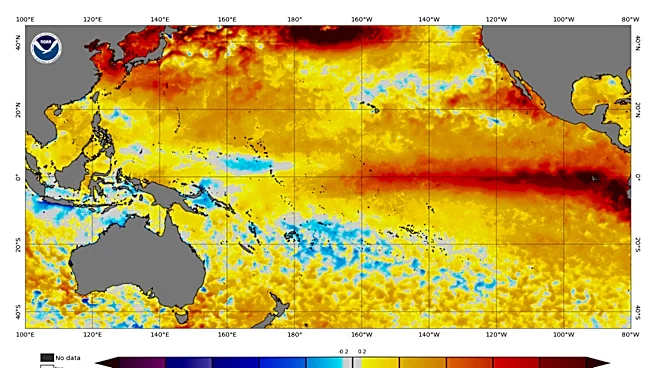
El Niño conditions have developed in the tropical Pacific Ocean and are expected to strengthen considerably before winter, according to the National Oceanic and Atmospheric Administration.
NOAA's Climate Prediction Center said in its latest El Niño update that the climate pattern has strengthened over the past month and has a 97% chance of continuing into early spring 2027. There's also an 81% chance El Niño becomes "very strong" from October through December, potentially ranking among the strongest events on record since 1950.
That has fueled early interest in what a potentially powerful El Niño− sometimes referred to online as a "Super El Niño"−
could mean for winter weather across the United States.
It's still far too early to predict individual snowstorms, cold snaps or exactly how much snow Columbus will receive. But both NOAA's long-range outlooks offer some early clues about what Ohioans could experience this winter.
Here's what we know so far.
Is a 'Super El Niño' coming this winter?
A very strong El Niño is increasingly possible, but "Super El Niño" isn't the terminology NOAA is using in its official forecast.
El Niño occurs when sea surface temperatures across portions of the central and eastern equatorial Pacific become unusually warm and interact with the atmosphere. Those changes can alter weather patterns thousands of miles away, including across the United States.
El Niño conditions are already present. NOAA reported July 9 that sea surface temperatures were more than 1 degree Celsius above average across a large portion of the central and eastern equatorial Pacific, while atmospheric conditions also reflected a strengthening El Niño.
NOAA's models expect it to continue intensifying through the end of 2026. The agency gives the event an 81% chance of reaching "very strong" strength during October, November and December.
Researchers at NOAA's Geophysical Fluid Dynamics Laboratory are also watching the potential for an exceptionally strong event. Experimental forecasts released in July indicated continued intensification through fall, potentially peaking in late fall or early winter.
But a stronger El Niño doesn't automatically mean more extreme weather everywhere. NOAA cautions that even the strongest El Niño events don't produce the typical impacts in every location. Instead, a stronger event increases the odds that characteristic El Niño weather patterns develop.
What could El Niño mean for Ohio this winter?
For Ohio, history provides some hints.
National Weather Service research into El Niño's effects on the Ohio Valley and lower Great Lakes found that winters during El Niño events have generally been warmer and drier than normal, with below-normal snowfall at many locations away from areas heavily influenced by lake-effect snow.
The influence of El Niño also tends to become more pronounced during late fall and winter than during summer.
NOAA's latest long-range outlook similarly favors a shift toward an El Niño-like pattern as winter approaches, including increased chances for above-normal temperatures across portions of the eastern United States.
Still, El Niño is only one factor influencing Ohio's winter weather, and long-range seasonal forecasts describe whether an entire season is more likely to finish above, near or below normal.
Will Ohio have a snowy winter in 2026-27?
It's too early to know.
While El Niño can influence snowfall patterns across the United States, its presence alone cannot determine how much snow Columbus or other parts of Ohio will receive during an entire winter.
Seasonal forecasts can indicate whether precipitation is more likely to finish above or below normal, but snowfall depends on several factors, including temperatures and the tracks of individual storms.
More reliable information about Ohio's overall winter pattern will become available this fall, while forecasts for individual snow events won't become clear until much closer to their arrival.
Trending reporter Amani Bayo can be reached at abayo@dispatch.com.
This article originally appeared on The Columbus Dispatch: Could a 'Super El Niño' shape Ohio's winter? Here's what to know