



If your phone has been lighting up with texts asking who you're voting for in November, you're not alone.
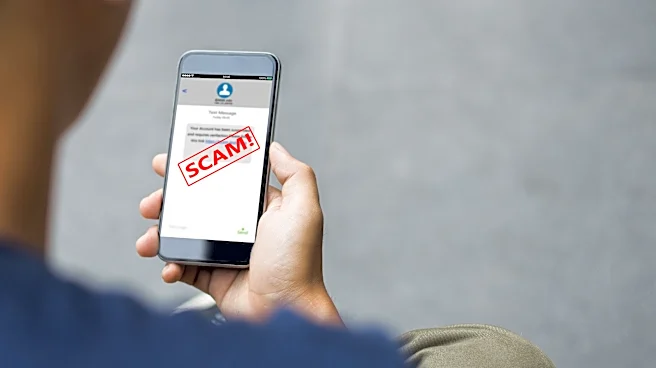
Political campaigns, organizations and pollsters frequently use text messages to reach voters, particularly as Election Day approaches. But scammers can also take advantage of current events and political interest to get people to respond, click links or provide personal information.
That can make it difficult to know whether to reply "STOP," block the number or simply ignore the message.
Roland Kreml, a senior lecturer in computer science and engineering at Ohio State University who teaches information security and social engineering, said he receives the messages himself.
"I just ignore them," Kreml said. "I just don't know if they're real
or not."
Here's what to know about political texts and what consumers can do about them.
Why am I getting political texts?
You don't necessarily have to give a political campaign your phone number directly to end up on a texting list.
Political campaigns and organizations can obtain contact information through voter records, data brokers, consumer information, verified cellphone lists and other sources.
Making a political donation is another way a person's information can end up on lists of potential donors.
Kreml said the availability of personal information makes it possible for senders to reach people who don't remember ever providing their number.
Scammers also may use politics simply as a way to start a conversation, Kreml said.
"A lot of times these things are taking advantage of current events," Kreml said. "They don't really care about your political thoughts. They're just trying to see if you'll respond to them."
A message that appears to be seeking a political donation, for example, doesn't necessarily mean the money would actually reach the candidate or organization named in the text, Kreml said.
Should you reply 'STOP' to political texts?
It depends on whether the message is legitimate.
For robotexts covered by Federal Communications Commission consent requirements, consumers may revoke consent using reasonable methods, including responding with words such as "STOP," "QUIT," "END," "REVOKE" or "OPT OUT."
Replying "STOP" to one political organization won't necessarily end political texts from other senders. FCC rules require senders to honor applicable opt-out requests, but those requests are specific to the sender.
And when the sender is suspicious or unfamiliar, Kreml recommends not responding at all.
"If you type in STOP, a lot of times it lets them know, 'Hey, you're going to respond,'" Kreml said.
Kreml compared it to seeing a fishing bobber move: A response can tell someone sending malicious messages that there's an active person on the other end.
"If it's truly from a real institution and you send, 'Please remove me from your list,' they are required to do it," Kreml said. "But if it's somebody that's not a big org like that and they're up to no good, then they are not going to follow that."
Ohio Attorney General guidance similarly warns consumers not to interact with suspected scam communications. Its February guidance says interacting with an unwanted robocall, even in an attempt to opt out, can confirm that a number is valid.
Are unsolicited political texts legal?
Political text messages aren't automatically illegal simply because the recipient didn't ask to receive them.
FCC rules distinguish between messages based in part on how they are sent and whether the sender was required to obtain the recipient's consent.
The FCC requires prior express consent for political campaign texts sent using an autodialer to a cellphone. Political texts sent manually are not subject to that same restriction.
That means the circumstances surrounding a text− including how it was sent− can determine what rules apply.
Does the Do Not Call Registry stop political texts?
Don't count on it.
The National Do Not Call Registry primarily restricts telemarketing. Political organizations and telephone surveyors are among the groups exempt from its restrictions, according to the Ohio Attorney General's Office.
That means registering a phone number may reduce commercial telemarketing without eliminating political outreach.
The Attorney General's Office recommends asking exempt organizations to place your number on their own internal do-not-call lists and says most legitimate organizations maintain such lists.
Blocking a suspicious number can prevent additional messages from that particular number, but it may not stop unwanted texts altogether.
Kreml said malicious senders can use multiple phone numbers, meaning another message could arrive from a different number even after the first is blocked.
Phones and wireless carriers also offer spam filtering and blocking features that can help identify suspicious communications. Kreml said reports from multiple users can help carriers recognize patterns associated with spam.
That is similar to why some incoming calls automatically appear with a potential spam warning.
How can you spot a political text scam?
Kreml said consumers should be particularly cautious when an unsolicited message tries to provoke an emotional reaction or quickly move them into another action, such as clicking a link, donating money or providing information.
"They're going to try to work off of your passions," Kreml said.
Even seemingly harmless questions can provide information about a person, he said. A scammer who gets someone to answer an initial question can continue the conversation and gradually ask for more information.
Kreml described the tactic as an electronic version of an old-fashioned confidence scheme.
"It's a con game," he said. "It's old-fashioned con games. It's just in electronics now."
His simplest advice for a message whose legitimacy you can't determine: Don't engage.
How can you report unwanted or suspicious texts?
Consumers have several options.
The Ohio Attorney General's Office recommends using a phone's built-in "report junk" or spam feature when available. Consumers can also check with their wireless provider about available blocking features.
Suspicious spam texts can also be forwarded to 7726, which spells "SPAM" on a phone keypad.
Potential scams can be reported to the Ohio Attorney General's Office at 800-282-0515 or through its consumer protection website.
Report a consumer complaint to the Ohio Attorney General's Office
Consumers can also report unwanted calls and texts to the FCC.
Trending reporter Amani Bayo can be reached at abayo@dispatch.com.
This article originally appeared on The Columbus Dispatch: Getting nonstop political texts? Here’s what you can do to stop them