


Doug Plank knew exactly what hit him. He’d done this so many times that even when his helmet broke, he barely took a break to absorb the shock of what happened.
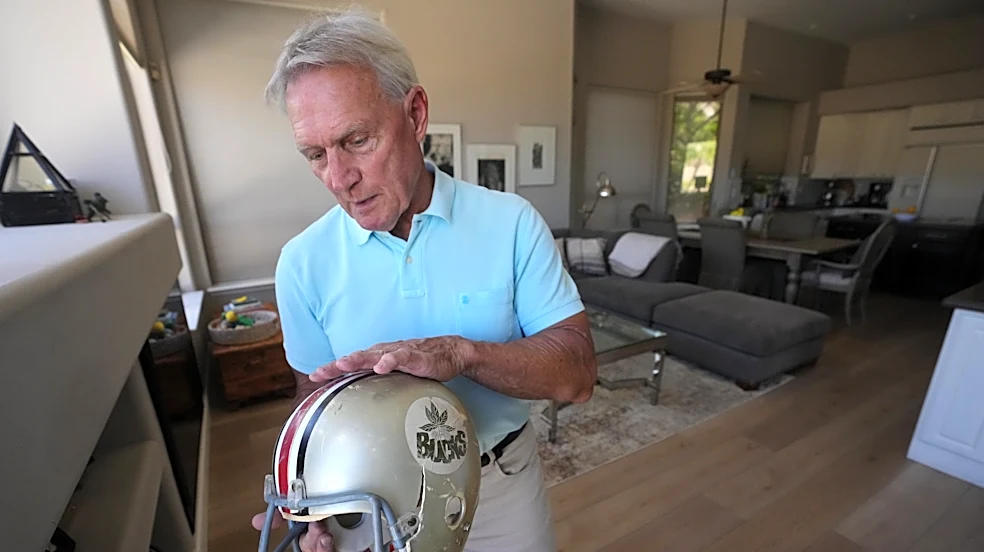
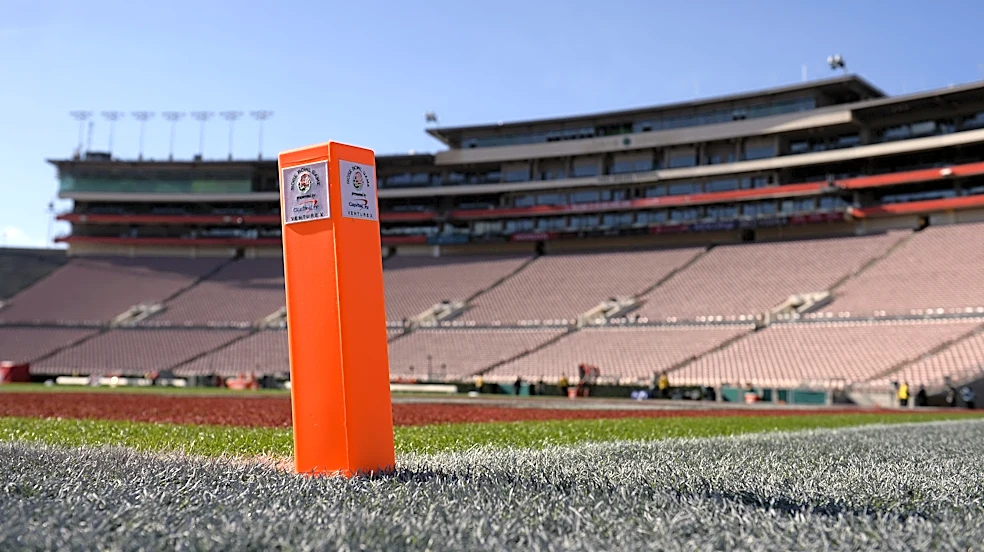
Plank tackled a USC player so hard during the 1975 Rose Bowl game that his helmet cracked across the side and the facemask came loose.
“All of a sudden I get up and I'm dizzy,” he said. “I can barely stand up and you know the world is just moving all around me.”
He ran over to Ohio State’s sideline where a coach helped him tape up his helmet and sent him back into the game. Plank isn’t sure if he had a concussion, but he’s sure he suffered from several throughout his college and professional career with the Chicago Bears.
A safety and cornerback, Plank played at Ohio State from the 1971
through 1974 seasons. Luckily for today’s Buckeyes, the helmets have evolved since Plank played and breakthroughs in technology show diagnosing concussions could soon become clearer and easier than ever before.

Buckeye helmets, for example, vary by position and also differ in quality and cost, according to data from Virginia Tech University's Helmet Lab. The lab rates helmets on a system of one to five stars to help identify which ones better reduce the risk of concussions.
“There's huge differences in these helmets,” said Barry Miller, director of outreach and business development for the helmet lab. “All cars have to pass a basic safety test, why not helmets? The public should have this data.”
Ohio State plays with five different types of helmets, including three made by Riddell and two made by Schutt.
One helmet, the Riddell Axiom 3D, is rated at five stars and costs $1,200 while the team's Riddell Speedflex TrueFit costs $950 and is rated at four out of five stars, helmet lab data shows. Riddell's Axiom 3D is the third highest-rated helmet by Virginia Tech and the company's TrueFit model is the fifth best helmet rated by the university lab.
The NCAA declined to comment for this story and Riddell did not respond to requests to comment.
The other three helmets used by the university were not listed with a rating as of Oct. 8. While most helmets are more or less one-model-fits-all, Ohio State is experimenting with a new type from Schutt that is built for a specific player's head, said Doug Calland, a senior associate athletic director who oversees sports medicine and athletic training.
"It wasn't too long ago that the football helmet shell hadn't changed in 30 years," Calland said. "They're becoming more position-based now."

'It's not all about football'
In 2024, Ohio State began requiring players to wear helmet shells, more commonly known by the brand name Guardian Caps, in practice. The puffy, boxy add-ons can blunt the force of a hit, though conflicting studies have shown their effect is unclear.
The NCAA also allows players to wear Guardian Caps in games. But to date, no Buckeye has worn one in a game, Calland said.
If research eventually proves that college players would benefit from wearing the helmet shells in games, Ohio State Athletic Director Ross Bjork said it's something Ohio State would consider requiring.

"That's where you're going to rely on the (medical) expertise," Bjork said. "A player does have a choice to wear it in a game. It really hasn't found its way into college football yet."
While Calland understands why Guardian Caps are being worn in practice, he said he isn't sure how much protection they really add for players. Although Guardian Caps can help, Miller warned they won’t “turn a two-star helmet into a five-star helmet.”
Regardless, one former Buckeye decided he's not taking any chances when it comes to the caps.
Chris Olave, a wide receiver who played for Ohio State from 2018 to 2021 and now plays for the New Orleans Saints, said he will wear a Guardian Cap in all games going forward.
“I want to be able to live the long game. It’s not all about football,” he said. “I want to live a regular life after I’m done with football… I just got to throw it on.”
Olave said he’s suffered several head injuries over the years. One of them came during the Buckeyes’ season opener against the Nebraska Cornhuskers in 2020.

The Saints star said he wants to ensure he’s around for his kids as long as he can be, once his playing days are over.
The epiphany hit Olave —literally— during practice one day in August.
During a play, the wide receiver said he ran deep for a ball and ended up hitting his head pretty hard. But, he believes the Guardian Cap he had on during practice kept him from suffering another concussion.
“I don’t really care how it looks no more,” he said. “I’m just trying to protect myself at the end of the day.”

How advances in tech could be a game-changer
While testing for head trauma has remained difficult, upcoming advancements — including ones being made right here in Ohio — could prove to be game-changing.
In the not so distant future, a contact lens might be able to diagnose a concussion in an athlete while the game is going on, said Edward Meng, an assistant professor of computer engineering at Cedarville University, about 60 miles west of Columbus.
Meng is working with colleagues at the Auburn University to develop a lens that would detect a change in eye movement. When someone suffers a concussion, they typically lose control of the muscles around their eyes for about 20 milliseconds, Meng said.
“The eyes are known as the window to our souls,” Meng said. “But we can also use them as the window to our brains with concussions.”

Meng and his colleagues have already tested their theory in the lab using sensors on test dummies and on human participants. The results, he said, have been promising. They’re now seeking grant funding to begin developing a wearable lens that could one day be worn by actual athletes.
Though Meng’s contacts may still be years away, sensors are already being used to detect and test the level of impact football players encounter in games and practices.
At Carnegie Mellon University, researchers partnered with the University of Rochester in New York to place accelerometers in the school’s football helmets for a season.
The sensors measured acceleration and recorded every contact that registered a gravitational force of 10 or greater. By comparison, that's three times the force an astronaut feels on a space shuttle during lift-off, and nearly double what a race car driver experiences. Car crashes can cause a brief gravitational force of more than 100, according to Carnegie Mellon.
Near the start of the season, players underwent an MRI scan so researchers could set a baseline for their brains. Then near the end of the season, regardless of whether they suffered a concussion, players underwent another scan.
The results showed that even smaller hits caused damage to the “white matter” in a player’s brain, which could in turn impact memory, thinking, balance and mobility, research shows. Now, researchers Brad Mahon and Adnan Hirad who led the study, want to develop a sensor that could alert athletic trainers when someone has suffered too many blows to the head and may need to sit out a game or two.
“There’s still a huge amount of science to be done,” Mahon said. “But the hope is maybe you could build a device that actually predicts when injury has accumulated to unsafe levels prior to the emergence of signs and symptoms.”

Any new tech that better protects players would be welcome news to Will Howard, the former Buckeyes quarterback now on the Pittsburgh Steelers roster. Howard suffered a head injury during the Steelers’ final preseason game this year.
And while advances in sports medicine are often first deployed in the NFL, Howard said he’s hopeful they continue to “trickle down” to the NCAA at a faster pace.
“Football is a great game and a lot of people are scared away from it because of injury,” he said. “There’s a right and a wrong way to play football. If you play it the right way and you keep yourself safe and you keep the people around you safe it’s the best game in the world.”
Dispatch investigative reporter Max Filby can be reached by email at mfilby@dispatch.com. Find him on X at the handle @MaxFilby or on Facebook at @ReporterMaxFilby.

This article originally appeared on The Columbus Dispatch: Are Guardian Caps the answer? How tech advances could change the game on concussions