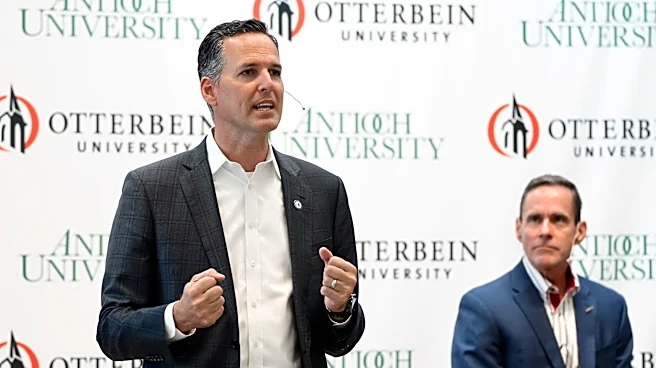








Three years ago, Otterbein University and Antioch University were widely praised for forging a new kind of partnership that gave many in higher education hope for another path toward survival in an increasingly challenging marketplace.
Now, that marriage appears to be headed toward divorce.
Leaders at Antioch — a private university headquartered in Yellow Springs with multiple campuses across the country — have filed two lawsuits in Greene County Common Pleas Court against the Coalition for the Common Good (CCG) seeking to block what Antioch has called a “hostile takeover” of its governance system. The university alleges that the CCG attempted to dissolve Antioch's Board of Governors, take control of its bank accounts and fire Antioch President
Lori Varlotta.
Varlotta also filed a separate lawsuit in a California court alleging gender discrimination against the CCG and more than a dozen individuals – including Otterbein President John Comerford.

The two private universities launched the CCG in July 2022 with both practical and noble plans in mind. Otterbein and Antioch, which was founded as Antioch College in 1852, were set on being the first schools in what would become a network of like-minded nonprofit, independent universities.
Leaders forged the partnership in the belief that the future of higher education is with graduate and adult education programs, continuing education and degree-completion programs. Affiliated universities in the coalition would focus on shared graduate and adult-learner programs, while maintaining their own distinct undergraduate programs and brand identities. Members could also share services to help reduce costs.
Their arrangement took more than two years to develop and aimed to establish a different kind of merger, one where two universities could have a marriage of equals rather than the complete takeover of one institution by another that often happens in higher ed.
But according to court filings and an advocacy website created by Antioch supporters, the CCG arrangement and its governance structure appear to be at the root of the conflict.

When the CCG was founded, it formed a nine-member governing board of directors: four directors appointed by each of the institutions and a ninth member, not affiliated with either university, appointed by the board. The presidents of each university served as executive vice presidents of the coalition.
The U.S. Department of Education required the new partnership to submit at least two years of financial audits during the initial approval process in order to be eligible for federal funds like federal student aid.
Negotiations between the two universities determined that Antioch would provide the audits. But in doing so, Antioch would become a division of the CCG. Antioch's board of governors resigned and were reorganized as an advisory board.
Antioch believed the move would be temporary until the CCG could maintain its own records.
But Otterbein leaders disagree. They believed the move was permanent, with Otterbein remaining completely independent.
Comerford told The Dispatch that Antioch would be a "joint venture" under the CCG, with Otterbein and any future members funding Antioch through the partnership.
That doesn't mean that Otterbein has free reign, Comerford said. Any new programs or new debt that Otterbein would want to take on needs approval by the CCG's board.
Otterbein leaders said the CCG was running smoothly until about nine months ago. That's when Varlotta, who was hired as Antioch's new president in August 2025, presented a report she prepared assessing how well the CCG was operating.
According to Antioch, the report was the product of months of visiting the university's campuses and analyzing financials for Antioch and the CCG. Her final report ultimately raised concerns about the CCG's long-term financial viability. When she went to give her report, Antioch leaders said Comerford and CCG Board Chair Dan Gifford postponed reviewing it.
Varlotta alleged in her gender discrimination lawsuit that Comerford "repeatedly labeled the analysis 'biased' and 'manipulative,' described it as 'entirely negative,' 'a full attack on the CCG' and a 'full disavowal of what we are trying to build here.'" Her lawsuit also alleged that she was intimidated and retaliated against for months following.
"The CCG claims the mantle of the Common Good. But when Dr. Varlotta raised hard questions, its leaders answered with personal attacks, a separation agreement that named her last day, and resolutions purporting to dissolve Antioch’s board and take control of its resources," said Katy Young, an attorney representing Varlotta in her gender discrimination lawsuit. "You cannot serve the common good by discriminating against women leaders, silencing constructive critics, punishing dissent, and dismantling a partner’s independence."

Comerford told The Dispatch that Varlotta's analysis isn't accurate, and he said the CCG is doing well financially and making strides after some of its programs took longer than expected to transfer.
Antioch and the CCG went back and forth for months over the governance structure. But in late August, the CCG board escalated the situation when it voted to dissolve Antioch's advisory board, as well as take over of its bank accounts and communications with its accreditor, according to the lawsuit.
Comerford also sent Varlotta a letter terminating her employment, which Antioch alleged he doesn’t have the power to do.
Antioch filed an initial lawsuit on Aug. 28, which led to the court imposing a temporary restraining order. Greene County Court of Common Pleas Magistrate Stephanie Hayden lifted that restraining order on Sept. 28 and ruled against Antioch’s request for an injunction against the CCG board’s moves. Hayden said Antioch’s advisory board lacked the legal standing to sue.
Therese Cannon, an education consultant and attorney who sits on both Antioch and CCG's boards, filed a new, nearly identical lawsuit on Sept. 29, in which she alleged the CCG's proposed actions would violate “contractual arrangements and governing documents."
In a statement, the CCG said it has "both the authority and the fiduciary responsibility to ensure Antioch University has clear, effective governance focused on students, academic quality and long-term sustainability."
Varlotta is currently on paid administrative leave while the CCG "reviews performance-related matters," according to the CCG. The group has also hired independent external investigators to look into Varlotta's gender discrimination claims.
"The investigation did not substantiate allegations of harassment or discrimination, and the appeal process related to that matter is now in its final stages," the CCG statement read. "The CCG Board remains focused on supporting Antioch’s students, faculty and staff and ensuring strong, effective leadership for the university."
But Varlotta said in a statement that Antioch's fight is not over yet.
“For months, Antioch has sought mediation aimed at an amicable separation from the CCG," Varlotta said. "We did not choose this legal battle, but we are prepared to fight it."

Higher education reporter Sheridan Hendrix can be reached at shendrix@dispatch.com and on Signal at @sheridan.120. You can follow her on Instagram at @sheridanwrites.
This article originally appeared on The Columbus Dispatch: Otterbein and Antioch's partnership was widely praised. Now it's headed to court.