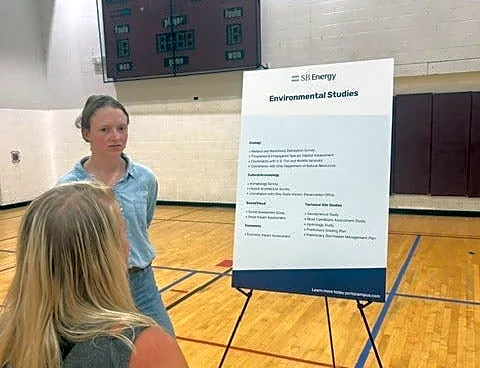








WAVERLY — Large posters lined center court in the gym of Pike County 's branch YMCA Aug. 27. Beside them, representatives of SB Energy took questions from residents about a massive power plant to be built in southern Ohio for a data center campus, the country's largest of its kind, government and company officials say.
If completed in a goal of about six years, the economic impact to Ohio alone, including about 35,000 jobs for construction (roughly the population of every person in Upper Arlington), along with new roads, natural gas lines and other upgrades could reach $500 billion — nearly five times Ohio's annual budget.
The open house posters included overviews of environmental impact, timeline and electricity usage with SB Energy staff beside
each one. But one of them, an aerial view of the site, about five miles south of this city of about 4,500, showed surrounding homes. This area drew most of the 50 or so residents who attended the two-hour open house for PORTS-Pike Energy Center.
"I'm waiting for at least a couple million," said a man, one of several lifelong residents of the area, who saw their homes on the map and wondered what might be in it for them. "I've heard the payment is 60 to $70,000 an acre."
Many live within a half-mile of the build-out site that, according to the map, which extends beyond the government-owed land of about 1,000 acres within the now-decommissioned Portsmouth Gaseous Diffusion uranium enrichment plant. The remaining U.S. Department of Energy acreage includes a water treatment plant, sediment ponds, closed landfills, cylinder storage yards and forested buffer areas.

Large swaths of land outside the government area is targeted for the buildout, according to the map.
Few wanted to jeopardize a potential offer for their land by being named. One woman said only "Other neighbors have gotten an offer. It seems random." Her husband added "We're not really supportive of what all is going on. But it could work out to our advantage."
The open house was the second held in the YMCA and is required as part of the Ohio Public Utilities Commission review process for the portion (about one-fifth) of an expected 10 gigawatts of power generation, most of it fueled by natural gas turbines, sourced from eastern Ohio shale drilling. Future public hearings and events are expected.

COO of SB Energy tells manufacturers "Why not Ohio?"
Just hours before the open house, Abhijeet Sathe, the co-CEO of SB Energy, a U.S. subsidiary of Japan-based SoftBank, told the Ohio Manufacturer's Association at a Columbus conference that the plant is being built at "world-record speed" and that: "We're going to be your neighbor for six years. Why not be good neighbors? Why not Ohio?"
SoftBank, through a tariffs-relief trade agreement announced earlier this year with the U.S. Department of Commerce, is funding much of the buildout, along with OpenAI, Nvidia, U.S. Department of Energy and others.
The partnership, including the world's wealthiest companies, are all but guaranteeing success, he said.
Sathe called the plans "the world's largest construction project, period," and said that Ohioans including mechanics, engineers, plumbers and construction and an array of others, even motel owners, would benefit, as the more than 17-building energy campus evolves.
What about those massive gas turbines?
The Dispatch has previously quoted expertswho have said that a backlog in orders of natural gas turbines — jet-engine like powerhouses that can take years to build and cost billions of dollars — would stall, or even derail hyperscale projects like this.
SB Energy's PORTS-Pike Energy Center project has apparently solved that problem, already having acquired the turbines needed to power about a fifth of the project's almost 10 gigawatts of power.
During the open house, Scott Valentino, SB's vice-president of power development, told The Dispatch that his company "made commitments early on" to acquire generators from both GE and Siemens Energy.
"We had reservation agreements. We were early in the queue."
"We got GE's attention. We were buying nine, 10 gigawatts of power generation. For them, this is more of a strategic relationship right now," said Valentino.
The turbines can last up to 50 years, Valentino said. But as technology changes their efficiency can be improved, one day even fueled by hydrogen, using excess power to produce the clean fuel via electrolysis, separating hydrogen from water via an electricity current, as done in many high school science classes.
"This day was something I never envisioned in my career," said Valentino. "No one ever thought five years ago we'd be building 10 gigawatts of generation in one plant."
Many residents unsure if benefits outweigh massive change
Tina Perkins, 68, worries about ground water contamination and property values.
"They say they are working with hydrology engineers. So my next question was 'Are they actually going to come on site, or are they going to sit in their offices in Timbuktu and draw out the plans?'
"I was told they (scientists) had already been to the site and had topographical maps and everything."
As for home values, she said "I think they have already risen and are going to go up, but I think when this big boom is over, they're going to bottom."
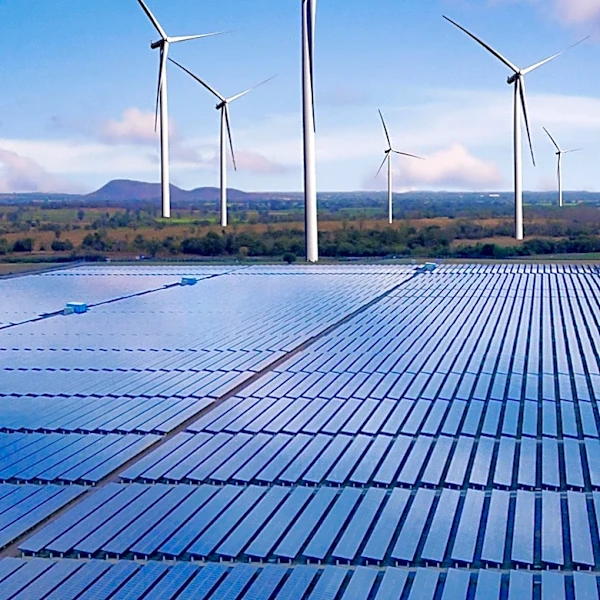
Overall, Perkins added, "Why don't they use solar and wind?" Experts have said that renewable energy isn't reliable enough to support around-the-clock power required of large data centers.
Jim Littleton, 77, a neighbor of the site since 2011 and a former employee of the uranium enrichment plant in the early 1980s who has undergone cancer treatment, said he's not willing to move and he's worried about noise and pollution. He learned about expansion plans on private property last fall when he saw surveyors in a big field across the road from him on a neighbor's property.

"But they're really just trying to force us out, and don't really want to pay for it," Litteton said. "It's a feeling that they're trying to push us out."
"Just think about the traffic we're going to have in the area," he said. "What needs to happen is they're going to have to come back inside the (uranium) plant area and build everything there. It's already government controlled. Keep it there. And don't be trying to force out the rest of us."
Mark Fielder, one of Pike County's five parks commissioners, said he attended to learn more. He's all for technology advances "as long as it doesn't affect what we're trying to stand for," adding "It's kind of hard to not be progressive."
Others want nothing to do with data centers without guarantees of their benefits and safety.
"We want assurances," said Kaya Coyan, collecting signatures at the event for a statewide ban on data centers greater than 25 megawatts. "Assurances that we're going to be healthy when these things come."
Water, air quality, electricity consumption, artificial intelligence taking jobs and "people's progress" versus benefits enriching billionaires are her chief concerns.
"There's people all over who have well water. Are our wells going to be safe?" she asked. "What do wars start over? Resources."
Growth and development reporter Dean Narciso can be reached at dnarciso@dispatch.com.
This article originally appeared on The Columbus Dispatch: Massive AI data center complex eyes buyouts, 'record speed' in southern Ohio