




With just three months left as Ohio governor, people are lobbying Mike DeWine for last-minute pardons and commutations.
"Death Penalty Action is calling for Gov. DeWine to free the innocent and commute the rest of Ohio's death row before leaving office," said Abe Bonowitz, a long-time advocate against capital punishment. "He's been very quiet about this, so all we can do is keep asking. We and a broad coalition of others are calling and writing him and drawing attention to this matter in any way that we can."
The ACLU of Ohio is running an email campaign to urge DeWine to issue commutationsfor everyone on death row who has exhausted their judicial appeals.
Governors hold the constitutional power to grant clemency to someone convicted of a crime,
an extraordinary tool that can un-do the work of another branch of government. A pardon is official forgiveness for a crime, a commutation is a reduction in a sentence and a reprieve is a delay in a scheduled execution.
Over the past eight years, DeWine's practice has been to make clemency decisions throughout the year.
Since he became governor in January 2019, DeWine received 2,252 clemency applications; he granted 396 and denied 1,413; and 446 are still pending. He can exercise clemency power until his last day in office, Jan. 11.
How does clemency work in Ohio?
A pardon removes hurdles to housing, education and employment that often come with a criminal conviction. It doesn't convey innocence or exoneration, but it's an act of mercy and forgiveness. A commutation is a reduction in a criminal sentence.
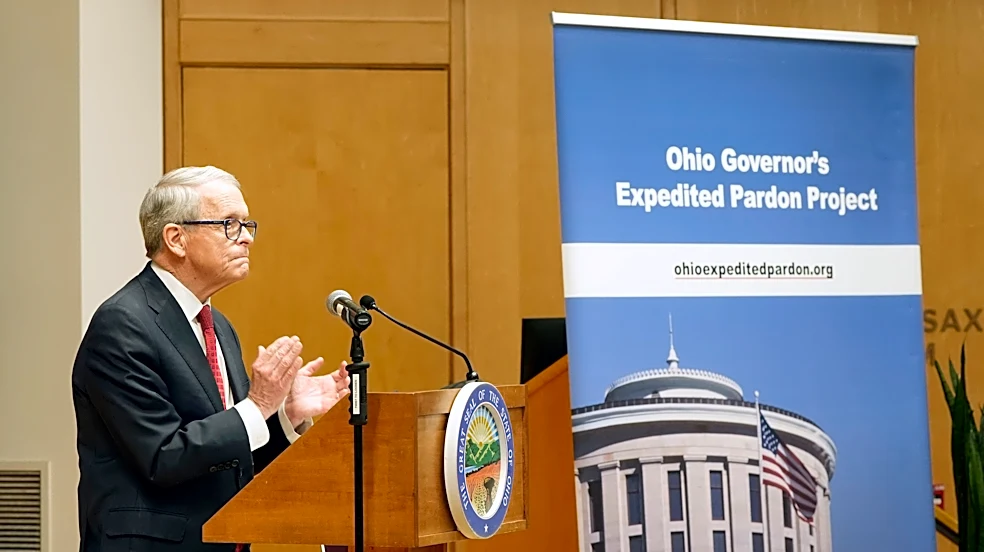
Under DeWine, there are two paths to a pardon: the traditional route, which can take more than a year, and the Expedited Pardon Project, which partners with law schools to fast-track pardon applications.

The Expedited Pardon Project has received more than 1,900 applications and resulted in 323 pardons and 14 denials. DeWine created the project in 2019 as an alternative for one-time, non-violent offenders who have lived model lives for at least a decade. Students and staff at law schools, including the University of Akron, the University of Cincinnati and Ohio State, help applicants assemble the required paperwork and make sure they meet qualifications.
The traditional route is open to all but can take more than a year and has a lower success rate.
On Aug. 31, the USA TODAY Ohio bureau asked the DeWine administration for the clemency applications for everyone granted a pardon through the traditional path since DeWine became governor. The request, which was made through Ohio’s open records law, is still pending.
In Ohio, state law bars the governor from granting clemency before the Ohio Parole Board has weighed in on an application. The board sends unfavorable recommendations for applications it determines lack merit. For applications that deserve more attention, the board will hold a hearing and then issue a recommendation to the governor. In all cases, the governor doesn't have to follow the parole board's recommendation.
Who wants clemency from Mike DeWine?
DeWine, a former county prosecutor, hasn’t indicated whether he’ll grant clemency in the closing days of his governorship. But here is a sample of who’s asking:

Kevin Keith was convicted in 1995 for three murders in what police called a revenge killing over drugs, but he has always maintained that he is innocent. In 2010, then Gov. Ted Strickland commuted his death sentence to life in prison without parole. In December 2022, the Ohio Parole Board recommended against clemency for Keith, the subject of a Kim Kardashian podcast about wrongful conviction. His application is pending before DeWine.

Keith LaMar was accused of orchestrating the killing of five fellow prisoners in Lucasville, Ohio, on Easter Sunday of 1993 in what remains state’s largest-ever prison riot. From the beginning, he has denied responsibility in the uprisings and murders. In the ensuring decades on death row, LaMar has built a following of supporters. His supporters, led by Amy Gordiejew, said LaMar is asking for a clemency hearing from the parole board, which isn't granted to all applicants. Ohio DRC said it has not received a clemency application from LaMar.

Tyrone Noling, who is represented by the Ohio Innocence Project, is on Death Row and seeking a new trial as well as a pardon. Noling maintains his innocence in the 1990 double murder of a Portage County couple. The Ohio Parole Board recommendedthat Noling's sentence be commuted to life in prison with possible parole after Jan. 1, 2029. "Tyrone Noling should receive a full pardon because he is an innocent man, on Death Row for a crime he did not commit. The evidence of that, at this point, is very strong. The executive is intended to have the authority to step in and correct injustices," said Brian Howe, Noling's attorney.
Angela Garcia’s home in Cleveland caught fire in 1999, killing her two young daughters. She was convicted and given two life sentences. In 2015, she won a rare evidentiary hearing for a new trial because of advances in arson science. Her attorney, Joanna Sanchez, said evidence showed the fire was accidental, likely caused by faulty wiring. In 2016, Garcia opted to accept a plea deal to reduced charges, rather than gamble on getting another guilty verdict at a new trial. "But that plea did not change what the scientific evidence proves: Angela Garcia did not murder her children. Because Angela is innocent, we are requesting that she be pardoned," Sanchez said. She added that a pardon application will soon be submitted to the parole board.
Gail Ritchey is serving a 15-years to life sentence for a 2022 murder conviction in Geauga County. In 1993, while working as a nanny, Ritchey gave birth in secret to a baby boy, who she thought was stillborn. She disposed of the body in a wooded area days later. Fifteen years later in 2018, a DNA sample from a trash bag found near the body identified Ritchey as the mother. Different experts testified as to whether it could be determined that the baby was stillborn or born alive. Ritchey lost her appeal and both the Ohio Supreme Court and U.S. Supreme Court declined to consider her case. Her clemency application is pending before the parole board.
Emile Weaver was sentenced tolife in prisonfor the death of her newborn baby, who was found in 2015 in a trashcan behind a sorority house at Muskingum University in New Concord. The trial judge gave her life without parole. In a 4-3 decision issued in 2022, the Ohio Supreme Court ordered a new sentencing hearing. Under her new sentence, Weaver is now eligible for parole in 2035. Her clemency application is pending before the parole board.
Previous governors' track records on pardons
Ohio governors grant pardons at different rates and for different reasons. No governor in modern history has commuted a death sentence to set a prisoner free.
DeWine granted clemency in 22% of the cases where he has made a decision, including the expedited pardons.
Republican John Kasich granted just 86 pardons among the 2,291 applications − 3.7%.
Democrat Ted Strickland approved about 20% of the 1,615 clemency applications he received. Most cases involved low-level, nonviolent offenses, but he commuted five death-penalty sentences to life in prison without parole.
Republicans George V. Voinovich, governor from 1991 to '98, and Bob Taft, governor from 1999 to 2007, each approved less than 10% of the clemency requests.
Democrat Richard F. Celeste, governor from 1983 to 1991, touched off a legal battle in the final days of his second term when he commuted the death sentences of eight men and granted clemency to 25 female prisoners who were victims of battered-woman syndrome. Legislators then changed state law to require governors to have a parole board recommendation before making a clemency decision.
State government reporter Laura Bischoff can be reached at lbischoff@usatodayco.com and @lbischoff on X.
This article originally appeared on The Columbus Dispatch: Ohio Gov. DeWine weighs pardons, commutations before leaving office