





The concept seems simple: Do your job well. Get a raise.
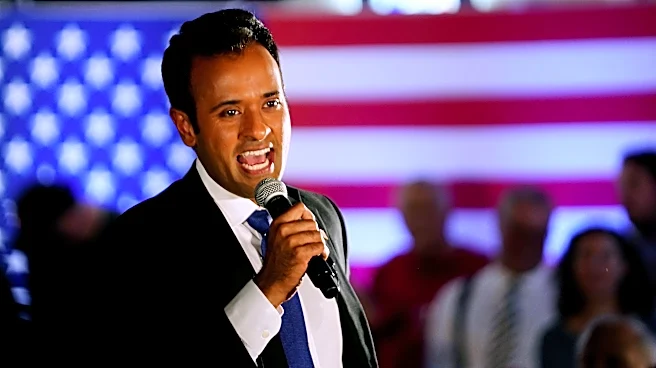
That's the pitch Republican gubernatorial candidate Vivek Ramaswamy has made for merit-based pay for Ohio's public teachers and administrators.
"We have to start paying for performance for the teachers where the best ones should get paid more for helping our kids excel in reading and writing and math, where they are falling behind," Ramaswamytold FOX News last year. "But that means we have to cut a lot of the dead weight hanging around that isn't serving our kids well either."
The push for merit-based pay is not new. It has been around since the 1920s. The idea had a resurgence in the 1960s when about 10% of U.S. school districts had merit pay plans. But many of those programs ended shortly
after because of problems with overreliance on testing, union opposition, favoritism and funding shortages, to name a few.
"I have not heard one concept from Ramaswamy that's a new concept," said Melissa Cropper, president of the Ohio Federation of Teachers, which endorsed Ramaswamy's Democratic opponent, Dr. Amy Acton. "He's basically rehashing old policies that have not worked."

Despite these pitfalls, Republicans and Democrats keep pitching merit-based pay for teachers.
Former President Ronald Reagan, a Republican, advocated for merit payduring a 1983 speech: "Teachers should be paid and promoted on the basis of their merit and competence." And in 2009, former President Barack Obama, a Democrat, encouraged states to adopt merit pay in his signature education policy, Race to the Top. Obama contended: "Too many supporters of my party have resisted the idea of rewarding excellence in teaching with extra pay, even though we know it can make a difference in the classroom."
Does merit pay work?
There's a reason why politicians keep pitching performance-based pay: it can workunder the right circumstances.
“Research says that merit pay can have a positive impact on student outcomes and teacher workforce. I think that’s what draws people to it," said Jessica Poiner, senior education policy analyst at the Thomas B. Fordham Institute, a conservative-leaning education think tank.
But lack of teacher buy-in, overreliance on test scores and a statewide, one-size-fits-all approach can doom even the most promising merit pay programs.
“Research is also very clear that when it comes to the success of these programs, the details matter a lot. The effects of these programs vary based on their design and their context," Poiner said.
For example, paying middle-school math teachers in Nashville up to $15,000 in bonuses didn't improve test scores, according to a 2010 Vanderbilt University study. A review of New York City's performance pay model from the late 2000s found the bonuses didn't improve student achievement, were too small to motivate extra effort and were too reliant on test scores.
Ramaswamy has provided few details on how he would implement performance pay in Ohio. The GOP gubernatorial candidate wants to give local leaders more power to set teacher pay, Ramaswamy spokesman Evan Machan said on July 31.
"After going on a listening tour over the last year with teachers, superintendents, principals and school board members across the state, Vivek is convinced that the first and most important change that needs to be made is to give local school leaders more autonomy in deciding how they reward teachers," Machan said. "That addresses concerns about the difficulty of making accurate cross-school and cross-district comparisons in a top-down manner."
"The sad truth is that school principals and local school boards currently have minimal power to reward the best teachers and few tools to recruit new teachers. Vivek wants to work with local school districts to change that for the better across Ohio," Machan added.
Acton, who is endorsed by education and teachers' unions, opposes Ramaswamy's education policies.
“Vivek Ramaswamy pretends to care about Ohio’s teachers while saying he wants to eliminate teachers unions, accepting millions of dollars from an out-of-state, pro-school voucher billionaire, and proposing scam policies that would gut school funding and pay teachers even less," Acton spokesperson Addie Bullock said.
Has Ohio tried merit pay for teachers before?
Past efforts to implement performance pay in Ohio have fallen apart.
In 2011, a controversial anti-collective bargaining law called Senate Bill 5 included language to replace teachers' automatic pay increases with pay-for-performance. But voters rejected Senate Bill 5, 62%-38%.
"That went over like a lead balloon," said state Sen. Andrew Brenner, a Powell Republican and merit pay supporter. One takeaway from Senate Bill 5, Brenner said, was that lawmakers would have to work with unions, rather than eliminate them, to find a path forward.
But Ramaswamy has a history of criticizing teachers' unions, saying in a 2023 GOP presidential debate: "End the teachers unions at the local level to allow public schools to compete."
Shortly after voters rejected Senate Bill 5, Cleveland schools attempted an innovative merit-based pay program backed by a bipartisan group of lawmakers.
A 2012 law allowed the Cleveland Metropolitan School District to pay teachers based on factors other than the traditional years of service and degrees. Performance evaluations, specialized training and placement in high-need or struggling schools could factor into teachers' pay.
Early signs were promising: about 65% of teachers earned pay bumps in the first two years, according to a 2016 Cleveland.com report. But frustrations over overreliance on performance evaluations and failure to implement the new system fully led to its demise.
A plan to incentivize teaching in more challenging schools never came together. "We saw some of our best teachers who wanted to take on challenging grade levels or schools say 'nope, my compensation doesn't even reward me for doing what I want to do,'" said David Quolke, past president of the Cleveland Teachers Union.
Cleveland's performance pay program was effectively dismantled within five years. It became a cautionary tale of how even a bipartisan-backed deal with union participation can collapse.
"It failed just because we focused on test scores. We didn't focus on the entire teaching profession and how to lift up that profession and the schools that are struggling," Quolke said. "We had a plan, but unfortunately, that piece just fell by the wayside."
AThomas B. Fordham Institute postmortem on the Cleveland program concluded: "until prevailing opinion changes within the profession itself, improvements to teacher pay models will be difficult to sustain."
Could merit pay work in Ohio?
Buy-in could be a challenge in Ohio, where teachers are wary of state-imposed education policies. Senate Bill 5 was a massive fight. Then, Gov. John Kasich pushed a controversial model that allowed the state to take over struggling schools. State lawmakers approved and then scaled back a plan to hold back students who couldn't read by the end of third grade. (Ramaswamy has said the third-grade reading guarantee "makes a lot of sense.")
“Ohio doesn’t have a super great history with top-down teacher policy," Poiner said. “A lot of times when there’s a new statewide policy, there’s just an intrinsic flinching from the ground level.”
Brenner, the Republican lawmaker, blames rigid union contracts for hamstringing state lawmakers' efforts to incentivize better performance. That'll be Ramaswamy's biggest challenge: "You have to figure out: 'How do you work with the existing union structure that’s in place?'" Brenner said.
Cropper, the union leader, said pay raises would attract more talented teachers to Ohio, but that starts with fully funding public education and paying teachers more. It doesn't need to include a complex, potentially flawed method of judging teachers' merit, she said.
"I don't disagree with the concept that higher salaries would be a driver in bringing high-quality people into the profession, but it doesn't have to be a merit-pay system that does that," Cropper said. "Let's just increase what we're paying people."
State government reporter Jessie Balmert can be reached at jbalmert@usatodayco.com or @jbalmert on X.
Tell us what you think
This article originally appeared on The Columbus Dispatch: Ramaswamy revives debate over teacher merit pay in Ohio. Can it work?