





Stephanie Muñoz donates plasma twice a week to bring in extra money for her family.
The 30-year-old Pickerington mother stays at home with her two children, so she doesn't have to worry about the high cost of childcare
. But even with her husband working two jobs, they feel the squeeze. Muñoz said she researches budget-friendly meals online and started shopping at Dollar Tree to find cheaper snacks."There's definitely anxiety sometimes when you see the big change in the prices of apples, or sometimes we see it in just the chicken alone," Muñoz told the statehouse bureau while her family enjoyed the Ohio State Fair.
Muñoz's family isn't alone. As Ohio boasts headlines about development
and business growth, people across the state are anxious about the cost of groceries, gas and electricity.
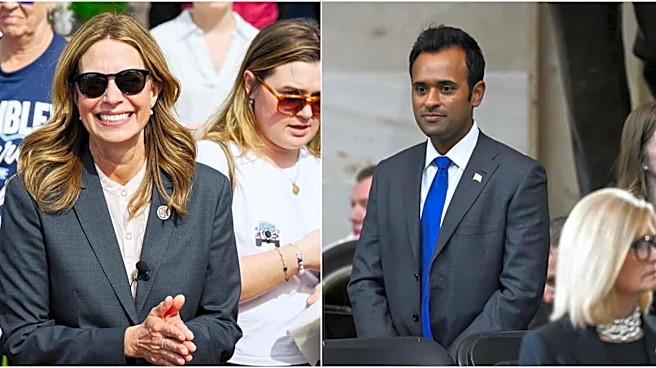
The sour mood about the economy is colliding headfirst with the November election, when Ohio voters will choose a new governor and decide a key U.S. Senate race. Republican entrepreneur Vivek Ramaswamy and Democratic Dr. Amy Acton are vying to replace Gov. Mike DeWine, while Sherrod Brown seeks a political comeback against GOP Sen. Jon Husted.

In some ways, this isn't a new phenomenon. Pocketbook issues are top of mind for voters and candidates in any given election year. For Republicans who control state and federal government, it's an opportunity to tout low tax rates and policies that eliminated taxes on tips and overtime.
But observers contend the anger feels more visceral this time. Democrats hope that climate − a perfect storm of tariffs, war, high property taxes and health care cuts − will motivate voters to reject GOP leadership on Nov. 3.
"It's not an academic discussion about the economy," said Aaron Pickrell, a Democratic consultant who worked for former Gov. Ted Strickland and President Barack Obama. "It's a practical, everyday, looking at your bank account discussion of the economy that you can't get away from. Everybody feels it."
'The economy sucks'
Doug Ingram, 60, who lives in Stark County, put it more directly.
"The economy sucks," he told a reporter.
Polls suggest many Ohioans feel the same. A June survey from the New York Times/Siena found 55% of Ohioans disapproved of President Donald Trump's handling of the economy. In another poll, 44% of Ohio voters cited rising prices and affordability as a top issue, with groceries, health care and utilities among their biggest concerns.
So, what is the state of the economy? Some statistics:
- In July, the cost of goods rose 3.4% from the previous year, according to the Bureau of Labor Statistics. Energy alone increased by 14.7%. (For context, recent inflation peaked at 9.1% in 2022 because of the COVID-19 pandemic.)
- Nationwide, Americans spent an average of $2.19 for a dozen eggs, a $1.41 decrease from July 2025. Beef prices jumped by 63 cents to $6.88 per pound.
- The typical electric consumer in Ohio paid $188.84 for their July bill, up 12% from the year prior, according to the Public Utilities Commission of Ohio.
- Ohio gas prices topped $4 a gallon in August.
- Ohio's unemployment rate was 3.4% in July, down from 4.5% the year prior, according to the BLS.
- A recent report from the Coalition on Homelessness and Housing found Ohio workers need to earn at least $23.82 an hour to afford a two-bedroom apartment. The average renter makes $19.59 an hour, according to the report.

The coalition's executive director, Amy Riegel, said inflation is "gobbling up" increases in worker pay. Ohio's minimum wage increased this year to $11 per hour for non-tipped employees and $5.50 for those who receive tips. The median hourly rate for all jobs was $23.74 as of May 2025, according to the BLS.
"When we have families who are feeling this instability, it doesn’t just affect that family," Riegel said. "It affects the workforce, and it affects all other amenities across the state."
For Kelly Nagy, a 53-year-old from Stow, the economy is a mixed bag.
Nagy said the price of food is affecting the restaurant where she works. Rising costs mean fewer tips, she said, and she and several other servers have gotten second jobs to make up the difference.
But Nagy said it helps that she can now exempt tips from her federal income taxes − a measure included in the budget bill championed by Trump, Husted and other Republicans. She hasn't thought yet about how she'll vote in November, but affordability is top of mind.
"It would be nice to be able to see things affordable again for families," Nagy said.

The doctor vs. the entrepreneur
During Ohio Democrats' annual fundraising dinner, Acton recounted the story of a family in Clermont County hit with $300,000 in medical debt from caring for their premature twins in the NICU.
"This is a story I hear everywhere," Acton told the crowd in August. "Every one of us is one health care emergency away from losing everything we’ve worked for our whole lives."
Groceries, gas, caring for aging parents and rising childcare costs have made life unaffordable for too many, Acton said. She contends Ramaswamy and other Republicans prioritize tax breaks for the wealthy over the needs of everyday Ohioans.
Acton, who was director of the Ohio Department of Health during the COVID-19 pandemic, has pitched medical debt forgiveness, a child tax credit to offset the cost of raising children and expanding eligibility for the homestead exemption to help with high property tax bills.
Acton, who experienced homelessness as a child, says she understands Ohioans' struggles far better than Ramaswamy, a billionaire biotech entrepreneur who uses a private jet.
“Ohio, this is my promise," she said. "I'm going to make it all cost less."

If you ask Ramaswamy, a businessman is exactly what Ohio needs to be successful.
Ramaswamy has simultaneously touted GOP policies and pledged to bring a fresh perspective on key issues. He pledged to roll back property taxes to "where they were before the end of the COVID pandemic," in part by ensuring local governments spend money "with greater discipline." He also argues more energy production will bring down Ohioans' utility bills.
"Next year, I’ll be able to provide immediate relief to bring down electric bills and bring down property taxes," Ramaswamy told the statehouse bureau. "We’re going to pair that immediate relief with the longer-run, more durable wage growth. But that’s not immediate. That doesn’t happen overnight."

Ramaswamy's long-term vision centers around making Ohio a zero income tax state. He wants to immediately scrap income taxes on capital gains − such as stocks, property and other investments − and phase out the income tax over eight to 10 years. Eliminating taxes on capital gains would benefit wealthy Ohio residents, including Ramaswamy.
But Ramaswamy said these ideas will attract more businesses and spur economic growth that benefits everyone.
"The real benefit of that is bringing added investment into the state, which results in the creation of more high-paying jobs, which in the long-run is the most durable way to address the affordability challenge," Ramaswamy said.
Husted, Brown spar over affordability
A similar fight over affordability is playing out in Ohio's U.S. Senate race, which could help determine control of the Senate next year.
On the campaign trail, Husted points to policies that he views as a win for Ohioans. The budget bill eliminated taxes on tips and overtime and increased the child tax credit. Congress also enacted an affordable housing law to streamline the construction of manufactured homes and limit large investors from buying up properties, USA TODAY reported.
On top of that, Husted says, more jobs are available to U.S. citizens as the Trump administration cracks down on undocumented immigrants. Trump's policies have also targeted people with legal status, including Springfield Haitians who "played a major role in the city's economic comeback," DeWine wrote in the New York Times.
"I think voters are smart," Husted told the statehouse bureau. "They understand jobs are good. They understand that now, their children and grandchildren don't have to leave Ohio to find a job. ... They also want to see prices get lower."
Husted knows Ohioans are unhappy with the cost of living, but he contends GOP leadership inherited a mess created by Brown and the Biden administration.
The blame game goes both ways.

Brown, who served as U.S. senator until his 2024 loss against Sen. Bernie Moreno, has revived a familiar refrain: The system is rigged. He accused Husted of supporting policies that drive up costs, including the Iran war that sent gas prices surging. Husted said he wants to see the conflict end, but he's repeatedly opposed a war powers resolution.
Brown is also hammering health care. The federal budget bill, which funneled money to rural hospitals, imposed work requirements for Medicaid that could lead to a dip in enrollment. Separately, Ohio had the biggest drop in people insured through the Affordable Care Act after Congress allowed enhanced subsidies to expire.

Brown supports ending the Iran war and reining in tariffs enacted by Trump. He's also advocating for legislation to ensure people pay the same price for prescription drugs, whether they live in the United States or Canada.
"People know what they know," Brown said. "They know when they go to the grocery store that sometimes they have to put items back as they’re unloading the cart."
Canton Repository reporter Grace Springer contributed to this report.
State government reporter Haley BeMiller can be reached at hbemiller@usatodayco.com or @haleybemiller on X.
This article originally appeared on The Columbus Dispatch: Ohioans are mad about the economy. It may decide the November election