




Buckle up, Ohio voters. With two months left in a highly competitive, well-funded governor's race, the attack ads aren't stopping anytime soon.
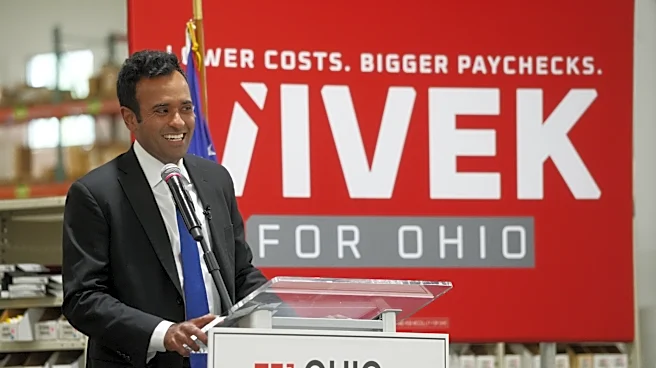
As of late August, groups backing Republican Vivek Ramaswamy have reserved $77.2 million in advertisements, while supporters of Democrat Amy Acton have spent $10.6 million, according to Columbus ad tracker Medium Buying. While some of that money will be spent on ads introducing the newcomer political candidates to voters, the rest is earmarked for undermining their opponent.
GOP ads focus on 2019 police report
Republican groups have accused Acton of being "unstable" and abusing alcohol and prescription medication. An ad from pro-Ramaswamy super PAC, V-PAC: Victors, Not Victims, ends
with the line: “Amy Acton. Drinking. Drugs. Disaster. Disqualifying."
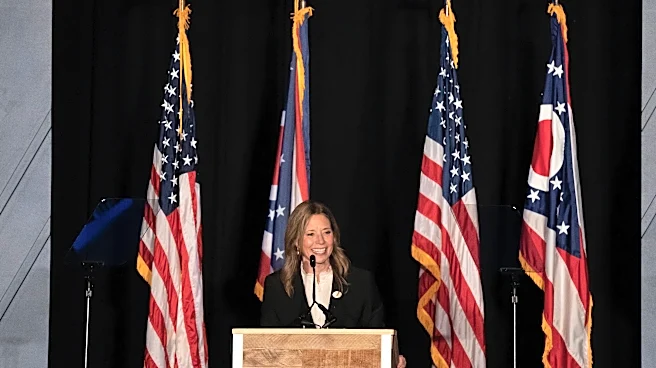
Acton and fellow Democrats say that's not true, and Republicans are attempting to smear her for what amounted to a private verbal disagreement between Acton and her husband in 2019.
"We did have a moment where my husband and I had an argument, and it was a normal marital fight. And police came because they heard of this argument. They saw that nothing had happened," Acton said on Aug. 25. "To blow it up, to bring family into it, to lie or to make the extrapolations they are − it's just what you tend to expect in politics at this point."
Here's what happened: On Aug. 17, 2019, Acton's 23-year-old daughter called police to report a fight between her mother and stepfather, saying that Amy Acton had "been drinking and throwing things and breaking glass," according to a 911 call report.

According to a Bexley police report, the Actons had a verbal argument about Acton's long work hours as Ohio's health director. Both adults had been drinking, and Acton "had taken an unknown amount of prescription medication." (Her campaign said the medications were for "minor health issues she was regularly taking and had been prescribed for 20 years.")
Acton shattered a mirror while walking down the stairs and tried to drive away, but Eric Acton convinced her not to leave, according to the police narrative. No one was arrested or charged. Acton did not disclose the incident to her boss, Gov. Mike DeWine.
A different V-PAC ad implied Acton is too addled to work a remote control. The quote came from a 2023 podcastin which Acton described being so busy responding to the pandemic that she didn't realize some of her motivational phrases were "trending" as memes until a t-shirt company's leader pointed it out. She wasn't clued in to the latest trend, much like an inside family joke that she can't operate the remote control.
"It is a little bit of a joke. I can't work the remote control very well," Acton said during an Aug. 19 event.
Conman or failed drug trial?
Meanwhile,the Democratic Governors Association-backed Ohioans for Lower Costs launched an ad calling Ramaswamy a "conman" and "huckster" on Aug. 19. The DGA-backed ad accuses Ramaswamy of peddling a drug to Alzheimer's patients that didn't work, but the drug in question was never marketed to patients.
In 2015, Ramaswamy's company, Axovant, invested in a drug called Intepirdine to delay the symptoms of Alzheimer's, making a big splash in the stock market and making the company a lot of money. Axovant purchased the drug for $5 million after a different pharmaceutical company discarded it.

But Intepirdineultimately failed to treat Alzheimer's in late-stage drug testing and was never sent for regulatory approval or sold to patients. The drug's failure sent the company's stock into a tailspin, losing three-quarters of its value in one day, the Cincinnati Enquirer reported.
“This is the single greatest failure of my career,” Ramaswamy told Forbes in 2017. “I feel much more accountable and it hurts me to have disappointed others who took a bet on something I believed in.”
Why attack ads aren't going away
Negative advertising is nothing new.An MGM producer is largely credited with launching the first attack ads against California's Democratic gubernatorial nominee Upton Sinclair, a socialist, in 1934.
Decades later, President Lyndon B. Johnson ran a devastating attack ad against Republican Barry Goldwater, highlighting the stakes of using nuclear weapons in the Vietnam War. The 1964 ad, which ran just once, depicted a young girl picking daisies before cutting to a nuclear explosion.
In 2026, attack ads are alive and well. Voters complain about the deluge of negative campaigning, but they are still watching and listening, said Mack Mariani, a professor of political science at Xavier University.
"Why do campaigns do it? It's because they work," Mariani said.
Negative ads work in a few ways, Mariani said. First, they fire up the base by reminding Political Party A's voters why they dislike Political Opponent B − even if they aren't thrilled about Candidate A. Second, they depress the vote for Candidate B by reminding voters that their candidate is flawed.
But it can be risky to lob attack ads, particularly if a candidate hasn't built up goodwill with voters, Mariani said. And campaigns for Ramaswamy and Acton will have to be particularly sensitive to attacks based on gender and race, which could turn off female and minority voters.
"If you don't do it well, you really run the risk of people choosing to vote against your candidate just because they don't like the ad," Mariani said.
Candidates besmirched by inaccurate campaign ads have little to no legal recourse. In 2014, a federal judge in Ohio ruled that politicians could legally lie in campaign ads without facing penalties from a state government panel.
The decision left candidates to defend themselves to voters. The federal judge quoted "House of Cards," a then-popular series, in his decision: "There's no better way to overpower a trickle of doubt than with a flood of naked truth."
USA TODAY Ohio Bureau reporters Laura A. Bischoff and Haley BeMiller contributed to this report.
State government reporter Jessie Balmert can be reached at jbalmert@usatodayco.com or @jbalmert on X.
Tell us what you think about Ohio's governor race
This article originally appeared on The Columbus Dispatch: Ohio governor's race is riddled with attack ads