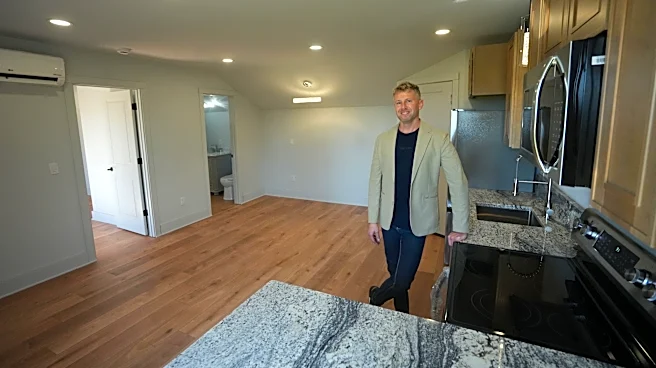








For John Zimnox, getting the green light to build a 600-square-foot apartment above his garage took eight months, a series of site visits and two failed inspections.
Not long after the Near East Side resident was at last given permission to request a building permit, the city passed legislation aiming to streamline the cumbersome process Zimnox had endured. Columbus City Council voted unanimously in November 2025 to reduce red tape around building accessory dwelling units, or ADUs – the apartments or small houses located on the same lot as a main single-family residence, sometimes called in-law suites, granny flats or casitas.
By making ADUs a permitted use in residential districts citywide, in turn allowing homeowners to bypass the "daunting"
zoning variance process Zimnox described, city leaders said the legislation could help residents build wealth while serving as part of the solution to Columbus' housing crisis.
But in the almost-year since that policy change, the city has received just over a dozen applications to build ADUs.

As of Sept. 24, the city's Department of Building and Zoning Services had received 14 applications for the units since the end of 2025. Two of those applications correspond with ADUs that have been built, including Zimnox's. Four have had permits issued and are under construction, and the other eight are still in the review stages, according to the department's deputy director, Tony Celebrezze.
The department didn't track ADUs before the policy change, Celebrezze said. But according to a council legislation document, the city issued 57 building permits for ADUs between 2019 and September 2025, an average of eight to nine per year.
Housing experts say they aren't surprised by the modest number of applications. Former Columbus City Councilmember Otto Beatty III, who introduced the ADU legislation, stands firm in his belief that the policy can have a significant impact on Columbus' housing stock, but "it's going to take a little bit of time for the market and the consumer to catch up to the opportunity."
"Although ADUs have been around, in a sense, forever, it is somewhat of a new housing type, and the use is new," he said, adding that the city's ADU guidebook, which breaks down the process for homeowners in plain language, wasn't released until summer 2026.
"The majority of people that are going to be constructing ADUs are not development professionals," Beatty said. "It is going to be a challenge for many people."
Per the city's guidebook, ADUs can be detached, attached or contained within an existing building. They can't exceed 65% of the main home's net floor area or 1,000 square feet – whichever is greater.
To local housing and community development consultant Keryna Johnson, the sparseness of the city's ADU applications isn't simply a function of the policy's infancy. A former director with the now-closed Rise Together Innovation Institute, who also testified before council in favor of more progressive ADU legislation in July 2025, said the low figures are entirely unsurprising – and it's because of cost.
"Homeowners can really get stuck when it comes to financing," she said. "I would not be able to build an ADU right now unless I was able to get a more creative loan."
Johnson estimated that building an ADU costs between $150 and $300 per square foot, depending on factors like utility needs, size and whether the unit is carved out of an existing structure like a garage or built from the ground up. For Zimnox, that's translated to roughly $125,000 altogether.
And as current city councilmember and chair of the housing, homelessness and building committee Tiara Ross pointed out, the roadblocks don't stop at affordability and zoning. Other regulatory barriers, like applying for a building permit or potentially registering the unit as a short-term rental, "play into the reason why we're not seeing this huge, significant spurt," she said.
But Beatty remains optimistic that Columbus will get there. He said it could take up to five years to fully gauge his legislation's impact, but he pointed to places like California – which passed statewide ADU reforms and now sees that property type account for one out of every five residential building permits, he said – as evidence of what's possible.
"I don't know if Columbus will be that way or not," he said, "but when we introduced the legislation and had public hearings, there was a lot of pent-up demand."

Can ADUs really make a difference in Columbus' housing crisis?
An in-law suite in the backyard may seem like a miniscule piece of a massive puzzle, but Beatty said ADUs align with the city's broader strategy to diversify its housing stock. Referring to ADUs as "a soft way" to increase density, he said the units help address a "missing middle" by creating options that aren't single-family homes but can still fit in existing neighborhoods.
"It's not a magic bullet," he said, "but it's one of many options."
ADUs also provide homeowners with a way to make money from their properties if they choose to rent them out, Ross added. Beyond that, she said, the units are particularly valuable for a city like Columbus, where land constraints make it increasingly difficult to accommodate growth.
"We are not a city that has a lot of land to build on, so how do you make creative use of the land that we already have?" she said. "ADUs are a perfect example of what you can do to be able to do that."

Consensus: The city could be doing more
Sources largely agreed that while the city's ADU reforms were a step in the right direction, Columbus has more work to do if it hopes to see meaningful results.
To address affordability barriers, Beatty and Johnson encouraged the city to explore financial mechanisms like grants, tax abatements, waiving fees or working with banking partners and credit unions to help homeowners finance ADUs. They also suggested creating pre-approved ADU plans so homeowners can avoid hiring an architect.
"Money's really tight for everybody – tight for the city, the banks aren't able to offer very favorable terms right now; it's just a hard time economically," Johnson said. "It's kind of like [trying to get] folks excited about buying a home when they're not allowed to start shopping for a home yet."
Ross said she and other councilmembers are working with the Department of Public Utilities to reduce costs associated with utility connections, which can also be a significant barrier to ADU construction.
Having navigated the process himself, Zimnox said eliminating zoning variance requirements addresses only one of many complicated steps. Building an ADU in Columbus still involves working through a host of other regulatory hurdles, he said, and he's not sure the policy change did enough to simplify those challenges for homeowners.
"I want to encourage more people to do this, and I want the city to create a team to help people navigate it," he said. "[The legislation] was a step forward, but they're not done."
Reporter Emma Wozniak can be reached at ewozniak@dispatch.com or @emma_wozniak_ on X.
This article originally appeared on The Columbus Dispatch: One year later, city effort to boost 'granny flats' has yet to gain traction