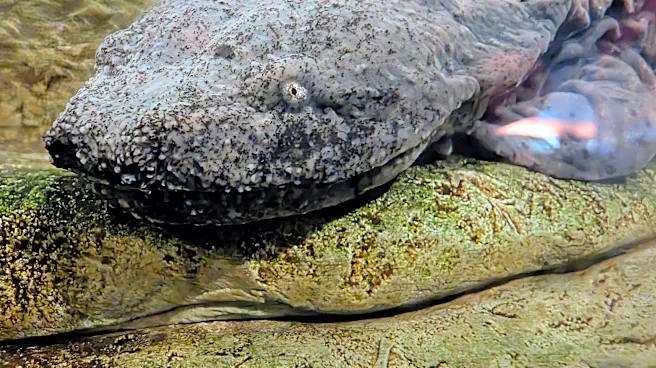









An endangered salamander is back home after shutting down a road project in eastern Ohio in August.
An eastern hellbender wandered into an active Ohio Department of Transportation (ODOT) job site this summer, shutting down the project as the agency collaborated with the Ohio Department of Natural Resources' Division of Wildlife on how to relocate the endangered species.
While not the official state salamander for Ohio, hellbenders are the biggest at up to 2 feet long. They are also covered in slime, earning them the nickname "snot otter."
Now, the hellbender is back in its home territory. Here's what happened.
Hellbender delays ODOT project in Belmont County
ODOT crews discovered the eastern hellbender
in the construction area of an active retaining wall repair project in Belmont County, in eastern Ohio along the Ohio River and the West Virginia border. According to an Aug. 12 Division of Wildlife Facebook post, crews stopped work and reached out to ODNR for guidance.
The rescue took two days as a team of experts safely captured the male salamander (after several failed attempts) and turned him over to the Columbus Zoo and Aquarium. Part of the Ohio Hellbender Partnership, the Columbus Zoo will care for the hellbender until conditions are right to possibly return it to the waterway where it was found, per ODNR.
"Kudos to everyone involved for putting wildlife first and showing what strong agency partnerships can accomplish!" ODNR wrote in an Aug. 12 Facebook post.
ODNR releases hellbender where it was found, rewards ODOT crew with 'Hellbenders are real' T-shirts
The hellbender was returned to its home waters at the site of the completed project the first week of October, according to an Ohio Division of Wildlife Facebook post on Oct. 5.
The salamander "enjoyed a vacation" at the Columbus Zoo and Aquarium during its time away from Belmont County, according to the post.
The ODOT crew was rewarded for its conservation efforts with ODNR's iconic "Hellbenders are real" T-shirts. The shirts were wildly popular when first introduced, needing to be restocked several times to keep up with demand.
Columbus Zoo and Aquarium project helps rare, endangered hellbenders recover, thrive in Ohio
Last summer, the Columbus Zoo and Aquarium released 116 eastern hellbender salamanders into protected waterways of eastern Ohio, part of a program that stretches back more than a decade. These hellbenders were raised for years by the zoo and its partners, growing from eggs until they were big enough to thrive in the wild.
Those efforts are paying off, with proof coming in 2023 that hellbenders raised by the zoo are reproducing in the wild.
The statewide recovery effort is led by the Ohio Hellbender Partnership, which includes the Columbus Zoo, The Wilds, the Ohio State University, other Ohio zoos as well as academic and government organizations.
For more than a decade, teams at the Columbus Zoo and The Wilds have raised young hellbenders from eggs collected within the species’ native range. The animals are monitored in a lab until hatching, and hand-reared until large enough to improve their post‑release survival and tagged for tracking before release.
Hellbenders raised at the Columbus Zoo are placed in high‑quality habitats in eastern Ohio while hellbenders raised at The Wilds are returned to streams primarily in West Virginia.
Over 2,000 hellbenders have been released in Ohio since 2012
What is an eastern hellbender? An endangered species, the salamanders are a good indicator of water quality

Hellbenders, an endangered species, can grow as long as 27 inches, though most are 11.5 to 20 inches long, according to the Ohio Department of Natural Resources. They're North America's largest amphibian, and are often nicknamed "snot otters" because of their skin's slippery protective coating, per the Columbus Zoo.
Because hellbenders need clean, oxygen-rich water, they can be a good indicator of water quality and overall health of a waterway, according to the Ohio State University Extension.
Found mostly in southern and eastern Ohio, hellbenders prefer large, fast-moving streams where they hide under rocks during the day. They feed on crayfish, snails, minnows, insects and worms. Hellbenders reproduce in August and September, with females laying as many as 500 eggs in nests dug by males beneath flat rocks in streambeds.
Ohio Department of Natural Resources uses hellbenders on 75th anniversary T-shirts in homage to Hell is Real sign
As part of its 75th anniversary celebration in 2024, ODNR put the hellbender on a T-shirt using the slogan "Hellbenders are real," in homage to the infamous Hell is Real sign on Interstate 71 between Cincinnati and Columbus.
The T-shirts proved popular, requiring ODNR to reorder them several times after selling out.
This article originally appeared on The Columbus Dispatch: Endangered hellbender messes with Ohio road project. Here's what came next