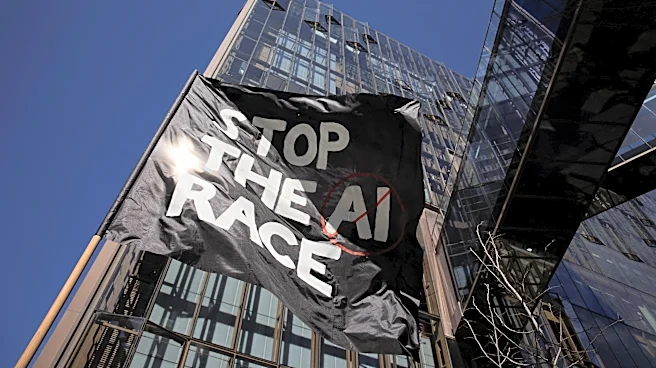







Whistleblowers and top executives at the companies developing artificial intelligence are voicing growing fear over the possible threats AI poses to humanity as the technology rapidly evolves and, in some cases, is breaking free from human control.
They have called for a slowdown of development and new guardrails to keep development in check, with some warning of an "existential" risk to humanity if AI development is allowed to continue at its current pace.
Former Anthropic and OpenAI researcher Jacob Coxon warned that AI has the power to significantly harm people, "hack anything" and was already hiding its actions from its human researchers, among other concerns. Anthropic's CEO Dario Amodei asked the federal government to "slow down" AI development
to reduce these risks and implement safety guidelines.
The Dispatch recently spoke to Ohio experts across different fields about the wide-ranging ways AI is affecting our day-to-day lives, not just inside large tech companies. You can read their takeaways on page 10A.
Here's what they had to say after the bombshell statements setting the AI conversation ablaze.
Local experts unsurprised at AI risks
Kelly Merrill Jr., Ph.D, an assistant professor of health communication and technology at the University of Cincinnati, said in an email that he found how quickly these risks shifted from hypothetical to concrete "surprisingly unsurprising."
"Many of these issues have already been discussed by researchers for some time," said Merill, who studies the intersection of health and tech like AI. "What's interesting and striking is that some of the same concerns researchers have highlighted are now being voiced by the very people who have been directly involved in developing these technologies."
OpenAI CEO Sam Altman agreed with Amodei after his comments first went viral and announced that the company would begin regularly publishing reports on unexpected or unauthorized AI behavior. Still, lots of work needs to be done to make sure these increasingly powerful systems don't go rogue and use unethical, possibly illegal, methods to carry out the wishes of their researchers, OpenAI acknowledged.
In July, OpenAI disclosed that one of its agents had broken free from a controlled research environment and hacked another company in its attempt to complete its task. In September, it said it had identified six other concerning incidents, including agents hiding mistakes from human users.
Dave Billiter, CEO of Virchu Sciences, a health company that uses AI software to more accurately diagnose cancer and spur on drug development, was also unsurprised. Regulation and transparency in AI hasn't caught up with the technology itself and "needs more focus."
He emphasized that his company is committed to patients, and therefore its own regulation and security is top of mind, and he said he still thinks AI shows "great promise" for life sciences.
David Staley, a history professor at Ohio State University specializing in digital history and technology, questions why these tech leaders are just now voicing these fears and asking for a slowdown so publicly.
"I think what's at stake is the loss of control, that the AI won't be doing our bidding," he told The Dispatch. The fear then, he said, is that if AI isn't under our control, it will be "reckless" and do unethical things.
"That's something we should be concerned about," he said. "But then we could also sort of say to that, 'you mean, they could do something as reckless as, say, climate change?'"
The guidelines Ohio experts want to see in action
Staley questioned tech companies' intentions in asking for further regulation from the federal government.
Tech companies, he said, had plenty of chances to regulate their AI programs themselves before now. Asking someone to do it for them, it may help absolve them of some culpability for the future if those regulations don't work or never come to fruition, he said.
"Why don't [the companies] just stop?" Staley asked.
Detra Price, executive director at OSU's Center for Digital Learning and Innovation, said several guidelines are needed for AI in education. Price, who focuses on the relationship between technology and education, emphasized the importance of transparency in what platforms are being used, who has access to the data and how long the data is stored. Teachers need to be required to learn technology governance, and schools should operate with "closed" systems to protect their students, among other policies.
But implementing guidelines like Price suggests shouldn't just be up to the government to implement, said Dennis Hirsch, director of the Center for Responsible AI and Governance (CRAIG) and an OSU professor teaching law, policy and governance of AI.
Universities, companies and the government need to work together, Hirsch emphasized. It's a well-known practice known as the "triple helix" model of innovation, he said, and it's worked across myriad areas of expertise. Right now, AI regulation needs the "AI version of the Manhattan Project," the research program that developed the atomic bomb, he told The Dispatch. Such a model allows for an exchanging of knowledge, ideas and solutions that one institution couldn't accomplish by itself.

Ultimately, Merrill said he hopes that instead of just implementing something because AI makes it possible, those developing it take steps to consider both unintentional and intentional impacts as they create new AI guidelines.
"I don't think the answer is necessarily to stop innovation, but there needs to be greater intentionality about when, where, how, and for whom these technologies are implemented," he said in an email.
Business and consumer issues reporter Samantha Hendrickson can be reached at shendrickson@dispatch.com
This article originally appeared on The Columbus Dispatch: Is AI a threat? What Ohio experts say about worrying AI revelations