


A splash was the last thing Darren and Heather Hamblin heard as their son slipped away into the water.
Cody, 22, was out fishing with his grandfather and was talking with his parents on the phone when he suffered a seizure and fell overboard. The phone line stayed open for several more minutes of agonizing silence.
A charismatic, goofy young man who had loved football since he was 7, Cody spent years absorbing violent blows on the field. Now, his parents were left confronting the possibility that those hits had left scars no one could see.
"The more I listened, I just knew," Darren said. "I told Heather, I think he's gone."
Cody's family never thought the sport he loved could do lasting damage, but his father now believes it contributed to his death.
Chronic traumatic encephalopathy is a brain disease more commonly linked to aging NFL players than 22-year-olds. But, Cody's brain had accumulated so many injuries that he was diagnosed with stage 2 CTE after he died.
An eight-month Dispatch investigation found that Cody is far from the only one to suffer from CTE even though he never competed in college or the NFL.
The guardrails in place to protect Ohio's youngest athletes fall short of measures in other states, The Dispatch found. And data collected by the Ohio High School Athletics Association captures just a fraction of the concussions that occur, a spokesperson said.
Ohio coaches and referees are required to take an online concussion course every three years. A Dispatch review, however, found the hourlong trainings cover mostly basic signs and symptoms of head injuries requiring users to pass simple quizzes of fewer than 10 questions.
At the same time, young Ohioans growing up in Buckeye country can play tackle football as young as 6-years-old —an age when many are still learning to read. And the earlier kids start playing tackle football the more likely they are to suffer an untimely demise like Cody, said Dr. Ann McKee, a professor of neurology at Boston University.
"It compounds over the course of your life," McKee said. "This is a huge tragedy and it is entirely preventable."
Cody had never suffered a seizure before he died. Searching for answers, Darren had his son's brain examined by a doctor in Chicago.
CTE can only be diagnosed after someone has died and Cody, who had only played youth and high school football, was suffering from stage 2 of the neurodegenerative disease.
Darren was in disbelief. He blamed himself for not seeing the danger before it was too late.
"He was so active and he just seemed bulletproof," Darren said. "As a parent, my job was to make sure my kids grow up safe. I fell short of that."

Is age 6 too early for tackle football?
Cody died in May 2016, roughly four years after he'd stopped playing football.
But in retrospect, Darren said he wonders if his son was showing signs of CTE years earlier.
Cody spent a lot of time laying in his bed during the day, which Darren now worries was an early sign of depression. One night Cody went missing and his family found him on a walk wandering around at 3 a.m., his father said.
"If people have kids playing these sports and they see little signs, they need to take every one of them seriously," he said.
Although CTE was first connected to football 20 years ago, it's largely been linked to the highest levels of the game. But, a 2023 study at Boston University showed that youth and high school athletes can still suffer from the neurodegenerative brain disease.
While fewer than 1% of the general population is diagnosed with CTE, 41.4% of the study's 152 athletes under the age of 30 were found to have the disease. On average, the young athletes diagnosed with CTE in the study died at the age of 25.
"No matter how you look at this data, millions of people could be at risk," said McKee, lead researcher on the study. "That's alarming. That's saying this sport is dangerous."
What McKee described as the "real danger of football" is the fact that kids are not given enough information about the health consequences of the game and many who start young likely don't understand that it could cut their lives short, she said. The state requires parents of student athletes review and sign a concussion information sheet from the Ohio Department of Health annually.
Concussions and symptoms of repeated minor head injuries can be tough to catch in kids, in part because a lot of the diagnosis depends on a child communicating what they're feeling, said Dr. Stephen Cuff, co-director of the sport concussion program at Nationwide Children's Hospital in Columbus. Many young athletes, Cuff said, don't want to be pulled from a game and are worried about coming off as weak to their peers.
Parents worried their child might have suffered a concussions should always take their kid to a doctor to be examined Cuff said. Some symptoms kids might show are severe behavior or mood changes, seeming more forgetful, or if a child seems more withdrawn mentally and emotionally.
Cuff, who has a 2-year-old son himself, said he's not sure whether he'd be OK with his son playing football.
But, he did encourage parents to start their kids out in flag football as opposed to tackle football at age 6. Although it's unclear whether a 6-year-old could create enough momentum and force to cause a serious head injury while playing, he said it's best not to risk it.
"I think age 6, just common sense-wise, seems a little too early," Cuff said. "They should be focused on learning the fundamentals of running, catching and throwing as opposed to tackling at that age. I just think it's unnecessary."

Reducing impacts in youth and prep football
The football game Cody Hamblin couldn't remember at all is now one of the few his father Darren can't forget.
During the first half of a game Cody's senior year, Darren said his son took a major hit. Cody was so disoriented after the play that he began walking to the opposing team's sideline instead of his own.
Coaches told Darren that Cody had suffered a concussion. He sat on the bench for the rest of the first half, but when the second half started Cody ran back onto the field.
"He was like: I don't remember any of that game, none of it before, during or after," Darren said of his son. "And they never marked him down as having a concussion, they kept no record of it."

Miamisburg schools athletic director Jason Shade declined to comment, saying he was not leading the department at the time. The Dispatch also reached out to the district's superintendent.
The Ohio Department of Health offers two from third-party organizations and one from the Centers for Disease Control and Prevention that count toward the requirement.
The concussion courses, required every three years for coaches and referees, each took an hour or less for The Dispatch to complete and varied in their depth of information.
The trainings broadly covered concussion symptoms, medical recommendations and how student athletes can return to play. The CDC version offered the most depth, providing different scenarios where athletes might have suffered a head injury.
Each course made little mention of CTE, if at all. To pass each training and receive a certificate, officials must take a quiz that consists of between five and nine basic questions, The Dispatch found.
The Ohio Department of Health selects the courses and reviews them quarterly to ensure they're still accurate and relevant, a spokesman said. Along with offering the training programs, the state health department also provides information sheets on the risk of head injuries, trains school nurses, funds concussion programs in local health departments and runs a statewide injury coalition with a focus on concussions in children.
"In youth football, you just don't have the expertise in concussions," a referee who calls games for both high schools and colleges told The Dispatch on the condition of anonymity.
Laws on concussion prevention in youth sports vary widely from state to state, The Dispatch found.
In New Mexico, for example, state law mandates that youth athletes must wait 10 days before returning to play whereas California requires them to wait seven days, according to the Network for Public Health Law, a national nonprofit that advocates for changes in health policy. Ohio, on the other hand, only prohibits a youth athlete from returning to play the same day they're suspected of suffering a concussion.
Unlike other states, Ohio also doesn't have any laws on the books requiring the collection of youth sports concussion data or limiting tackling in practices. Data reported to the OHSAA includes concussions only chronicled by contest officials, meaning many go unreported because they occur in practice or are diagnosed by a doctor after a game or practice, said association spokesperson Tim Stried. OHSAA did not respond to requests for the data.
Connecticut requires school districts to report concussion data to the state board of education and the state health department. In California, full contact practices are limited to 90 minutes per day, twice a week, according to the network.
The easiest place to start is practice. NFL players now have very little contact in practice, averaging less than one contact practice per week during the regular season. Yet at younger levels, players can still accumulate a huge number of head impacts before they ever get to a game.
When it comes to lowering the potential for head injuries, addressing practice as California has done may be the best option, said Dan Daneshvar, an associate professor at Harvard Medical School and the lead researcher on a recent study that found one in four NFL players suffer from CTE.
Pro football, he said, has done a good job at limiting the number of tackles each player takes per practice. NFL players on average experience less than one contact in practice a week with another player and Daneshvar said it would make sense for youth programs to follow suit.
"You still get the competition, the teamwork and everything people love about the sport," he said. "You just remove impacts that do not need to happen."
When football takes a life
While Cody's diagnosis for CTE offered an explanation for his death, it still wasn't enough for his dad Darren.
In the years after his son's death, Darren decided that he wanted his son's loss to mean something. So he looked to hold someone accountable.
In 2019, Darren filed a wrongful death lawsuit against Riddell, the maker of the helmet his son wore. His goal wasn't to win a ton of money but it was to shine a light on the dangers of the sport and what he saw as failures to protect the kids like his son who loved to play it.
The lawsuit brought national media attention and scrutiny of football to Miamisburg, its high school and the team that Cody wore #13 for. After getting the issue the attention he felt it deserved, Darren finally agreed to settle the lawsuit for an amount he's prohibited from discussing due to an agreement with Riddell.
The helmet maker did not respond to a request to comment.
"It's supposed to protect them, their head and their brain and it doesn't" Darren said about football helmets. "We wanted the evidence to come out. We wanted them to have to tell everybody what they know."
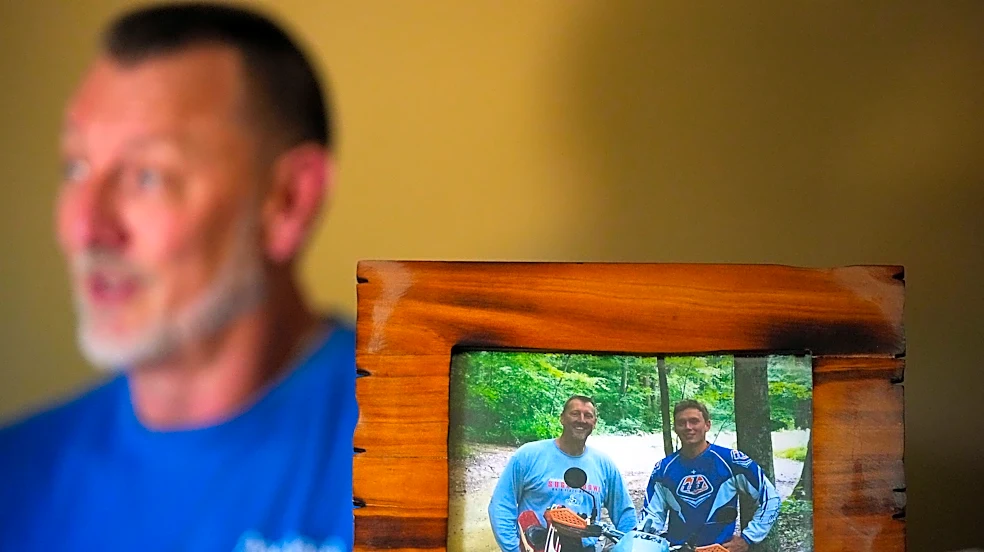
Although 10 years have passed since Cody died, Darren's home is still filled with memories of his son and his time on the gridiron. Photos of him in his high school uniform sit around the house, as does a blue and white football a high school gave his parents.
Sitting at his kitchen table in August, Darren fought back tears as he reminisced about his son's love of the game. He recalled watching Cody play football with the neighbor kids and how he just seemed to really excel at the sport.
But Cody's death has forever changed the way Darren looks at football. Even today, he said it can be painful to watch a college or NFL game on TV.
One thing's for sure — if Darren had a chance to go back and redo the past, he would have never let Cody play football. And Darren wonders how many more young athletes like Cody will die before policymakers do something to stem the violence youth tackle football.
"I wish they would just get rid of tackle football until a certain age. If you're 18 or older... You can join the Army, you can go off to war," he said. "The way I look at it, my son gave his life for it."
Dispatch investigative reporter Max Filby can be reached by email at mfilby@dispatch.com. Find him on X at the handle @MaxFilby or on Facebook at @ReporterMaxFilby.
This article originally appeared on The Columbus Dispatch: His son never played college or pro football. He still died with CTE