
Ohio’s largest salamander – and one of the world’s largest species – lives in select Ohio streams, but it is almost completely out of sight and mind.
The eastern hellbender (Cryptobranchus alleganiensis
) resides in rocky streams largely free of siltation and other pollution. Prior to European settlement, hellbenders were likely widespread in streams within the Ohio River drainage, and that covers most of the state.
Today, the completely aquatic salamanders are far scarcer, a reflection of how people have treated our waterways. In 1990, the Ohio Division of Wildlife listed this fascinating animal as endangered, and while recovery efforts are bearing fruit, hellbenders remain rare.
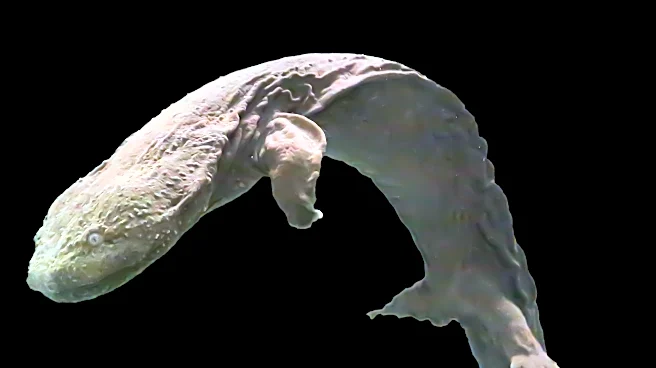
Clapping eyes on a big adult hellbender for the first time generally provokes a two-fold reaction: shock and awe. Adults average nearly 20 inches in length and old individuals might reach 2 ½ feet. A behemoth might weigh 5 pounds or more.
But it isn’t just the sheer bulk of this strange amphibian that draws a reaction. A hellbender looks like it was assembled from a spare parts bin from an amphibian factory. The dorsally compressed salamander appears flattened, as if run over by a steamroller. The oversized head houses a disproportionately large mouth and tiny beady eyes. Short stout legs propel the beast, and a large laterally compressed tail helps propel the critter through the water.
Above all, it is the hellbender’s wrinkled skin that holds one’s eye. It is as if the animal is clad in a suit one and one-half times too large that was left wadded up in a closet for 10 years and never saw an iron. All those wrinkles have a purpose, though. Hellbenders respirate through their skin – it is a lung in essence – and the wrinkles increase the surface respiratory area.

The strange appearance of the hellbender has spawned many colloquial names such as "mud devil," "snot otter" and "walking catfish." To me, it resembles an amphibious shar pei dog. But “hellbender” is an odd name too. It apparently stems from the slow, exaggerated side to side movement of the animal as it moves about.
No one will claim that a hellbender is the Fabio of the amphibian world, but beauty is in the eye of the beholder. Those of us who have come to know these special animals find them attractive indeed, and worthy of the highest protection.
Fortunately, there is a highly competent group of people that have united to form the Ohio Hellbender Partnership. One of Ohio’s foremost herpetologists and longtime hellbender researcher, Greg Lipps, plays a leadership role. Partners include the Akron, Columbus and Toledo zoos, the Ohio Division of Wildlife, U.S. Fish & Wildlife Service, Ohio Environmental Protection Agency, The Wilds, Ohio University and others.
The partnership regularly surveys and monitors hellbender populations, and such work is not for the lazy. Finding hellbenders involves snorkeling about in cold streams and using video borescopes (underwater cameras) to peer underneath enormous slab rocks on the stream bed. During the day, hellbenders hole up in such places and emerge at night to feed on crayfish and other aquatic fare.

Conservation of existing hellbender populations, and the restoration of former populations, is the principal aim of the partnership.
On Sept. 1, I accompanied Lipps, the Columbus Zoo’s Pete Johantgen and other partnership members to a north-central Ohio stream. Our goal was to release 44 “head-started” juvenile hellbenders. They were raised from wild eggs in specialized facilities at The Wilds, the Columbus Zoo’s expansive conservation facility in Muskingum County. These hellbenders are reared for two to three years, which gets the animals beyond their most vulnerable stages.
Siltation of waterways has been a leading cause of hellbender declines, as the animals require clear, highly oxygenated and largely unpolluted streams. Fortunately, water quality in Ohio streams has improved significantly since the early 1970s following the formation of the Environmental Protection Agency (EPA). Their efforts, and those of other agencies, to clean up streams have led to much healthier waterways, which has allowed the reestablishment of hellbenders to formerly occupied creeks and rivers.

“Seeding” young hellbenders into appropriate habitat has accelerated the return of this endangered species. In between releasing the young hellbenders, Lipps and his partners snorkeled about the site, threading their cameras under rocks. A few older hellbenders from previous releases were relocated, showing that the site is now conducive to their survival.
The hellbender is a little-known and almost completely unseen but strangely charismatic barometer of our stream health. While few people will ever lay eyes on a wild hellbender, just knowing that they are there should please the conservation minded. A stream without hellbenders, that should have them, is a stream with environmental issues. That they can now successfully be restored to many former hellbender streams is truly an environmental success story.
Thanks to all the people, agencies and zoos that have worked so hard to ensure that hellbenders survive.
Naturalist Jim McCormac writes a column for The Dispatch on the first and third Sundays of the month. He also writes about nature at jimmccormac.blogspot.com.
This article originally appeared on The Columbus Dispatch: Meet the eastern hellbender, Ohio's largest salamander