


The name on the back of his jersey is synonymous with Ohio State football. But in some ways, the game has taken nearly as much from Ray Griffin as it gave him.
The younger brother of Archie Griffin, the only two-time Heisman Trophy winner
, Ray followed his sibling to Ohio State where he played wingback and later safety from 1974 to 1977. The brothers then went from being Buckeyes to Bengals in the NFL.Ray's football career came at a cost though. He's had both of his shoulders replaced, underwent a spinal fusion surgery and after suffering at least 12 documented concussions, he struggles with severe anxiety, depression and memory loss.
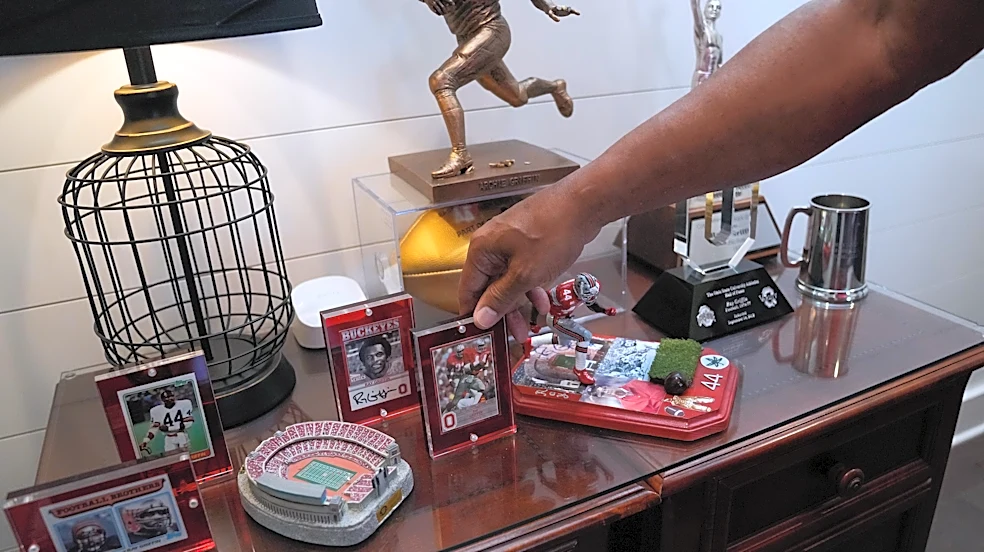
Long retired, Ray's New Albany home office is a museum of Ohio State memorabilia and reminders of a past he helped
create. Yet far more recent memories — appointments, plans and pieces of everyday life — often elude him if he doesn't write them down.

"It scares me," said Ray, 70. "Nobody wants to actually lose their mind like that."
But Ray's fading memory is part of a much larger reckoning former Buckeyes and other football players face as fallout from past failures emerge decades later, an eight-month Dispatch investigation has found.
A Harvard University researcher first assessed the danger of concussion in 1952 and found that athletes should stop playing contact sports after suffering from three. But the NCAA didn't adopt its first concussion protocol until 1994, 17 years after Ray left Ohio State for the Bengals.
Even then, college programs were not required to adopt concussion management plans for student athletes until 2010, according to Ohio State.
And the concussion protocol in place today is still not enough to protect athletes like Ray from developing chronic traumatic encephalopathy, said Dr. Ann McKee, a neurology professor at Boston University who has studied the neurodegenerative disease in athletes.
"The NCAA and the NFL pretend it is just a concussion issue when it's not," she said. "Here we are in 2026 and nothing has been done."
There is no way to test for CTE before someone has died. Ray's doctors, however, believe he has many of the markers for the neurodegenerative disease.
The symptoms of CTE can include memory loss, confusion, impaired judgment, a lack of impulse control, aggression, depression, anxiety, suicidal thoughts, Parkinson's Disease and advanced dementia, according to Boston University. Timing varies as symptoms can begin years or even decades after a football player ends his career.
Ray has been diagnosed with what he described as a "mild cognitive impairment." He sees a neurologist regularly, takes a pill in the morning and at night to help with his memory loss and lives and dies by his calendar.
"You learn how to navigate your way through it," he said. "I was a warrior and these are just my scars."

The concussions and the aftermath
Ray said he suffered several concussions while playing for the Buckeyes, including one he remembers only by what came afterward — waking up in a hospital the next morning.
Ray was knocked out during an Ohio State spring game he now can't recall. It would be one of at least three times he said he lost consciousness in a game in college and the NFL.
But at the time, Ray thought the concussions were just a minor byproduct of putting everything he could into each play.
At 5 feet and 9 inches tall and 177 pounds, Ray was considered small to be playing safety and felt he needed to make up for his size. He knew the running backs he was chasing down would be a lot bigger than he was.
"I was taught to go full speed all the time... I did not slow down to make my tackles," he said. "I hit them as hard as I could."
Ray said he's sure he often suffered concussions with fewer symptoms, after which he'd feel dazed foggy and confused or even have a pounding headache. Instead of removing players after a head injury in the 1970s, Ray said coaches often gave them smelling salts to rouse them so they could keep playing.
Players like Ray are far more likely to suffer additional head injuries if they continue to play with one, research has shown. But Ray and many others stayed on the field after brain injuries.
At least one in four former NFL players like Ray suffer from CTE caused by repeated hits to the head, a study published in August 2026 in the British Medical Journal found. And that number is likely far higher, experts told The Dispatch.
"That changes how we should think about prevention," said Dan Daneshvar, an associate professor at Harvard Medical School and the lead researcher on the study. "We need CTE prevention protocols that reduce the number and force of head impacts players are taking in the first place."
Ray played seven seasons with the Cincinnati Bengals before he was released from the team at age 29 in 1984.

Soon after, he said he fell into a deep depression he thought was fueled by the fact he was no longer playing football. To cope, he said he began drinking heavily. When he woke in the morning hungover from the night before, he poured himself another drink.
When his father died in 1993, Ray said it was the wakeup call he needed.
He knew his father was aware of his drinking problem, even though the two never spoke about it. He decided it was time to stop "self-medicating," as he put it, and he checked himself into a rehabilitation facility and has been sober for more than 33 years.
"My dad passing was the thing that triggered me to get help and get my life together because I felt like I let him down," Ray said. "I wanted to make sure my mom was still alive so that she could see that I got myself back on my feet."

The lawsuit and helping future players
Ray's rebound didn't end with him regaining his sobriety.
Years later, he decided he needed to do something to make sure that no more players would suffer the consequences of head injuries and to make sure those who did got the support they deserved.
As the lead plaintiff, Ray filed a class action lawsuit in 2016 against the Big Ten and the NCAA on concussions.
Concussions were known to have caused head trauma since the 1950s, and while the NCAA implemented a non-binding protocol for handling them in 1994, the class action lawsuit stated it wasn't enforced until 2010.

Griffin and his attorneys sought to show that the actions of the conference and the NCAA were negligent. The lawsuit also claimed that both the Big Ten and the NCAA actively concealed information about traumatic brain injuries, breached their duties to student athletes and were unjustly enriched for profiting off student athletes while refusing to pay their medical bills.
"I never knew the long-term impact of what football would do to me," he said. "But you've got to accept the things you cannot change and change the things that you can."
The NCAA declined to comment for this story when reached by The Dispatch.
And while the lawsuit was settled in 2025, Ray still has more plans to help shape the future of head injury research and protect the players at his alma mater that he still loves.
When Ray, now 70, dies, his brain will be donated to Boston University's UNITE Brain Bank, which has led many breakthroughs in research on CTE.

It's a small gesture, Ray said, that he hopes will help the next generation of players to be better informed on the dangers of the game.
Despite knowing what he knows now, Ray said he'd still do it all over again. And he hopes that advancements in research he'll contribute to long after he's gone will bring more people to the gridiron instead of scaring them away.
"That's how much I love the game and I think any football player would tell you the same thing," he said. "It's just part of you."
Dispatch investigative reporter Max Filby can be reached by email at mfilby@dispatch.com. Find him on X at the handle @MaxFilby or on Facebook at @ReporterMaxFilby.
This article originally appeared on The Columbus Dispatch: How Ray Griffin took on the NCAA, Big Ten on concussions in football