



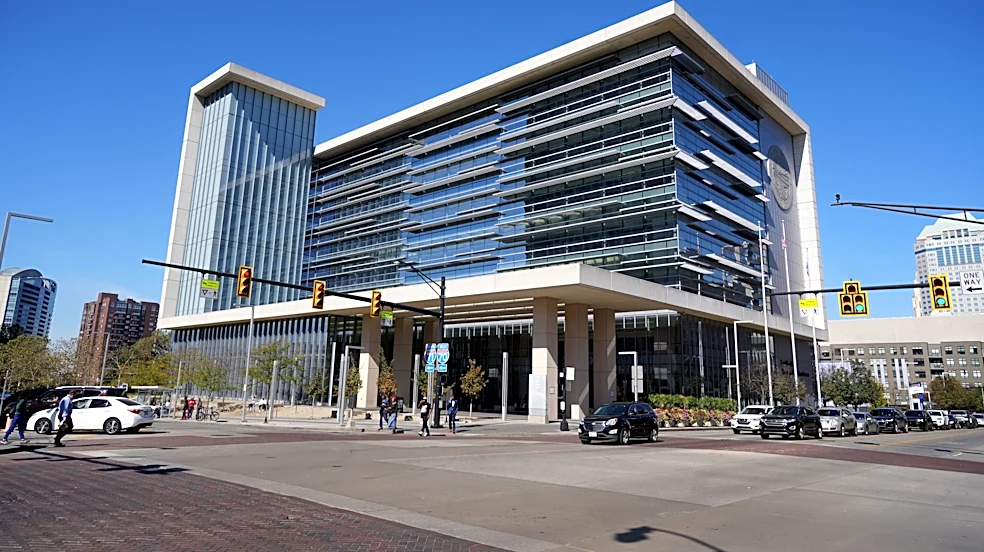

Tensions continue to rise over a controversial, state-proposed bridge through a protected ravine in Columbus' Clintonville neighborhood, with the project's future unclear as state officials and Franklin County's conservation agency clash over how to offset its environmental impacts.
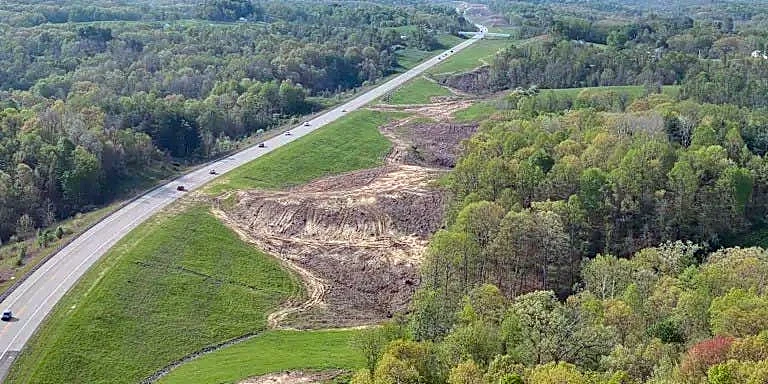
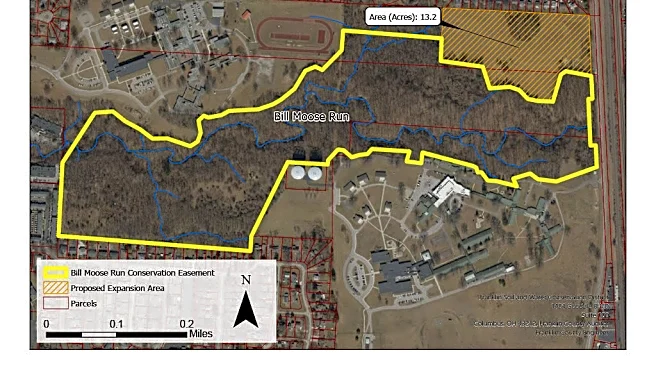
Located north of Morse Road between North High Street and Indianola Avenue, the 73-acre tract referred to as Bill Moose Run has been protected since 1999 by a "perpetual conservation easement," a deed restriction that indefinitely limits certain development and land uses. The Ohio State School for the Blind and the Ohio School for the Deaf, situated northwest and southeast of the easement, respectively, want to build a 12-foot-wide two-lane roadway and pedestrian
path connecting the two campuses, saying it's necessary to improve student safety and accessibility.
The state owns the land, but the Franklin Soil and Water Conservation District, or FSWCD, controls the easement, which means any changes to it require approval from its five-member Board of Supervisors.
What began with FSWCD appearing open to approving the project in return for 13.2 acres of additional protected land has now, after an exchange of rejected proposals, evolved into the Ohio Department of Administrative Services offering the district $42,000 to sign off on the bridge in what the agency called "a final attempt" to reach a resolution, according to a copy of a letter to be sent to FSWCD acquired by The Dispatch on Oct. 22.

Over the past few months, several nearby residents have been outspoken in their opposition to the campus connector project. The concerns, for some, are many: harm to the natural environment, setting a precedent for overriding other perpetual easements and an alleged lack of transparency from the state after neighbors saw construction work happening on the site in fall 2025. Others argue the project is a foregone conclusion, noting that about $13.6 million in state funding has already been appropriated for it.
At its September board meeting, FSWCD assistant director Kyle Wilson said a mitigation proposal to add 13.2 acres from the site's northeast corner into the easement might be the real "conservation win."
"We've got a pretty real threat of that 13.2 acres being developed," Wilson said at the Sept. 14 meeting. "And we've got an opportunity that was created quite frankly from the school kind of getting the cart before the horse with some of this – they have funding, they weren't aware of the need for approval and things like that – that has actually created leverage."
That leverage appears to have carried less weight than Wilson expected.
Instead of FSWCD's desired 13.2 acres, the Ohio Department of Administrative Services offered 6 acres of noncontiguous land scattered throughout the easement as mitigation. In written response, FSWCD argued the larger mitigation was necessary given the project's impacts on forest canopy, water quality and wildlife habitat. The letter, dated Oct. 19 and written by FSWCD board director Jennifer Fish, outlined that the board would not approve the bridge without either the 13.2 acres or a less impactful bridge design.

Three days later, the state agency formally rejected that request and instead offered $42,000 – what director Kathleen Madden wrote is a "fair valuation" of the 2 acres needed to build the bridge – as a final offer.
"I am disappointed in this outcome, which would have resulted in a net gain of four acres to the District’s existing easement, while permitting the prompt resumption of project planning without additional significant delay," Madden wrote, referring to FSWCD's rejection of the state agency's 6-acre mitigation offer. The state was unable to clarify in time for publication whether the cash offer would be accompanied by any acreage.
With respect to the district's initial 13.2-acre mitigation proposal, Madden wrote that she's unaware of precedent for "such an extraordinarily large exchange."
"While environmental conservation is certainly an important part of this discussion, much of the public discourse surrounding this topic is inaccurate and overlooks the best interests of the students and their well-being," Madden stated in the letter. "I fully intend to assist this project in moving forward expeditiously, acting in the best interests of the safety and security of the students, the state of Ohio, and the public good."
Madden requested a response from FSWCD by Oct. 30. The conservation agency's next board meeting scheduled for Nov. 9.
Reporter Emma Wozniak can be reached at ewozniak@dispatch.com or @emma_wozniak_ on X.
This article originally appeared on The Columbus Dispatch: Clintonville ravine dispute escalates, state turns to cash as 'final' offer