





Cortez Hankton settled into his desk chair and turned to his computer.
In a matter of seconds, a play flashed across the front wall in the dimly lit office in the Woody Hayes Athletic Center.
“I know we’re all big visual creatures,” Hankton said.
During an afternoon in the middle of Ohio State’s idle week, Hankton guided The Dispatch through a series of clips of superstar wide receiver Jeremiah Smith
.Few in college football have been as dominant as Smith. Since he arrived in Columbus in 2024, his rare combination of speed and size at 6-foot-4 and 222 pounds has made him a matchup nightmare for defenses.
But Smith has been virtually unstoppable this fall, becoming the favorite for the Heisman Trophy and widely regarded as the best player in the country.
He has caught 52 passes for 984 yards and 12 touchdowns in seven games, keeping pace with DeVonta Smith, who was the last pure receiver to win the sport’s most prestigious player of the year award in 2020.

The leap is not only a product of generational talent, but also technical refinement.
When Hankton was hired as the Buckeyes’ wide receivers coach in January after Brian Hartline left to become the coach of South Florida, he sought ways to help elevate Smith’s game, ranging from his route running to movement after the catch.
“He’s already physically dominant,” Hankton said. “It’s how do you take it to the next level?”
The film session revealed the broadening of Smith’s skill set, a receiver with the capability of finding the end zone on underneath touches as well as downfield shots.
Smith’s versatility has allowed the Buckeyes to make him even more of the focal point of their high-scoring offense. His target share has risen from 27% as a sophomore to 36% as a junior this season. He’s gone from averaging eight targets per game to 10.
As the Buckeyes move forward without starting quarterback Julian Sayin for the foreseeable future and continue their College Football Playoff push, they could lean even more heavily on Smith.
But the expanded role might not have been possible without Smith’s evolution into a more multifaceted weapon.
“Typically, what you find at different places is you have a receiver who can do this well, a receiver who can do that well, so you use them for different things,” Hankton said. “Well, when you can do it all well, you find ways to create those opportunities for him to do it. You find ways to get your best player the ball.”
The top of the route
As Hankton peered at the rows of cut-ups filling his computer screen, he found a moment from the Buckeyes’ win at Iowa in early October.
It wasn’t one of Smith’s two touchdowns against the Hawkeyes, even though one had prompted Smith to strike a Heisman pose, but a 4-yard reception on a stop route in the third quarter.
Smith pushed 10 yards downfield before turning around to catch a pass from Sayin, leaving the Buckeyes near the first-down marker.
Smith’s break back toward the ball allowed the Buckeyes to capitalize on soft coverage by cornerback Jaylen Watson, who left a cushion on the perimeter but possessed enough recovery speed to close quickly. Watson has seven pass breakups, one shy of the most in the Big Ten.
“If he gets stuck at the top of his route, this reception turns into a PBU (pass breakup),” Hankton said. “That’s why it’s important to be really, really clean. It’s such a little thing, but it’s a big thing in being efficient.”

The work at the top of the route had been a point of emphasis for Smith during the offseason. As Hankton combed through film for areas of improvement, he found instances in which Smith had opportunities to establish more separation when moving out of his breaks.
Smith could get hung up when he put too much weight on his lead foot, carrying his momentum forward before working back to the ball. His hips needed to flip faster too.
While Smith’s frame allowed him to overpower defensive backs in tight coverage, it didn’t make it as natural for him to break away like smaller, shiftier receivers.
“Imagine if you got an 18-wheeler and a sedan,” Hankton said. “Both of them are driving 60 mph. But in terms of for them to stop, it’s going to take an 18-wheeler a lot longer than a sedan to stop, because of the weight and the power behind it. That’s the same thing with him.”
As Smith took steps to minimize any hesitation at the top of the route, it put him in a better position to make the catch. Hankton noted that defensive backs often have an advantage while backpedaling. They don’t have to transfer as much of their weight in order to break on the ball, while receivers almost reach a full stop.
“This is where he has improved tremendously,” Hankton said, “really understanding and being more consistent with the fundamentals of playing the position.”
The gains on these types of sequences might be minimal, but they allow Ohio State’s offense to remain on schedule and keep the chains moving. They are especially valuable if the Buckeyes need to preserve game clock, one of the reasons they have managed a touchdown in the final 25 seconds before halftime in all seven games.
Hankton cycled to a clip from late in the second quarter of the Buckeyes’ win over Illinois in September.
Smith ran almost 10 yards downfield before snapping back to the ball. Once he pulled in the pass, he took a couple of steps to get out of bounds.
“Clock stops,” Hankton said approvingly.
The easy catches also help reduce wear and tear, both over the course of a season and throughout a career. Hankton referenced the example set by Jerry Rice, the NFL’s all-time leading receiver who spent 20 seasons in the league by preserving his body.
“We have to work on not being as violent to protect your joints, your knees, your hips, your ankles,” Hankton said, “so we have to make your feet lighter, we have to transfer balance, torso control, all those little things.”
The catch transition
Hankton had no shortage of highlights at his fingertips.
As he moved through the catalogue of clips, he arrived at a touchdown from the Buckeyes’ win over Maryland.
It was first down in the second quarter when Sayin hit Smith on a screen pass behind the line of scrimmage.
Smith hovered just above the 40-yard line after pulling in the pass and got a block from tight end Nate Roberts, who sealed Terrapins cornerback Jamare Glasker, allowing Smith to get to the edge as a swarm of defenders converged.
But they never caught him.
“Even though these guys have angles,” Hankton said, “he’s trusting his speed and power.”
Smith took off down the sideline, pulling away from the pursuit and slipping past one last-ditch attempt at a shoestring tackle at the goal line.
Jeremiah Smith continues to make things happen!
— FOX Sports (@FOXSports) October 10, 2026
He finds his second TD of the first half pic.twitter.com/b5Glwm1b81
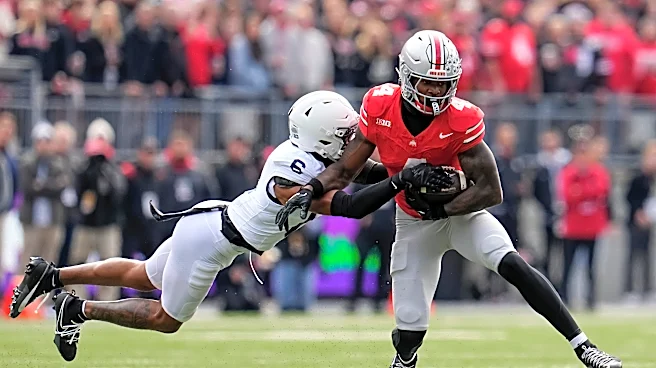
Smith has been more dynamic with the ball in his hands this season. He's averaged 6.3 yards after the catch, up from an average of 4.3 a year ago, according to Pro Football Focus. Only 10 FBS receivers have accumulated more yards after the catch than Smith in 2026.
Along with refining Smith’s route running, Hankton focused on the transition from receiver to runner.
Hankton described receivers “fronting” after the catch as one of his pet peeves. Instead of turning upfield, they square up and look for an opening.
But Smith and others are bound to find soft edges in defenses if they accelerate as soon as they secure the ball. As Hankton explained, most defenders are not approaching them at full speed. They are gathering themselves and maintaining balance before attempting a tackle.
“If you can run through soft edges, you'll be able to force missed tackles,” Hankton said, “as opposed to stopping your feet and allowing the defense to essentially gang tackle.”
When Smith found the end zone on the 40-yard touchdown against Maryland, he kept moving his feet.
It gave him an opportunity to gain steam.
“The biggest thing is, ‘As soon as I catch the ball, how fast can I get to top speed?’” Hankton said. “It’s about not stopping your feet. It's really a mindset, being intentional, because naturally when you're a kid and you're playing in the park, you're looking, you're trying to make a move as opposed to running through contact. This is tackle football.”
Defensive back manipulation
Smith is often at his best as a vertical threat.
It was only a matter of time before Hankton queued up clips of Smith getting over the top of defenses. He lingered on Smith’s fourth touchdown catch against Illinois.
When the Buckeyes faced a first down at the Illini’s 26-yard line, Smith lined up outside across from cornerback Juice Clarke and tore downfield.
Smith took a step inside once he moved past the 20-yard line, appearing as if he would bring his route over the middle of the field.
The move turned around Clarke, who anticipated a move toward the hash marks and sought to follow him.
But it was a setup. Smith only took one step before breaking outside toward the end zone pylon. The maneuver left him wide open to catch a pass in the north end of Ohio Stadium.
“He’s full speed,” Hankton said. “He makes you a believer. Then it’s a hard, violent stick. Now he’s redirecting.”
4️⃣'s got 4️⃣ TDs 💥
— Big Ten Football (@B1Gfootball) September 26, 2026
Jeremiah Smith reels in his fourth TD of the day.
Watch on FOX pic.twitter.com/XFIuleNBEQ
Not only did Smith manipulate Clarke with his change of direction, but subtler movements got him to bite as well.
Smith tilted his shoulder, leaning the left side of his body inside, before making his cut to the perimeter.
It was a convincing sell to Clarke, a returning All-Big Ten honorable mention selection.
“It’s really making you believe that I’m going this way,” Hankton said. “How do I sell it? I sell it with my head, my eyes, my shoulders. If everything is going this way, you believe that I'm going that way.”
Smith set up a similar deep catch two weeks earlier in the Buckeyes’ loss at Texas. He was lined up in the slot on a second down in the second quarter and drew coverage from safety Derek Williams Jr.
After Smith went upfield 20 yards, he took a step outside before breaking back deep over the middle and hauling in a 43-yard pass.
“He gets the safety to open up this way because he knows he's going to cross his face,” Hankton said. “It’s just understanding how to influence DBs.”
All three levels
One route from the Buckeyes’ season-opening win over Ball State remains Hankton’s favorite.
It combined everything.
As Smith operated out of the slot on a first down with 53 seconds left in the second quarter, he ran 5 yards and used a slight shoulder tilt to get cornerback Willizhuan Yates off balance.
But Smith didn’t just break the route toward the sideline when he cut back outside at the Cardinals’ 35-yard line. He took it upfield.
By the time he reached the 25-yard line, he snapped off the top of the route and worked back, reducing the route by a few yards in order to maintain separation from Yates as if he was boxing him out. Yates shoved him out of bounds at Ball State’s 21-yard line.
The 19-yard completion was the result of coverage manipulation, vertical push and maneuvering at the top of the route.
“If you can win at all three levels,” Hankton said, “you're a different dude.”
The play became a sign of things to come for Smith in his evolution into an all-around receiver, leading to his dominant season.
“He’s understanding how to put all three phases of route-running together,” Hankton said.
Joey Kaufman covers Ohio State football for The Columbus Dispatch. Email him at jkaufman@dispatch.com and follow him on @joeyrkaufman on X.
This article originally appeared on The Columbus Dispatch: Watching film with Cortez Hankton: How Ohio State's Jeremiah Smith leveled up