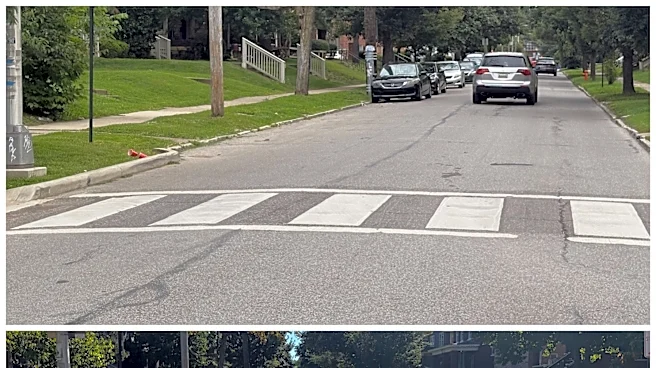





Months after the City of Columbus dispatched a crew to clean up a vandalized rainbow crosswalk in the University District, city crews scraped the rainbow painting off and placed a zebra crosswalk at Lane and Waldeck avenues.
All but a few traces of rainbow paint on the crosswalk – and splatters of black paint from the vandalism – remain.
Another rainbow crosswalk in Victorian Village at West 3rd and Hunter avenues that was not damaged in August 2025 was also removed.
Those two rainbow crosswalks – and three other intersections – were part of a national study by the Federal Highway Administration (FHWA) that started in May 2024. Columbus removed the Pride-themed crosswalks after Mark Kehrli, the director of the office of transportation operations
at the FHWA, told the city in a Nov. 18, 2025, that the “experimental devices have been found to demonstrate adverse safety conditions.”
“Specifically, the aesthetic treatments were found to degrade both the detection and recognition of the crosswalk as a traffic control device for pedestrians with low vision,” Kehrli wrote in a letter the city shared with The Dispatch.
His letter also mentioned that the city had three months to “restore the sites of the experiment” to comply with federal street standards.

Debbie Briner, a spokesperson for the city’s Department of Public Service, said in an email to The Dispatch that the city removed the rainbow painting in November, “soon after the city received the letter instructing us to do so.”
The study also involved three other cities: Raleigh, North Carolina; Austin, Texas; and Washington, D.C.
A neon pedestrian crossing sign that was present at the Victorian Village intersection last year was also not there in August 2026. Briner said that sign was in place before this project started and that the sign was likely damaged or knocked down at some point. The city's sign shop can replace it, she added.
Another intersection part of the study at Indianola Avenue and Tompkins Street, with a red brick pattern in the crosswalk, remains: Briner said that crosswalk is still in compliance with the rules.
Crosswalks featuring bricks are also pervasive throughout downtown Columbus and in other places, such as New Albany.
While the Trump administration and U.S. Transportation Secretary Sean Duffy have been particularly opposed to rainbow sidewalks around the country since 2025, the FHWA as far back as the Obama administration has been against bright colors “that degrade the contrast of the white transverse pavement markings establishing the crosswalk.”
Briner said that the city did not hear any negative 311 calls from residents about the rainbow crosswalks, including safety concerns or requests to remove them. The city also did not conduct an independent data analysis of the results.
"Since this was a Federal Highway Administration-funded research project using their research firm to collect in-field data, the city’s only role was to install the crosswalks as requested by FHWA," Briner said.
The one-page FHWA letter mentions that the full technical report and technical brief should be available by spring 2026. Briner said that the city is not yet aware of a published report.
A nonprofit study from Bloomberg Philanthropies found a reduction in crashes at intersections using rainbow crosswalks, and a study from St. Petersburg also found multi-colored sidewalks helped reduce the rate of crashes.
Other studies, including one from the Canadian government, have noted that “non-standard” markings in crosswalks can be hard for people with visual impairments to see and that fully painted crosswalks can be more slippery. However, the crosswalks are also associated with drivers yielding to pedestrians more often.
Anna Lynn Winfrey covers regional/suburban trending news for the Columbus Dispatch. She can be reached at awinfrey@dispatch.com.
This article originally appeared on The Columbus Dispatch: Federal government asked Columbus to remove rainbow crosswalks after study