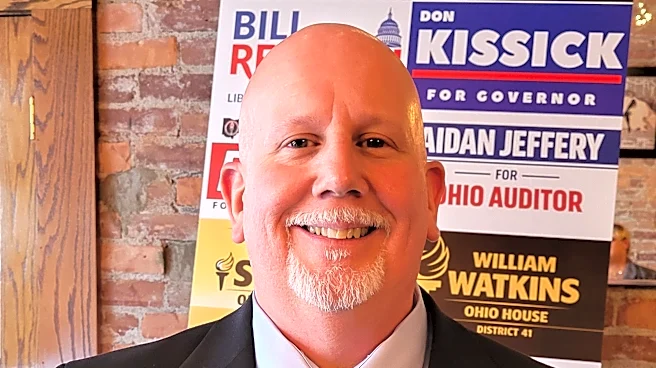

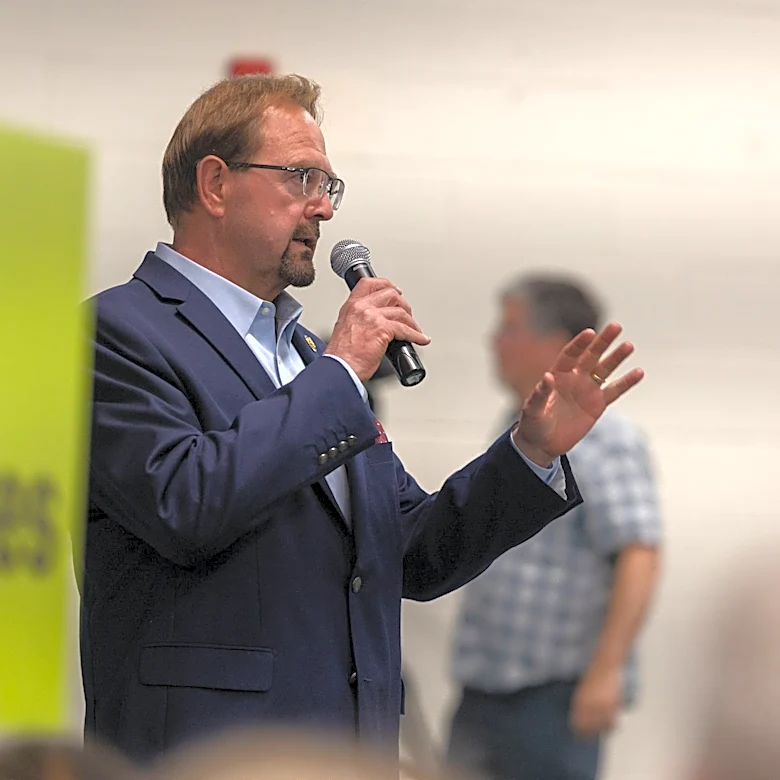


Libertarian gubernatorial candidate Don Kissick is used to losing.
The Navy veteran from Ottawa in northwest Ohio has lost a U.S. Senate race, two congressional bids and a county commissioner race in Allen County.
But he believes in the Libertarian Party principles of limited government and has something to say about data centers, Flock cameras and property taxes. (He'd ban all three.) Plus, the Libertarian Party needs Kissick to win at least 3% of the vote for their candidates' names to remain on voters' ballots from city council to president.

Kissick said he isn't worried about crossing that threshold with opponents like Republican entrepreneur Vivek Ramaswamy and Democratic Dr. Amy
Acton on the ballot.
"There's so much dissatisfaction just within their own core votership that we will not struggle," Kissick told the statehouse bureau. "The big question is, for me, how big of a bite can we take out of this?"
Republicans and Democrats in tight races have that same question.
As statewide contests for governor and U.S. Senate appear close, Libertarian and independent candidates could shake up these closely watched campaigns. Third-party candidates have made a big splash in recent races, helping U.S. Rep. Marcy Kaptur, D-Toledo, win reelection in a close race in 2024.
"Our American political system is a duopoly, dominated by two major parties, but third-party candidates, especially if they are decently funded and people take notice of them, can be a spoiler," said David Cohen, a political science professor with the University of Akron's Ray C. Bliss Institute of Applied Politics.
Spoiler or another option?
Libertarians and other third-party candidates bristle at the word "spoiler." Kissick said that voters deserve another option after the Republicans and Democrats "essentially anointed their nominees for this year's election." (Acton had no Democratic primary challenger and President Donald Trump's endorsement of Ramaswamy largely cleared the GOP field.)
In the race to fill Vice President JD Vance's unexpired term, appointed Sen. Jon Husted, a Republican, faces Democrat Sherrod Brown and two third-party challengers: Libertarian Bill Redpath and independent Gregory Levy, a socialist.

Kissick was polling at 2.8% in a new Suffolk University-USA TODAY Network Ohio Bureau poll. Redpath and Levy polled at 2% and 1%, respectively, in the Senate race.
Third-party candidates could have an even bigger impact this year as voters are increasingly dissatisfied with the two main political parties.
"In a close race, every vote counts," Cohen said. "In an anti-incumbent year, people are more willing to break with their own party."
Historically, Libertarian candidates have pulled from Republican contenders, and Green Party or socialist candidates have pulled from Democrats, Cohen said. Libertarians dispute that analysis, saying they pull from Republicans and Democrats alike.
"I definitely reject that we pull from Republicans," said Travis Irvine, communications director for the Libertarian Party of Ohio and a 2018 gubernatorial candidate. "Obviously, Republicans think that we pull from Republicans."

Republicans vs. Libertarians
In Ohio, Republicans and Libertarians have a fraught history.
The state has different rules for major parties that earn at least 20% of the statewide vote (currently, that's Republicans and Democrats) and minor parties, which earn at least 3% of the statewide vote but less than 20%. Ohio currently has one recognized minor party: the Libertarians.
Over the years, other political parties have fought for the right to have their names and political parties listed on voters' ballots. Libertarians successfully sued in 2006, allowing several smaller parties to make the ballot.
In the 2006 gubernatorial race, having Green and Libertarian candidates on the ballot made little difference. Democrat Ted Strickland easily defeated Republican Ken Blackwell in a blue wave midterm election.
But in 2010, Republican John Kasich narrowly defeated Strickland in a race where third-party candidates won nearly 4% of the vote. Three years later, GOP lawmakers passed new rules for minor parties that made it harder for them to make the ballot. Libertarians called it "the John Kasich Re-election Protection Act."
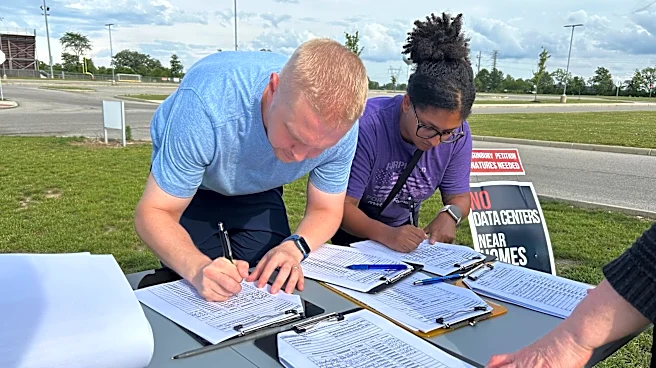
Now, Libertarians and other minor political parties must clear certain hurdles to have their candidates' names listed on the ballot alongside their political party. First, they must collect tens of thousands of signatures, which Libertarians did in 2024. Second, they must win 3% of the statewide vote in the governor or presidential race.
For Ohio Libertarians, 2026 is crunch time. The party formed too close to the 2024 elections for those results to count toward its minor-party status.
"If you look nationwide, it's one of the most strict requirements for minor party ballot access," Irvine said.
Libertarians also suspect Republicans tampered with the 2026 congressional rematch between Kaptur and Republican Derek Merrin, a former state lawmaker. Libertarians backed David Gedert − also known as the drag queen Sugar Vermonte, but he lost to Matthew Althaus in a primary. Then, Althaus dropped out of the race in late August, shortly after the deadline to replace him on the ballot.
"This candidate had no ties to the Libertarian Party of Ohio at all," said Tom Pruss, who won 4.1% of the vote in that Toledo-area district in 2024. State party officials repeatedly reached out to Althaus, but they were met with silence.
Pruss, who is running for Ohio secretary of state this year, said he was "highly disappointed" with how it played out. "Unfortunately, the voters of the 9th district are stuck again with the two worst candidates that they could possibly have on their ballot," he said.
The Ohio Republican Party's spokesman did not respond to a request for comment about the 9th congressional district.
Winning issues from losing candidates?
Libertarians are fighting for ballot access, but they're also fighting for their issues.
Kissick has advocated for banning property taxes, data centers and Flock cameras, often taking a harder line than his major-party opponents. He says Ohio lawmakers are spending too much money and are too involved in Ohioans' personal decisions.
"We are consistent when we say we want less government," Kissick told the statehouse bureau. "We don't just talk about less government regarding the economy. We don't just talk about less government with regard to civil liberties. We want less government and maximum freedom for everyone."
Libertarians are also running 10 statehouse candidates and four county commission contenders in an effort to elect more Libertarians up and down the ballot. Irvine is realistic about Libertarians' chances to win the statewide races, but he's glad the candidates are talking about issues that matter most to Ohioans.
"Even if our candidates don't win, our issues do eventually," Irvine said.
State government reporter Jessie Balmert can be reached at jbalmert@usatodayco.com or @jbalmert on X.
Tell us what you think
This article originally appeared on The Columbus Dispatch: Third-party candidates could play a pivotal role in Ohio's close races